

Hardwood floors do not usually need aggressive cleaning. In fact, the fastest way to create problems is often to treat them like tile.For most finished hardwood floors, the safest routine is straightforward: remove grit with a soft broom, dust mop or hardwood-safe vacuum; clean spills promptly.
Then use a barely damp microfiber mop with a cleaner approved for your floor and finish. Work in small sections and never leave puddles or standing moisture behind. Flooring-industry and manufacturer guidance consistently favors controlling grit and moisture over soaking or steaming wood.
The complication is that not every wood floor has the same finish. Before reaching for the mop bucket, figure out what you are actually cleaning.
Before You Mop, Find Out What Finish Is on the Floor
The species of wood matters far less to routine cleaning than many homeowners assume. Oak, cherry and maple may look different, but the protective layer on top determines what the cleaning solution touches.
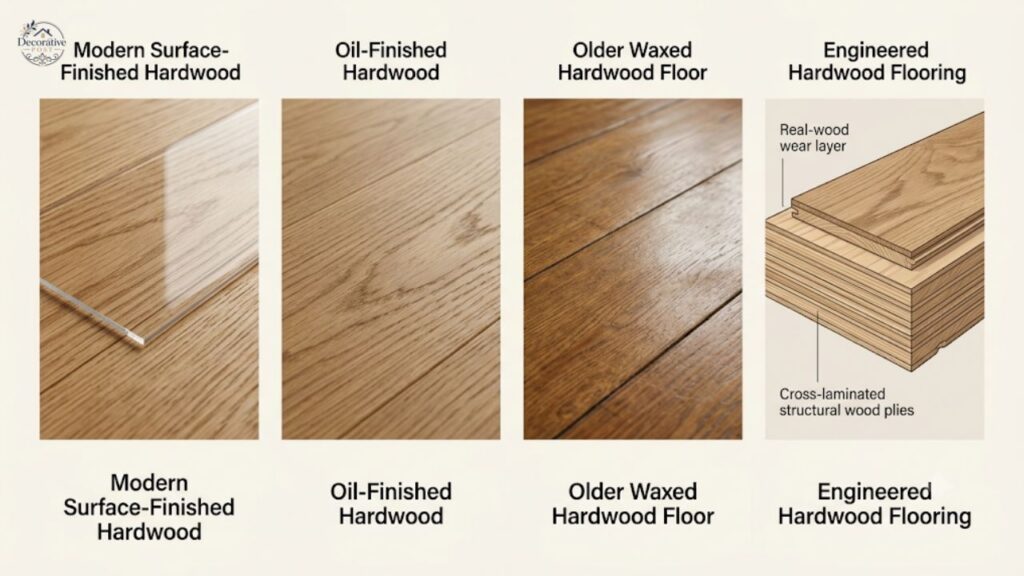
Modern hardwood commonly has a surface finish such as polyurethane or urethane. Older floors may have penetrating oil, wax, shellac or another finish. Engineered hardwood adds another consideration because the visible wood is a veneer over a layered core.
Bob Vila and Lowe’s both make this distinction central to their floor-care recommendations.If you know the flooring brand, start with its care documentation. This matters particularly while the floor is under warranty.If you do not know what you have, be conservative.
Avoid experimenting on the middle of the room. Test any new product in a closet, behind a door or beneath furniture first.A water droplet that beads temporarily can suggest an intact surface finish, while rapid absorption can indicate an unsealed, penetrating or worn area.
Do not deliberately leave water sitting there to conduct the test. Wipe it up immediately.If the floor is old, visibly worn, waxed or unfinished and you cannot identify the finish confidently, obtain professional advice before wet cleaning the entire room.That five-minute decision can prevent a much more expensive correction later.
What You Need to Clean Most Finished Hardwood Floors
You do not need a cupboard full of chemicals.For a typical polyurethane-finished floor, gather a soft broom or microfiber dust mop, a vacuum with a hard-floor setting or non-abrasive attachment, several clean microfiber pads or cloths, and a hardwood cleaner approved for the floor.
A pH-neutral hardwood-specific product is a sensible default when the flooring manufacturer does not specify another formula. Lowe’s, Bona, Bruce and Shaw all emphasize floor-specific or neutral-pH cleaning products in current guidance.The word clean matters here.
A bottle that promises to “polish,” “revitalize,” “restore shine” or leave a protective coating is performing a different job. It may deposit material on the finish rather than simply removing soil.
Architectural Digest, citing NWFA technical expertise, specifically warns that shine/restorer products can create short-term cosmetic improvement while complicating future maintenance coats.For routine cleaning, simpler is usually safer.
Remove Dust and Grit Before Adding Moisture
This is the step people most often rush.If sand, crumbs or gritty soil remain on the floor, the mop can drag those particles across the finish. Think of them as tiny abrasives trapped beneath the cleaning pad.Use a microfiber dust mop, soft broom or vacuum first.
With a vacuum, turn off the rotating carpet brush or use a dedicated hard-floor head where your machine allows it. Both Good Housekeeping and Shaw warn against floor-cleaning setups that can scratch the finish.Pay extra attention to:
- entrances
- kitchen work areas
- underneath dining chairs
- edges of rugs
- hallway turns
- gaps between boards
- areas around pet bowls
These locations accumulate the dirt that gets repeatedly ground underfoot.If you are cleaning after drywall work or renovation, vacuum the fine dust before introducing moisture. Shaw specifically advises keeping water away from sheetrock dust initially.
Treat Spills and Sticky Spots Separately
Do not flood the whole room because one spot is sticky.Blot fresh liquid spills immediately with an absorbent cloth. Do not spread the liquid across several boards.
For a dried sticky mark, begin with the least aggressive option approved for your floor: a small amount of hardwood floors cleaner on a microfiber cloth. Give the product time to loosen the residue and wipe gently.The useful principle is:
Persistence beats force.
Dyson makes the same point in its 2026 stain guidance: repeated gentle treatment is less likely to damage a finish than one aggressive attempt.Avoid reaching immediately for an abrasive pad, knife, strong solvent or homemade acid.
If a substance such as wax or chewing gum has hardened on the surface, chilling it first may make it easier to lift carefully with a plastic edge, provided your floor manufacturer allows this approach.
Apply Cleaner Sparingly
This is where “mopping” hardwood differs from mopping a waterproof tile floor.You are not trying to create a layer of wash water.
For most modern surface-finished hardwood, lightly apply the approved cleaner to a small area or according to the product instructions. A spray-and-wipe technique generally gives you much better moisture control than dumping cleaner into a large bucket.
Good Housekeeping recommends working in roughly 3-foot-by-3-foot areas when wet cleaning surface-treated floors.The floor should never look flooded.If liquid is gathering in seams, forming puddles or sitting on the surface while you move to another room, you are using too much.

Clean With a Microfiber Mop
Use a clean microfiber pad and work through one manageable area at a time.Why microfiber?It can collect fine soil effectively while allowing you to clean with far less free liquid than a saturated string or sponge mop.
Move along the boards in overlapping passes. Following the direction of the planks also makes it easier to notice missed areas and streaks.Do not keep using the same filthy pad across an entire house. Once it becomes loaded with soil, you can start redistributing grime instead of removing it.
This is one overlooked reason dark hardwood can still look streaky after a careful cleaning.Have two or three pads ready for a large floor. Swapping a dirty pad is often more effective than adding more chemical.
Let the Floor Dry Quickly and Inspect It
When you finish a section, it should dry reasonably quickly.If visible moisture remains, go over the area with a clean dry microfiber cloth or pad.The National Wood Flooring Association advises avoiding wet and steam mops and cleaning spills quickly because wood changes dimension with moisture.
Once the floor is dry, look at it from an angle in natural light.You are checking for three things:
Remaining dirt: isolated visible soil that can be spot-cleaned.Streaks or film: broad hazy areas that may indicate too much cleaner, a dirty pad or product residue.Finish wear: dull traffic paths, exposed-looking wood, deep scratches or areas where water no longer beads.
Only the first two are cleaning problems.A worn finish will not become new simply because you mop it harder.
Can You Use Vinegar on Hardwood Floors?
The safest universal answer is: do not use vinegar unless your flooring or finish manufacturer specifically approves it.Vinegar is acidic. Bona explicitly advises against vinegar because repeated exposure can affect hardwood finish, and Good Housekeeping gives similar advice.
You will find older articles and homeowners who report using diluted vinegar for decades without visible problems. That does not make it universally compatible.Different floors have different coatings, ages, maintenance histories and warranty requirements.
When a pH-neutral cleaner designed for hardwood is available, there is little reason to make vinegar the default recommendation.
Can You Steam Mop Hardwood Floors?
For ordinary real hardwood, the conservative answer is no unless the flooring manufacturer explicitly states that the specific floor can be steam cleaned.The concern is not merely surface water. Steam combines moisture with heat and can enter seams and vulnerable areas.
HGTV cites NWFA guidance against high volumes of liquid or vapor on wood floors. Lowe’s also notes that many manufacturers prohibit steam and that steam-related damage may not be covered by warranties.A floor being described as “sealed” is not automatically permission to steam it.
What Else Should You Avoid?
Avoid treating hardwood with the strongest product that happens to be under the sink.Unless specifically approved for your floor, avoid:
- bleach
- ammonia
- abrasive powders
- steel wool
- harsh scouring pads
- excessive water
- steam
- oil soaps on incompatible finishes
- furniture polish
- wax on no-wax polyurethane floors
- repeated “shine restoring” coatings
A cleaner can remove dirt perfectly and still be the wrong product if it damages the finish beneath it.The finish is what you are really maintaining.
Why Does My Hardwood Floor Still Look Dirty After Mopping?
This is where many cleaning guides stop being useful.
A hardwood floor that looks dull after cleaning is not necessarily dirty.
The mop pad may be dirty
If the first half of the room looks clean but the second half looks smeared, change the pad.
You may be using too much cleaner
More product does not equal more cleaning. Excess formula can dry as film.
The cleaner may be incompatible
Multi-surface sprays, oils, soaps and polishing ingredients can interact differently with various finishes.
You may be seeing scratches rather than soil
Fine surface scratches scatter light, especially on darker or high-gloss wood.
The finish may be worn
Look at the normal walking routes through the room. If those areas remain dull while protected areas beneath rugs or furniture still look rich, the difference may be wear rather than dirt.
Architectural Digest notes that recoating can restore a worn protective layer without necessarily requiring complete sanding in appropriate situations.That is a flooring-maintenance problem, not a reason to add stronger cleaner.
How to Clean Hardwood Floors Without Streaks
Streak-free hardwood is mostly about controlling four variables:
Product amount. Follow the cleaner’s dilution/application directions instead of estimating.
Pad cleanliness. Change microfiber pads before they become visibly dirty.
Moisture. A heavily wet floor dries unevenly and can leave marks.
Residue. Avoid layering several cleaners, oils or polishing products.
Martha Stewart’s expert guidance also recommends working with the grain and limiting moisture to reduce streaking.If your floor suddenly begins streaking after you change products, suspect the product before assuming the floor needs more of it.
How to Deep Clean Very Dirty Hardwood Floors
“Deep clean” should mean more thorough, not more water.First vacuum carefully, including corners, edges, underneath furniture and between accessible seams.Next inspect the finish. Do not deep-clean across worn bare patches as though they were intact polyurethane.
Use the manufacturer-approved hardwood cleaner and work in small sections with a clean microfiber pad. For heavily trafficked floors, you may need several pad changes.Persistent spots should be treated individually instead of increasing the chemical concentration across the entire floor.
Lowe’s current deep-cleaning guidance follows the same basic sequence: identify the finish, remove loose grit, choose a compatible cleaner, clean with limited moisture and allow the floor to dry.If years of residue appear to be present, identify what products have been used before attempting to strip the film. Removing an unknown coating is not the place for an improvised chemical experiment.
How to Clean Engineered Hardwood Floors
Engineered hardwood still has real wood at the surface, but its layered construction changes how aggressively it can be restored.Use the manufacturer’s instructions, remove dry grit first, choose a compatible hardwood cleaner and minimize free moisture.
Bruce’s 2026 guidance recommends microfiber cleaning, a pH-balanced hardwood cleaner, and avoiding excess water, steam, abrasive tools and oil-based soaps.Do not confuse engineered hardwood with laminate or luxury vinyl. They may look similar in photographs, but the materials and care requirements are different.
What About Old, Waxed or Unfinished Hardwood?
This is where generic internet advice becomes dangerous.If an old floor readily absorbs water, appears waxed, has a penetrating oil finish or contains areas where the protective finish has worn through, do not automatically follow instructions written for modern polyurethane.
Water-based cleaning may be inappropriate.Start by identifying the finish or having a flooring professional do so.An old floor does not necessarily need a stronger cleaner. It may need maintenance of the existing wax/oil system or restoration of the finish.
How Often Should Hardwood Floors Be Cleaned?
There is no useful schedule that ignores household traffic.A home with two adults and no pets is different from an entrance hallway shared by children, dogs and muddy shoes.A practical routine is:
As needed: blot spills immediately.
Every few days: dust or dry mop high-traffic areas.
Weekly: vacuum the room thoroughly with a hardwood-safe setup.
Periodically: damp clean when visible soil can no longer be removed dry.
Good Housekeeping suggests sweeping/dusting every few days, vacuuming weekly and deeper cleaning every one to two months depending on use. NWFA guidance similarly emphasizes frequent dry cleaning and routine wood-floor cleaner use.
Do not wet-clean simply because the calendar says it is mop day.If the floor is already clean, removing abrasive grit is more useful than repeatedly adding moisture.
Keep Hardwood Floors Cleaner Before Dirt Reaches Them
The cheapest floor cleaner is the dirt you never bring inside.Use good entry mats. Remove wet or gritty shoes. Wipe pets’ paws after muddy walks. Place felt pads beneath furniture. Lift rather than drag heavy items. Clean underneath area rugs periodically because trapped grit can behave like sandpaper.
Shaw also recommends controlling indoor humidity, using protective mats and pads, trimming pet nails and limiting prolonged moisture exposure.These habits are not cosmetic housekeeping.They reduce wear on the finish itself.
When Cleaning Is No Longer the Answer
Stop trying new cleaners when you see:
- bare-looking wood
- widespread gray or dark discoloration
- boards that remain swollen or cupped
- finish peeling or flaking
- deep gouges
- water rapidly absorbing into worn areas
- persistent pet urine damage below the finish
- a cloudy coating that cannot be identified
- heavy wax/polish buildup
- widespread dull traffic lanes despite a clean surface
At that point, the next step may be recoating, screening, refinishing or board repair.That can feel frustrating when all you wanted was a clean floor, but recognizing the difference early prevents another common mistake: trying to solve finish damage with increasingly aggressive chemicals.
The best hardwood floor cleaning routine is not the one that makes the floor wettest or shiniest.It is the one that removes soil while leaving the finish alone.
Frequently Asked Questions
What is the best thing to use to clean hardwood floors?
For most modern finished hardwood, start with a microfiber mop and a hardwood-specific cleaner compatible with the floor’s finish. If available, follow the flooring manufacturer’s exact recommendation.
Can I mop hardwood floors with water?
A lightly damp method may be permitted on many surface-finished floors, but standing water and saturated mops should be avoided. Waxed, penetrating-finish, damaged or unfinished flooring may require a different method.
Is vinegar safe for hardwood?
Not as a universal cleaner. Several manufacturers and cleaning experts advise against vinegar because its acidity can affect some finishes over time.
Can I use a steam mop?
Avoid steam unless the manufacturer of your exact flooring explicitly approves it. Heat and vapor can create moisture-related damage, and some warranties exclude steam-related problems.
Why is my hardwood floor sticky after mopping?
Common causes include excessive cleaner, dirty mop pads, soap/oil residue or an incompatible product. Stop layering additional cleaners until you know what has been used on the finish.
How do I make hardwood floors shine naturally?
Clean floors should show the appearance of their existing finish. If the clean floor is still dull, the finish may be worn. Do not automatically add oils or homemade polish.
Can I use dish soap?
Some editorial guides recommend very diluted dish soap, while certain manufacturers specify their own cleaners. Manufacturer instructions should take priority.
How often should hardwood be mopped?
Wet or damp cleaning should be based on soil and traffic rather than an inflexible schedule. Frequent dry removal of dust and grit reduces the need for wet cleaning.
How do I clean engineered hardwood?
Vacuum or dust first, then use minimal moisture and a cleaner approved for the engineered floor. Avoid assuming that engineered hardwood is waterproof simply because it is more dimensionally stable than some solid wood flooring.
Can badly stained hardwood always be cleaned?
No. If a stain has penetrated through damaged finish and into the wood, sanding, refinishing or replacing the affected board may be necessary.