

There is a particular sinking feeling that arrives in early July. You walk out to the roses and the leaves have gone to lace, green veins with nothing between them, and the flowers are being eaten by a cluster of small metallic insects that do not appear remotely bothered by your arrival.
That is the Japanese beetle, and it is one of the few garden pests that genuinely earns the frustration it generates.
The good news is that control is achievable. The bad news is that the most commonly sold solution actively makes your situation worse, and almost nobody selling it mentions that.
The short answer
Hand-pick adults into soapy water in the early morning, when they are sluggish. Spray neem oil or insecticidal soap at dawn or dusk to protect bees. Cover high-value plants with floating row cover during the six-week peak.
Treat grubs separately in late summer with beneficial nematodes or Bt galleriae.
And do not buy a pheromone trap. They draw more beetles into your garden than they remove.
How to be sure that’s what you have
The adult Japanese beetle is distinctive once you know what to look for, and misidentification is common.
It runs about three-eighths to half an inch long. The head and thorax are a bright metallic green; the wing covers are a coppery bronze. In sunlight the combination is genuinely striking, which is part of why people photograph it before realising what it is doing.
The detail that confirms it: five small white tufts of hair along each side, beneath the edge of the wing covers, plus another pair at the tip of the abdomen. Those twelve tufts are the clincher. No lookalike has them.
They feed in groups, almost always, and usually on the sunniest part of the plant.
The damage is equally distinctive. Adults eat the soft tissue between leaf veins and leave the veins behind, producing a lacy skeleton rather than holes or ragged edges. If your leaves look like green netting, that is this insect.
What it is not
Three insects get confused with it regularly.
| Insect | How to tell |
|---|---|
| Green June beetle | Much larger, around three-quarters of an inch, and a duller, more uniform green. No white tufts |
| Ladybug | Domed and round rather than oval, red or orange with black spots, no metallic sheen. A beneficial insect; leave it alone. |
| Other white grubs | Grub stages look nearly identical. The distinguishing feature is a V-shaped row of spines on the underside of the last abdominal segment |
One insect, two completely different problems
This is the thing almost no article about the Japanese beetle explains, and it causes a lot of wasted effort.
The adult beetle chews leaves, flowers, and fruit above ground, from roughly late June to August.
The grub lives underground for about ten months, feeding on grass roots, and causes irregular brown patches in lawns, often blamed on drought or disease.
They are the same insect. The grub you treat in September becomes the beetle that eats your roses next July.
But here is the catch, and it is the reason grub treatment disappoints so many people. Adults fly. Treating the grubs in your lawn reduces the population emerging from your soil, and does nothing about beetles arriving from a quarter-mile away.
So grub control protects your lawn. It does not protect your roses. Those are two separate jobs, done at two different times of year, and expecting one to solve the other is the most common mistake on this topic.
Why it became a problem here and not in Japan
A short piece of context that explains why this insect behaves so differently on either side of the Pacific.
In its native range, it is an unremarkable species. Natural predators, parasitoids, and diseases hold the population at levels where nobody considers it a pest.
It arrived in the United States without any of them. The first specimens were found in New Jersey in 1916, probably introduced a few years earlier in soil around imported ornamental plants.
Free of the controls that limited it at home, and with an enormous range of suitable host plants available, it spread steadily through the eastern and central states and continues to push westward.
That history is the reason control is a management exercise rather than an elimination one. There is no missing predator to reintroduce and no quick ecological fix, which is why the practical advice below focuses on protecting specific plants rather than clearing the garden.
The lifecycle, briefly
Understanding the timing makes every decision below obvious.
One generation per year across most of its range. Adults emerge from the soil in early summer, and the females begin releasing a sex pheromone almost immediately.
Adults live roughly forty days. In that time,e they feed heavily, mate, and the females burrow a few inches into moist soil, usually turf, to lay eggs.
Bulbs and tubers are largely spared, which is one reason spring planting such as tulips finishes before the beetles arrive at all.
Eggs hatch in about two weeks. The grubs feed on roots through late summer and autumn, then move deeper as soil cools and overwinter below the frost line.
In spring they move back up, feed briefly, pupate, and emerge as adults. The cycle closes.
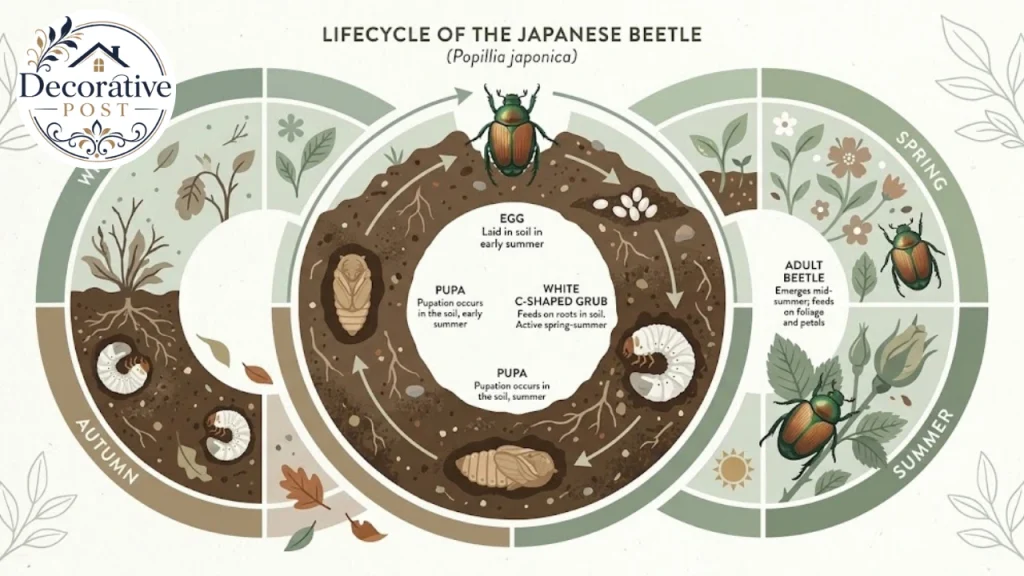
Two practical consequences fall out of this. Grubs are most vulnerable when they are small and near the surface, which is late summer. And irrigated lawns in a dry summer are magnets for egg-laying females, because they need moist soil.
Do not buy a trap
The single most useful thing on this page.
Pheromone traps are sold everywhere, and they work exactly as advertised in one narrow sense: they catch an enormous number of beetles. Gardeners empty bags full and conclude it is working.
The problem is what else the lure does. Traps combine a floral scent with a synthetic version of the female sex pheromone, and that signal carries a long way. It pulls beetles toward your property from well beyond your boundary.
Research from university horticulture programmes is consistent on the outcome: traps attract more beetles than they capture. The surplus the ones that arrive, miss the trap, and find your roses instead leaves you worse off than if you had hung nothing.
If a neighbour has one, that is partly your problem too. A trap two gardens away is recruiting beetles into the whole neighbourhood.
The only defensible use is monitoring by agencies tracking the insect’s spread, or trapping placed a long way from anything you care about, and even then the benefit is marginal for a home garden.
If you already own one, take it down. That is a genuine improvement for free.
What actually works on adult beetles
Ranked by effectiveness for a home garden. None of these eliminates the Japanese beetle outright, but together they change the outcome substantially.
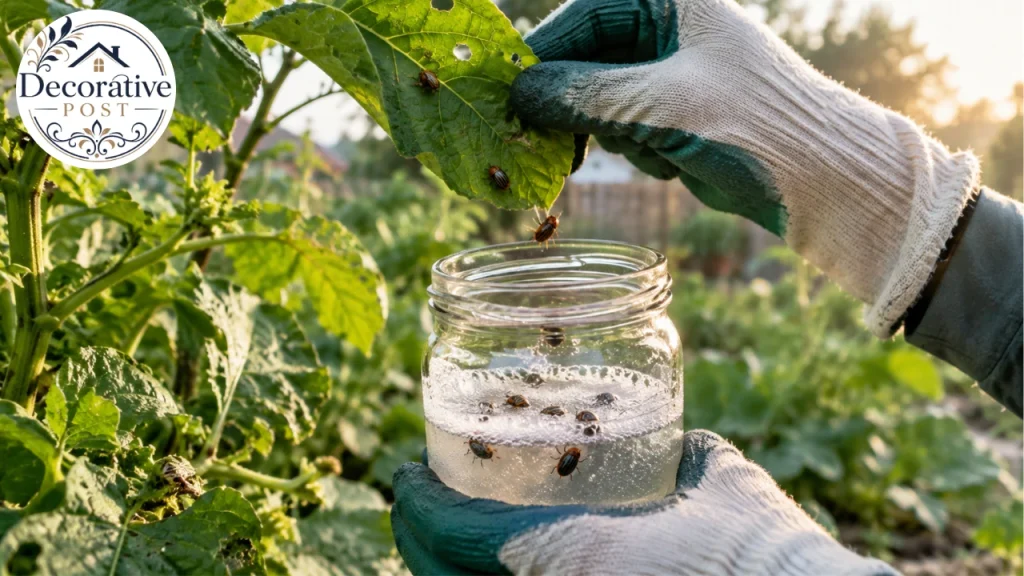
Hand-picking. Un-glamorous and the most effective thing available to most gardeners. Go out in the early morning while they are cold and sluggish, hold a container of soapy water beneath the beetle, and tap the leaf. They drop rather than fly when disturbed.
Ten minutes a day during peak season genuinely changes the outcome. It is the same low-effort, high-return principle behind most of our easy garden hacks. The next section explains why it works better than the effort suggests.
Floating row cover. Physical exclusion, and completely effective while it is on. Practical for vegetables, young fruit, and individual high-value shrubs. Remove it from anything that needs pollinating.
Neem oil. A deterrent rather than a knockdown. It disrupts feeding and reproduction, and repeated application reduces damage meaningfully. Apply at dawn or dusk, never in full sun on a hot day.
Insecticidal soap. Works on direct contact only, with no residual effect. Useful for knocking down a visible cluster, useless preventatively. Test on a few leaves first;t some plants react badly.
Pyrethrin. Fast-acting botanical insecticide, short residual. Effective, but it kills pollinators and beneficial insects on contact, so it should be a last resort and applied only at dusk.
Systemic insecticides. Effective and widely sold. They also move into pollen and nectar, which makes them a poor choice on anything flowering. Many gardeners decide the trade-off is not worth it, and that is a defensible position.
If you prefer to stay away from sprays entirely, the approach is much like dealing with any soft-bodied garden nuisance;ce our guide to getting rid of gnats naturally uses the same logic of interrupting a lifecycle rather than chasing adults.
What does not work: ultrasonic devices, most companion-planting claims, and the various home remedies involving household products. Nothing in that category survives contact with evidence.
Why hand-picking works better than it should
Worth understanding, because it reframes a tedious job as a strategic one.
Beetles aggregate deliberately. Females release a pheromone that attracts males, and feeding damage itself releases volatile compounds from the plant that attract more beetles.
So a plant with twenty beetles on it is actively advertising. Left alone, it recruits.
Remove them early, and you interrupt the signal. The first beetles to arrive matter far more than the hundredth, which is why starting the moment you see the first one is dramatically more effective than waiting until the damage is obvious.
This also explains why the gardener who picks daily for two weeks often reports the problem simply fading, while the neighbour who sprayed once in late July is still fighting in August.
Start early. Be boringly consistent. It is the whole technique.
Protecting the plants they love most
Some plants are magnets, and knowing which lets you concentrate effort.
The favourites are roses, grapes, linden, crabapple, Norway and Japanese maple, birch, mountain ash, raspberry, cherry, plum, hibiscus, zinnia, hollyhock and basil. Fruit in full sun is especially attractive.
For roses, consider removing flower buds during the peak six weeks. Blooms attract beetles far more strongly than foliage, and sacrificing one flush of flowers protects the plant and reduces recruitment. It feels wrong,g and it works.
For grapes and raspberries, netting or row cover during peak is the practical answer.
For young trees, cover is impractical, so hand-picking plus accepting some damage is realistic. Established trees tolerate heavy defoliation in one season without lasting harm.
For vegetables, row cover on anything not needing insect pollination. Basil can simply be grown under cover. Containers on a front porch are easier to protect than anything in open ground, and easier to move if a cluster arrives.
Dealing with the grubs
Separate problem, separate season, separate products. Japanese beetle grubs are treated on a different calendar from the adults entirely.
Treat in late summer, roughly August into early September, in most regions when grubs are small and feeding near the surface. Spring treatment is far less effective because larger grubs are tougher and about to pupate anyway.
Beneficial nematodes. Microscopic parasitic worms, specifically Heterorhabditis bacteriophora. Applied as a drench, they seek out and kill grubs. They are living organisms, so they need moist soil, cool conditions, and application out of direct sunlight. Water before and after.
Bt galleriae. A strain of Bacillus thuringiensis effective against beetle larvae, including this species. Available as a drench for turf.
Reduce irrigation during peak flight. Females need moist soil to lay eggs. This is also an argument for reducing how much thirsty lawn you keep replacing; a strip of it with a gravel area removes egg-laying habitat permanently. Letting the lawn go dormant through late July deters egg-laying, a free control method, considerably, provided you can tolerate a brown lawn for a few weeks.
Tolerate low numbers. Healthy turf handles a modest grub population with no visible effect. Treatment is warranted when counts are high enough to cause patches, not on sight of a single grub.
Milky spore, honestly
It comes up constantly and deserves a straight answer rather than enthusiasm.
Milky spore is a bacterium, Paenibacillus popilliae, applied to turf, which infects and kills grubs and theoretically establishes permanently in the soil.
The appeal is obvious: treat once, protected forever. The reality is more complicated. Establishment is slow, often several years. It works best in warm soils and performs poorly in colder regions. Results in independent trials have been inconsistent.
It is not a scam, and it is not a quick fix. In a warm region, with patience measured in years, it is a reasonable long-term supplement. If you want results this season, nematodes applied at the right time will do considerably more.
Plants they mostly leave alone.
The most durable fix available, and the one that requires the least annual effort.
| Resistant trees and shrubs | Resistant perennials and herbs |
|---|---|
| Boxwood | Hydrangea |
| Lilac | Geranium |
| Forsythia | Hosta |
| Dogwood | Coreopsis |
| Holly | Chives and garlic |
| Magnolia | Rue |
| Red maple | Tansy |
| Juniper and yew | Ferns |
If you are replacing a tree, planting a new bed, or redesigning a border, this list is worth consulting before the nursery visit. Choosing a red maple over a Norway maple is a one-time decision that saves twenty years of July irritation.
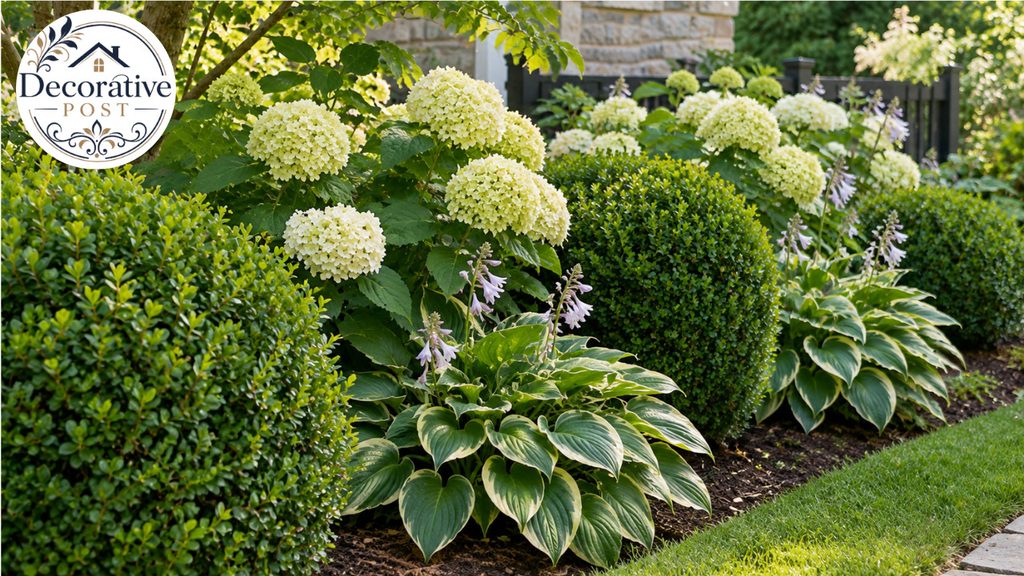
Hydrangea is the most useful name on that list for most gardens, because it carries a border through high summer without becoming a target. Our guide to keeping hydrangeas from wilting covers the one thing they are genuinely fussy about.
That is not an argument for giving up roses. It is an argument for not planting a linden next to them.
Seasonal planting decisions are easier with a bloom plan in hand. Our guide to seasonal garden tips covers how to phase a border so the resistant planting still carries colour through summer.
Protecting bees while you treat
This matters, and only one page on the entire first page of results mentions it.
Bees forage during daylight, concentrated through the warm middle of the day. Beetles feed then too, which creates the conflict.
Spray at dawn or after dusk. Neem and insecticidal soap break down or dry before pollinators are active, which is the single most effective precaution available.
Never spray open flowers if you can avoid it. Target foliage.
Avoid pyrethrin and systemics on anything in bloom. Both kill pollinators, and systemics persist in pollen and nectar for a long time.
Hand-picking is completely pollinator-safe, which is another argument for it.
A month-by-month plan
Timing varies by region, so treat these as a sequence rather than fixed dates; shift earlier in the south, later in the north.
| Period | Action |
|---|---|
| Late spring | Inspect vulnerable plants. Prepare row cover. Do not hang traps |
| First beetles appear | Begin daily hand-picking immediately. This is the highest-leverage moment of the year |
| Peak, roughly 6 weeks | Cover high-value plants. Remove rose buds. Neem at dawn or dusk. Reduce lawn irrigation |
| Late summer | Adults decline. Apply nematodes or Bt galleriae to turf while grubs are small |
| Autumn | Assess lawn damage. Overseed thin patches. Resume normal watering |
| Winter | Plan replacements from the resistant list |
| Early spring | Grub treatment is far less effective now. Focus on lawn recovery instead |
By the time the beetles have gone, the border still has to look like something. Our notes on September flowering plants cover what carries colour once the damage is done.
The late-summer grub window and the first-sighting hand-picking window are the two that matter most. Miss them, and the rest is damage limitation.
What to accept
A note that the extension factsheets, for understandable reasons, do not offer.
You will not eliminate the Japanese beetle from your garden. It is established across a huge area, the adults fly, and your neighbours are not treating. Anyone promising eradication is selling something.
What you can do is reduce numbers, protect the plants you care most about, and shorten the period of damage. That is a realistic and achievable goal.
Established trees recover from a bad year. Roses re-leaf. Lawns regrow. A heavily chewed shrub in August is usually fine the following May.
Six weeks of focused effort, every year, on the plants that matter. That is the actual job, and framing it that way makes it manageable rather than endless.
Five mistakes worth avoiding
Hanging a trap. Covered at length above, and still the most common error.
Starting late. The first beetles recruit the rest. Waiting until damage is obvious means fighting a crowd you invited.
Treating grubs in spring. Too large, too deep, about to pupate. Late summer is the window.
Spraying in midday sun. Harms pollinators, scorches foliage, and evaporates before it works.
Expecting grub control to save your roses. Different problem, different season, and the adults fly in regardless.
Where this leaves you
The plan is short enough to remember. Take down any traps. Start hand-picking the day you see the first beetle. Cover what you can, spray neem at dawn or dusk on what you cannot, and treat turf for grubs in late summer.
Then plant for the long term. Every resistant shrub you put in is one less thing to defend in July, and the Japanese beetle is a problem that rewards design decisions far more than it rewards products.
The roses will be fine. They nearly always are.
FAQs:
Do Japanese beetle traps work?
They catch large numbers, but research consistently finds they attract more beetles to the area than they capture. For a home garden, they make the problem worse, and existing traps should be taken down.
What kills Japanese beetles naturally?
Hand-picking into soapy water is the most effective non-chemical method. Neem oil and insecticidal soap reduce feeding when applied at dawn or dusk. Beneficial nematodes and Bt galleriae control the grub stage in late summer.
When do Japanese beetles go away?
Adults are active for roughly six weeks, typically late June through August with a July peak, and individual beetles live about forty days. Timing shifts earlier in southern regions and later in northern ones.
What do Japanese beetles eat?
More than 300 plant species, with roughly 50 strongly preferred. Roses, grapes, linden, crabapple, Norway and Japanese maple, birch, raspberry, cherry and basil are among the favourites. Grubs feed on grass roots.
Are Japanese beetles harmful to humans?
No. They do not bite or sting and pose no direct risk to people or pets. The damage is entirely to plants.
Are the grubs in my lawn the same insect?
Often, yes. The grub stage feeds on grass roots and causes irregular brown patches. The distinguishing feature is a V-shaped row of spines on the underside of the last abdominal segment.
Does milky spore work?
Inconsistently. It can establish in warm soils over several years but performs poorly in colder regions and works slowly. Beneficial nematodes give faster, more reliable results in a single season.
What plants do Japanese beetles avoid?
Boxwood, lilac, forsythia, dogwood, holly, magnolia, red maple, juniper, yew, hydrangea, geranium, hosta, chives, garlic, and rue are among the plants they largely leave alone