

These are the easiest lilies to grow and the first to flower. They need six inches of depth, full sun, almost no maintenance, and they return reliably for years in zones 3 through 9.
There is one thing to settle before you buy a single bulb, and it has nothing to do with gardening. If you have a cat, this plant is a genuine danger not mildly irritating, but capable of causing fatal kidney failure, with documented cases from pollen exposure alone.
That is a decision rather than a caution. Everything after it is straightforward.
The short answer
Plant Asiatic lily bulbs in autumn, six inches deep, pointed end up, twelve inches apart, in full sun and well-drained soil with a pH around 6 to 6.5.
They flower late spring into early summer, the earliest of any lily, on stems two to six feet tall. Blooms face upward or outward and carry essentially no scent.
Water about an inch a week at the roots, feed once in early spring with a balanced slow-release granular fertiliser, and leave the foliage standing after flowering until it browns.
Divide every three or four years. Keep them away from cats entirely.
Read this first if you own a cat.
The most important paragraph on this page, and the one most gardening articles reduce to three words in a sidebar.
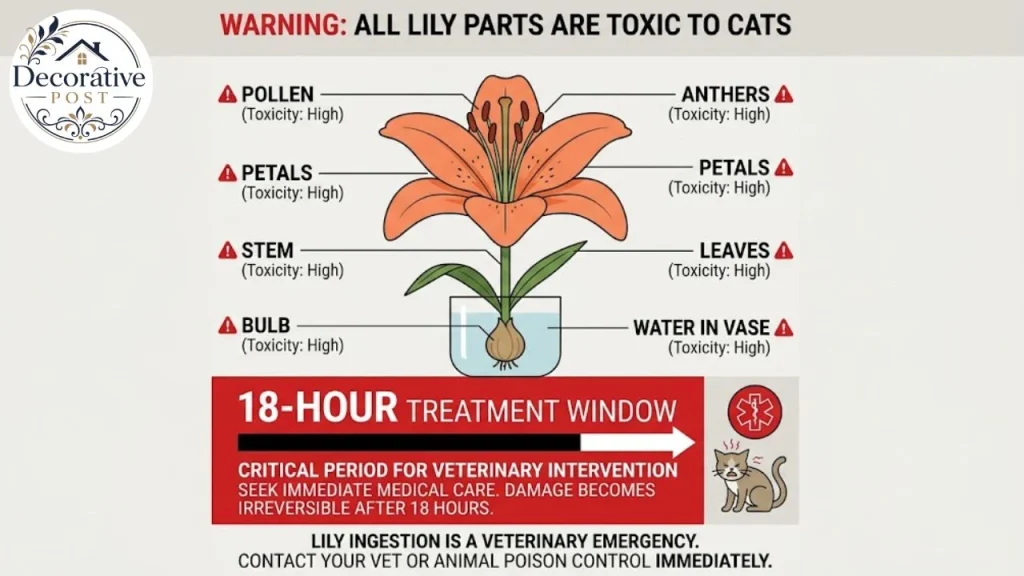
True lilies, the Lilium genus, which includes every Asiatic lily, are renal toxins in cats. Exposure causes acute kidney injury, and the outcome can be fatal.
All parts are toxic. Not just the bulb, not just the leaves. The American Society for the Prevention of Cruelty to Animals documents acute kidney injury in cats from pollen exposure alone: a cat brushing past an open flower and later grooming itself.
The treatment window is roughly 18 hours. Beyond that point, kidney damage may be irreversible. Standard veterinary treatment is intravenous fluid diuresis for 48 hours, with monitoring of renal values and electrolytes.
If you suspect any exposure, this is an emergency rather than a wait-and-see situation. The ASPCA Animal Poison Control Center is reachable at (888) 426-4435.
Daylilies (Hemerocallis) carry the same renal risk despite being a completely different plant. Worth knowing, because people often plant them as a substitute.
What this means practically. If you have an indoor-outdoor cat, do not plant these. If you have an indoor cat, never bring the cut flowers inside. There is no safe way to have both in the same space, and the risk is not proportionate to the plant’s merits.
Dogs are affected far less severely, generally mild stomach upset rather than kidney failure. The warning is specifically about cats.
If cats rule these out for you, the resistant plants in our guide to May flowering cover the same season with safer options.
Asiatic or Oriental: the distinction that matters
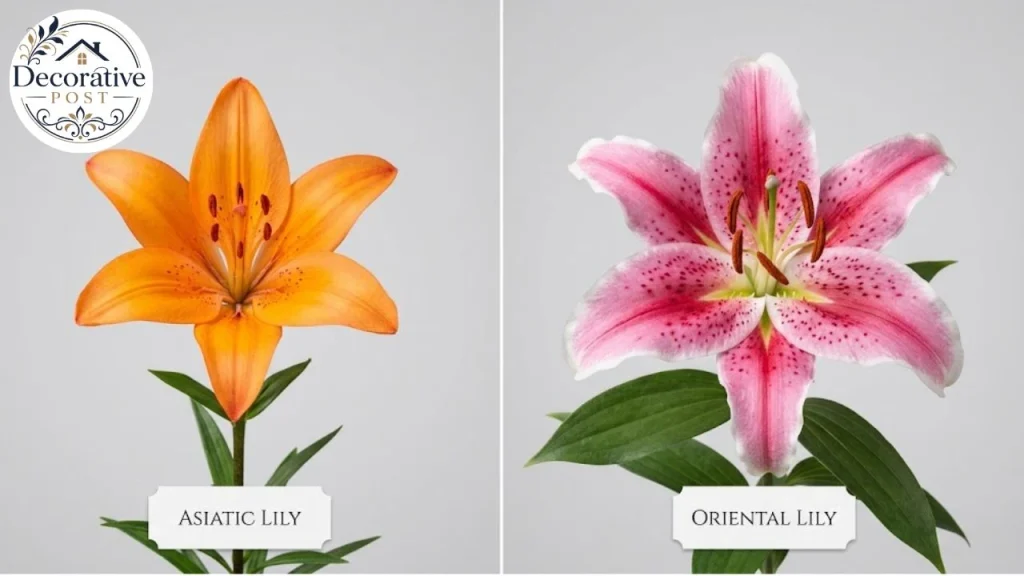
People use “lily” for a dozen unrelated plants, and the two classes most often confused are the two most commonly sold.
| Asiatic | Oriental | |
|---|---|---|
| Scent | Essentially none | Strongly fragrant |
| Bloom time | Earliest late spring to early summer | Later mid to late summer |
| Flower direction | Upward or outward, never down | Often outward or downward |
| Flower size | Smaller, more numerous | Larger, fewer per stem |
| Ease | Very easy | Slightly more demanding |
The scent difference is the one that decides purchases. Asiatics are effectively odourless, which makes them the right choice for anyone who finds Oriental lilies overpowering, for cut arrangements in small rooms, and for households where strong fragrance is unwelcome.
It also means they do nothing for a garden planted for perfume. If scent is what you want, you want Orientals, and you should accept the later bloom.
The bloom time difference is the one that matters for planning. Asiatics open first among lilies, which makes them useful for bridging the gap between spring bulbs and high-summer perennials. Plant both classes and you extend lily season by a month or more.
Planting: timing and depth
Autumn is the right time to plant an Asiatic lily, and the reason is root establishment.
Plant at least six weeks before your average first frost. The bulb puts down roots through the cooling soil, settles over winter, and emerges ready in spring.
Spring planting works with nursery-grown potted plants, which are already established. Spring-planted dry bulbs will usually flower, but less impressively in the first year.
Depth: six inches, measured to the base of the bulb, pointed end facing up. A common alternative rule is three times the bulb’s height, which lands in the same place for most bulbs.
Depth matters more here than with most bulbs. These stems reach two to six feet, and the bulb is the anchor planted shallow; a tall stem in flower will lean or topple.
Spacing: twelve inches apart. Plant in odd-numbered groups of three, five, or seven. A single lily stem looks like an accident; a cluster looks deliberate.
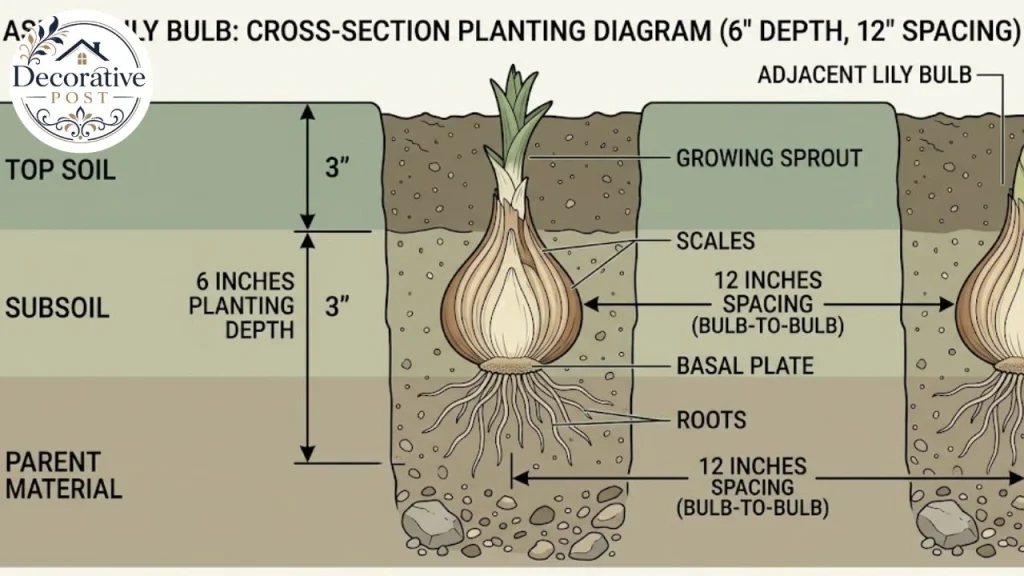
For potted nursery plants, dig a hole twice as wide as the container and set the crown about an inch above soil level. Settling is normal, and a crown planted flush often ends up buried.
Seed is possible at about an inch deep, but it is a multi-year project. Bulbs are the sensible route.
Site and soil
Get these two right, and the rest of Asiatic lily care is minimal.
Full sun, around six hours minimum. Morning sun is ideal. Afternoon heat in hot climates causes wilting, so a position with morning light and some afternoon shade suits warmer zones better than all-day exposure.
In too much shade, stems stretch toward the light, flowering drops off, and you get leaning plants that need staking.
Well-drained soil, pH around 6 to 6.5. Slightly acidic and crumbly. Working compost through the planting area before you start is the single most useful preparation.
What kills them is wet feet. Dense clay and anywhere that holds water after rain will rot the bulbs, and bulb rot has no cure. If your soil is heavy, plant on a raised bed or improve drainage before planting rather than hoping.
A useful test before committing: dig a hole, fill it with water, and see how long it takes to drain. If water is still sitting there an hour later, that spot is wrong for lilies.
Mulch lightly after planting. It moderates soil temperature, holds moisture, and suppresses weeds. Gravel works as well as bark around bulbs and improves surface drainage; see the same material covered in our guide to pea gravel areas.
Water and feeding, without overdoing it
Both are easy to get wrong in the generous direction.
Water about one inch per week, delivered at the roots rather than over the foliage. Let the surface dry between waterings.
Overhead watering wets the leaves and invites botrytis, which is the main disease these plants get. A soaker hose or a watering can at the base is better than a sprinkler.
Feed once in early spring with a balanced slow-release granular fertiliser; a 10-10-10 is standard. That single application covers the season.
When buds appear, an optional high-phosphorus feed or a scattering of bone meal supports larger, longer-lasting flowers. This is a refinement rather than a requirement.
Do not overfeed, and do not feed in autumn. Excess nitrogen produces lush foliage at the expense of flowers, which is the most common feeding mistake with lilies. Autumn feeding pushes growth the plant cannot use before dormancy.
The general seasonal rhythm in our garden tips guide applies here with bulbs; timing matters considerably more than quantity.
After flowering: the part that decides next year
This is where good intentions cost people their second season.
Deadhead the spent flowers. Cut just above the top set of leaves with clean, sterilised pruners. It will not produce new blooms; these flowers bloom once per season, but it keeps the plant tidy, prevents rot where petals collapse, and stops energy going into seed.
Leave the stems and leaves standing. This is the rule people break. The foliage is feeding the bulb for next year, and removing it early gives you a smaller flower, or none at all.
Cut stems to ground level only when they turn brown or yellow, usually around first frost. At that point the bulb has taken what it needs.
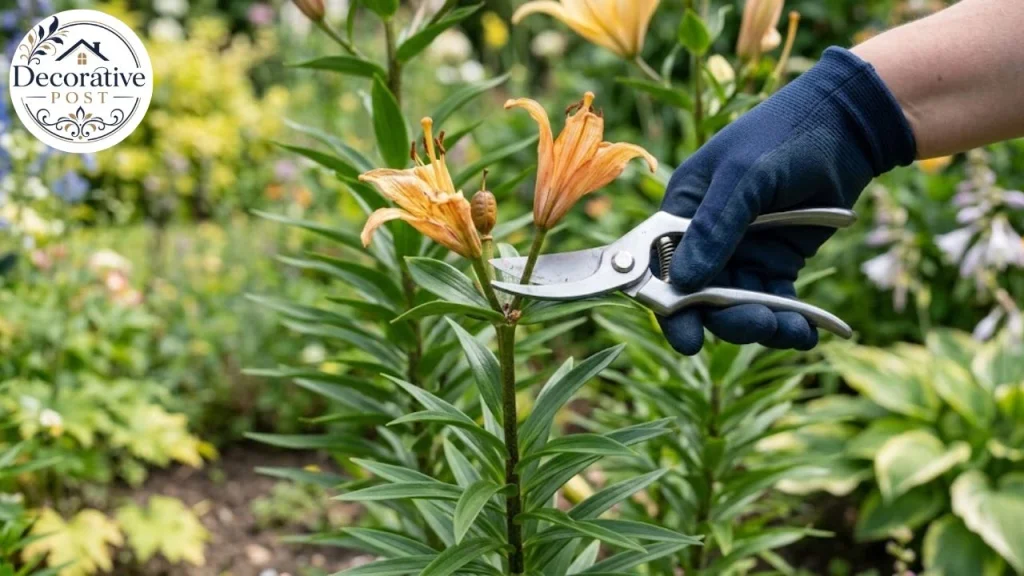
The dying foliage is untidy for several weeks, and that is the honest cost of growing lilies. Plant something in front of them that fills out in late summer, and the problem largely disappears.
Cutting flowers for the vase
A specific warning, because it works against the rule above.
Every stem you cut for a vase is foliage the bulb loses. Take the whole stem,m and that bulb has nothing left to photosynthesise with for the rest of the season.
The working guidance is to leave at least two-thirds of the stem and its leaves on the plant. Cut the flowering top, not the stalk.
If you want lilies primarily for cutting, plant a dedicated row somewhere out of sight and treat those bulbs as replaceable. Trying to harvest from a display planting degrades it within two seasons.
And again, never bring them indoors if a cat lives there.
Staking the tall ones
Varieties vary enormously in height, from around a foot to six feet, and the tall ones need support in exposed positions.
Put stakes in at planting time or in early spring, before growth is up. Driving a stake into established soil risks spearing the bulb.
A single cane behind the stem with a soft tie near the top handles most situations. Grow-through grid supports work well for clusters.
Signs you will need support: stems over three feet, an open or windy site, heavy flower heads, or plants in part shade that have stretched.
Container-grown lilies need it more often, because pots dry and move more than open ground.
Pests and diseases
A short list, and none of it is complicated.
Lily leaf beetle. Small, bright red beetles with black legs, heads,s and antennae. They feed mainly on the undersides of leaves and are the most destructive pest these plants face.
Hand-picking is genuinely effective: check leaf undersides and drop them into soapy water. Shaking the plant over a container works too, since they drop when disturbed. A hose blast dislodges them, and neem-based soap helps where numbers are high.
Start early. The first beetles attract more, and dealing with a few in late spring is far easier than dealing with a population in July. The same principle applies to most garden pests, which is covered properly in our guide to the Japanese beetle.
Aphids. Clusters on stems and buds, leaving a sooty residue. Treated the same way: hose, soap, or beneficial insects.
Botrytis blight. The main disease. Tan or reddish-brown spots on leaves, spreading in damp conditions.
Remove infected material promptly and bin it rather than composting it. Copper fungicide helps with light infections. Prevention is airflow and watering at the roots rather than overhead.
Bulb and root rot. No cure. Affected bulbs are removed and discarded. Prevention is entirely about drainage.
Deer and rodents. The bulbs are edible, and deer will eat the foliage. Planting short annuals around the emerging shoots gives some cover in spring, and a wire basket under the bulbs deters digging.
Dividing, and why clumps decline.
Every three or four years, and it is the only structural maintenance an Asiatic lily needs.
Signs it is due: fewer flowers than previous years, smaller blooms, stems noticeably thinner, or a visibly crowded clump.
Autumn is the right moment, after the foliage has died back. Lift the clump with a fork, well clear of the bulbs, and separate them by hand.
Healthy bulbs are firm with visible roots. Soft, mushy or mouldy ones go in the bin, not back in the ground.
Replant immediately at the same six-inch depth and twelve-inch spacing. Bulbs out of the ground deteriorate quickly, so this is not a job to start and leave half-finished.
Dividing is also how a single purchase becomes a drift. Three bulbs become nine over six years, which is the cheapest way to fill a border the same multiplication that makes tulips worth planting the first time properly.
Growing them in containers
Entirely workable, with three adjustments.
Depth over width. A pot at least twelve inches deep gives the bulb the anchoring it needs. Shallow bowls produce leaning plants.
Drainage is non-negotiable. Holes in the base, a free-draining mix, and never a saucer that holds standing water.
Water more often than in the ground. Containers dry fast, and the one-inch-a-week guidance assumes open soil.
Three to five bulbs in a large pot give a better display than one. Shorter cultivars suit containers best; the dwarf types in the one-to-two-foot range are bred for it.
Overwintering is the main consideration in cold zones. A pot freezes solid in a way open ground does not, so either sink the pot in the ground for winter, move it to an unheated garage, or wrap it.
A container of lilies works well on a front porch or by a door, where the upward-facing flowers are seen at close range and where a pot can be moved out of reach if needed.
Designing with them
The flower shape dictates how an Asiatic lily is best used, and it differs from most bulbs.
They are vertical accents, not ground cover. Narrow stems topped with flowers, with little presence at ground level. They need something at their feet.
Plant them behind or among perennials that fill out as the lilies come up. Hardy geranium, catmint, hosta in part shade, or low grasses all work, and they solve the dying-foliage problem later in the season.
Upward-facing flowers want to be looked down on or seen at eye level. This makes them good beside a path, near a seating area, or in a raised bed and less effective at the back of a deep border, where you only see stems.
Group in odd numbers. Three, five, seven. The flowers are individually striking and collectively make a statement that single stems cannot.
Mind the colour. Asiatic cultivars run hot oranges, reds, deep pinks and strong yellows alongside white and cream. The saturated ones dominate a soft pastel scheme, so either commit to them or choose the whites.
For cut arrangements, their lack of scent is the practical advantage. Our guide to table centrepiece ideas covers arrangements where an unscented flower is genuinely preferable, dining table being the obvious one.
And in a cut arrangement, remove the anthers. The pollen stains fabric permanently if it reaches a tablecloth; treat it with the dry-brush-first method rather than water, much like the approach in our guide to removing candle wax from fabric. It is also the specific part documented as dangerous to cats.
A year with them, month by month
Timing shifts with your zone, so read this as a sequence rather than dates.
| Period | What to do |
|---|---|
| Early autumn | Plant bulbs, six inches deep, at least six weeks before first frost. Divide established clumps |
| Late autumn | Cut browned stems to ground level. Mulch lightly |
| Winter | Nothing. Bulbs are dormant |
| Early spring | Apply balanced slow-release fertiliser. Insert stakes before growth emerges |
| Mid spring | Watch for lily leaf beetle on leaf undersides. Begin hand-picking at first sighting |
| Late spring | First flowers open. Optional bone meal as buds form |
| Early summer | Peak bloom. Deadhead spent flowers above the top leaves |
| Mid summer | Leave all foliage standing. Water at the roots, about an inch a week |
| Late summer | Foliage begins to yellow. Resist cutting it |
The two steps that matter most are planting depth in autumn and leaving the foliage alone in summer. Nearly every disappointing second season traces back to one of those.
Varieties worth knowing
Cultivar names change constantly, so these are categories rather than a shopping list.
Dwarf types, roughly one to two feet, bred for containers and front-of-border planting. Sturdy enough to need no staking.
Mid-height types, two to four feet, the most widely sold group and the easiest to place in a mixed border.
Tall types, four to six feet, which make the strongest statement and most reliably need support.
Double-flowered forms, with extra petals and often no anthers at all. The absence of pollen makes them better for cut arrangements, and they shed nothing onto furniture.
Brushmark and tango types, with contrasting speckling or a darker throat. More interesting at close range, which suits them for pots and containers.
When buying, choose firm bulbs with no soft spots, no mold,ld aa nd visible root plate. Size correlates with first-year flowering; larger bulbs flower better in year one.
Buy from one source in one order if you want a uniform display. Mixed batches often flower a week or two apart.
Buying bulbs without getting caught out
Bulb quality varies more than catalogue photographs suggest, and a few checks save a disappointing season.
Buy in autumn, when the trade sells them. Bulbs offered in late spring have usually been in storage through a warm summer and will underperform in year one.
Check firmness. A good bulb is solid under gentle pressure, like an onion. Soft patches mean rot has already started, and planting it spreads the problem.
Look for the root plate. Visible dried roots on the flat base are a sign of a healthy, properly lifted bulb. A clean, scarred base suggests rough handling.
Reject anything with mould or a sour smell. Light surface dust is normal; blue or grey fuzz is not.
Size predicts first-year flowering. Larger circumference bulbs carry more stored energy and flower better in the first season. Smaller ones often skip year one and perform from year two.
Plant them quickly. Unlike tulips, lily bulbs are never fully dormant and have no protective tunic. They dry out in storage, so a bulb that sits in a paper bag in a warm kitchen for a month loses vigour.
If a delivery arrives and you cannot plant immediately, keep the bulbs cool, dark and slightly damp; a bag of barely moist compost in an unheated shed is better than a windowsill.
Common mistakes
Planting too shallow. Six inches, and a tall stem with a shallow bulb will fall over in flower.
Cutting the foliage after flowering. The most consequential error. The leaves are building next year’s bulb.
Taking whole stems for the vase. Leave two-thirds of the stem and its leaves on the plant.
Planting in soil that holds water. Bulb rot is fatal and unfixable. Check drainage before planting, not after.
Overfeeding. Lush leaves, few flowers. One balanced feed in early spring is enough.
Watering overhead. Wet foliage invites botrytis. Water the roots.
Ignoring the first beetles. They recruit. Ten minutes in late spring saves weeks in summer.
Bringing cut lilies into a house with a cat. Covered at length above, and worth repeating.
Where this leaves you
Grown properly, an Asiatic lily is close to the ideal perennial bulb plant: once in autumn,, it flowers every early summer for years, and you can divide it occasionally to multiply.
The whole method is four things: six inches deep in free-draining soil, full sun, one feed in spring, and leave the leaves alone until they brown.
That last one is the difference between a planting that improves annually and one that fades by year three. The bulb is built underground, during the weeks the plant looks least impressive.
Which leaves the question this article opened with. If there is a cat in your household, choose something else; the pollen alone is enough, and the eighteen-hour window is narrower than most people’s weekends.
If there is not, plant them in autumn, and they will be the first thing flowering next June.
FAQs:
Are Asiatic lilies perennials?
Yes. They are hardy in zones 3 through 9, return each year from the same bulb, and multiply over time. Dividing every three or four years keeps flowering strong.
When do Asiatic lilies bloom?
Late spring into early summer, making them the earliest-flowering lily class. Each plant blooms once per season, and individual flowers last a limited time.
How deep do you plant Asiatic lily bulbs?
About six inches deep, pointed end facing up, spaced twelve inches apart. An alternative rule is three times the bulb’s height. Depth matters because the bulb anchors stems that can reach six feet.
Do Asiatic lilies have a scent?
Essentially none. This is the main difference from Oriental lilies, which are strongly fragrant, and it makes Asiatics the better choice for indoor arrangements and anyone sensitive to strong floral scent.
Are Asiatic lilies toxic to cats?
Yes, severely. All parts of true lilies are renal toxins in cats, and acute kidney injury has been documented from pollen exposure alone. Kidney damage may be irreversible if treatment begins more than about 18 hours after exposure. Contact a vet or the ASPCA Animal Poison Control Center on (888) 426-4435 immediately.
Should you cut back Asiatic lilies after they bloom?
Deadhead spent flowers just above the top leaves, but leave the stems and foliage standing. The leaves feed the bulb for next season. Cut stems to ground level only once they turn brown or yellow, usually around first frost.
Why are my Asiatic lilies not flowering?
The most common causes are foliage removed too early the previous season, bulbs planted too shallow, too much shade, overfeeding with nitrogen, or a crowded clump that needs dividing.
Can Asiatic lilies grow in pots?
Yes, in containers at least twelve inches deep with good drainage. Use three to five bulbs per large pot, water more often than in the ground, and protect the pot from freezing solid in cold zones.