

That recognition is the company’s greatest asset and its biggest problem. The name became shorthand for recliners generally, which means plenty of people shopping for one have no idea what the brand actually sells today or that the business behind it is not the one that built its reputation.
Here is what you are buying in 2026, what changed, and whether it is worth the money.
The short answer
BarcaLounger makes leather and fabric recliners, loveseats, and sofas, priced roughly between $900 and $2,000 for a single chair. The range covers manual pushback, power recline, power headrest, rocker, glider, swivel, and lift models.
The brand dates to 1896 and is the oldest recliner manufacturer in the United States. It is also, since a 2010 bankruptcy sale, a different company from the one most people remember, owned by a private equity firm and sourcing differently.
Quality today is solid mid-market rather than heirloom. Which is worth knowing before you pay for a name.
How a brand name became a common noun
The company began as the Barcalo Manufacturing Company in Buffalo, New York, founded by Edward Joel Barcalo. It made brass beds and hand tools long before it made chairs.
The reclining chair arrived later, and the name followed from it: Barcalo plus lounger. It is the oldest manufacturer of reclining chairs in the US, and for several decades it effectively defined the category.
That dominance had a side effect. The word slid into general use as a term for any recliner, in the same way people say hoover for a vacuum or biro for a pen.
For a trademark holder, this is a mixed blessing. Universal recognition is worth a fortune in advertising you never had to buy. It also means a large share of people typing the name are not looking for your product at all; they are looking for a recliner and reaching for the only word they know.
If that is you, read on anyway. Most of what follows applies to buying any recliner, and the brand comparison near the end covers the alternatives.
What actually happened to the company
This matters more than brand histories usually do, because it explains the gap between the reputation and the current product.
The original business ran for over a century. In 2010, it went through a bankruptcy sale, and the Barcolounger name and assets were acquired out of it. The buyer was Hancock Park Associates, a private equity firm, and the company that emerged was effectively a new entity trading on an old name.
In 2011, the relaunched business announced a US-made line, which suggests the point was understood internally: the heritage only has value if something behind it is still true.
None of this makes the current product bad. Plenty of respected furniture names have been through ownership changes and come out fine. But it does mean that a chair bought in 1985 and a chair bought today share a logo and not much else.
So judge the chair in front of you rather than the memory. If someone tells you they do not make them like they used to, they are literally correct, not as an insult, but as a description of corporate history.
The leather question nobody highlights
This is the single most useful thing on this page if you are about to spend money.
Look closely at the material description on a leather barcalounger, and you will frequently find a phrase like top grain leather with polyurethane match on sides and back.
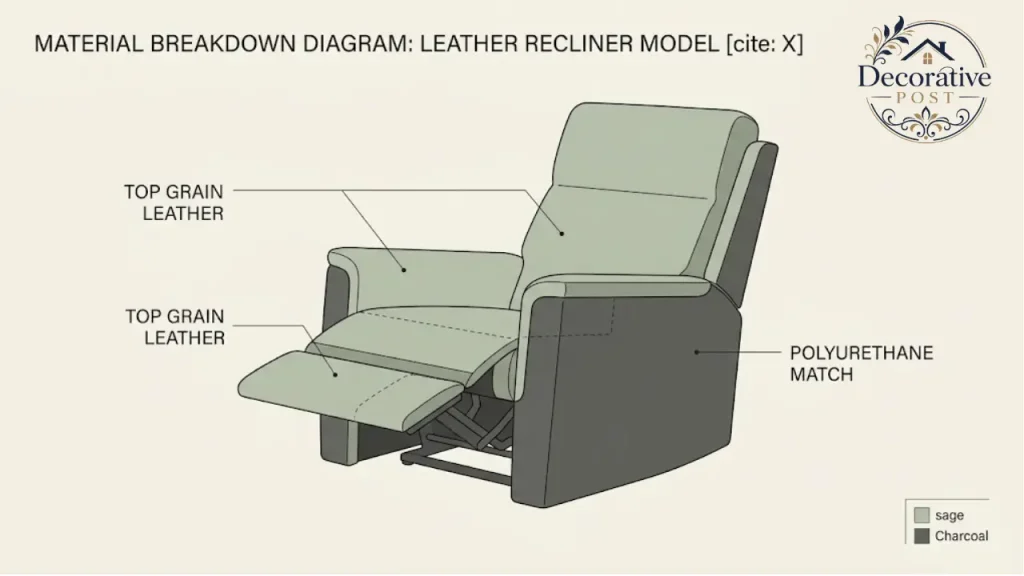
Read that carefully. It means the surfaces you sit on and touch are genuine top-grain leather. The outside arms, the sides, and the back panel are polyurethane vinyl, colour-matched to blend in.
This is standard practice across the mid-market furniture industry, and it is not a scandal. It keeps the price down substantially, and the parts getting the most wear are the real thing.
But it changes two things you should know about. The polyurethane sections will not develop the patina leather does, so over years the chair ages unevenly. And in a room where the back of the chair is visible, floating in the middle of a space rather than against a wall, the difference becomes noticeable in certain light.
If you want leather everywhere, look for all leather in the description. Some models specify it, and they cost more.
Manual, power, or something else
The mechanism is the biggest decision after size, and it affects price, reliability, and how the chair will suit you in ten years. Every barcalounger in the current range falls into one of these types.
Manual pushback. You lean back, and your body weight opens the chair. No lever, no motor, no cord. Cleanest look, fewest parts to fail, and the least expensive. Requires reasonable core strength to operate, which matters more than people expect.
Manual with handle. A lever on the side releases the footrest. Easier than pushback for anyone with limited mobility, though the handle is visible.
Power recline. A motor does the work from a button. Infinite positions rather than two or three, which is genuinely more comfortable for long sits. Needs a plug socket within reach, and introduces a motor and a control that can fail outside warranty.
Power headrest. A separate adjustment for the head and neck, usually on higher-end models. If you read or watch television in the chair, this is the feature most likely to justify its cost.
Lift recliners. Tilt forward to help the sitter stand. A mobility aid rather than a comfort feature, and worth considering for anyone who struggles to rise from a seated position.
Rocker, glider and swivel. Rockers move on curved runners. Gliders move on a fixed arc and feel smoother. Swivels rotate. Any of these can be combined with recline, and the combinations get expensive.
For most buyers under sixty, manual is the better value. For anyone who will spend hours in the chair or has any mobility limitation, power earns its premium.
Decoding the model lines
Furniture naming is deliberately opaque. Here is what the recurring barcalounger model names actually indicate.
| Model | Character | Typical buyer |
|---|---|---|
| Presidential | The classic. Traditional roll arm, deep seat, the chair most people picture | Someone replacing a chair they already loved |
| Longhorn | Western-influenced, heavier leather, wood legs | Studies, dens, masculine rooms |
| Mission / Craftsman | Straight lines, exposed wood, Arts and Crafts influence | Period homes and craftsman interiors |
| Melrose | Transitional: neither traditional nor modern | The safest choice for a mixed room |
| Nixon / Nixen | Mid-century influenced, lower profile, tapered legs | Modern and mid-century interiors |
| Ashebrooke | Updated traditional with cleaner tailoring | Traditional rooms that want less bulk |
| Columbia / Bryson | Contemporary power models with headrests and USB ports | Media rooms and daily use |
| Anaheim Big & Tall | Reinforced frame, higher weight capacity, larger dimensions | Larger sitters |
| Oakleigh / Dawson | Swivel pedestal chair with separate ottoman | Reading corners, offices |
Names migrate between fabric and leather versions and between manual and power, so always check the full specification rather than assuming the model name tells you the mechanism.
What you will pay, and where
Prices run a wide band depending on mechanism, material, and retailer.
| Configuration | Typical range |
|---|---|
| Manual fabric recliner | $900 – $1,150 |
| Manual leather recliner | $1,000 – $1,500 |
| Power recliner | $1,300 – $1,700 |
| Power with headrest and USB | $1,500 – $2,000 |
| Reclining loveseat | $1,900 – $2,700 |
| Reclining sofa | $2,400 – $3,200 |
The brand sells through its own dealers, through Costco, Walmart and Amazon, and through independent furniture retailers. That spread is unusual, and it works in your favour.
Costco carries a small selection of power models, often with USB and USB-C ports, at competitive pricing and with a generous returns policy. Independent dealers carry far more of the range and will often discount ten percent or more from list, particularly around holiday weekends.
Dealer clearance is where the real savings sit. Floor models and discontinued colourways routinely sell at half of original list, and a floor model that has been sat in by strangers for six months is still a chair with a warranty.
Avoid buying leather furniture from photographs alone if you can help it. Colour reproduction on screens is unreliable, and leather in particular photographs warmer than it looks in a north-facing room.
The specs that matter
Five numbers tell you whether a chair will work in your house.
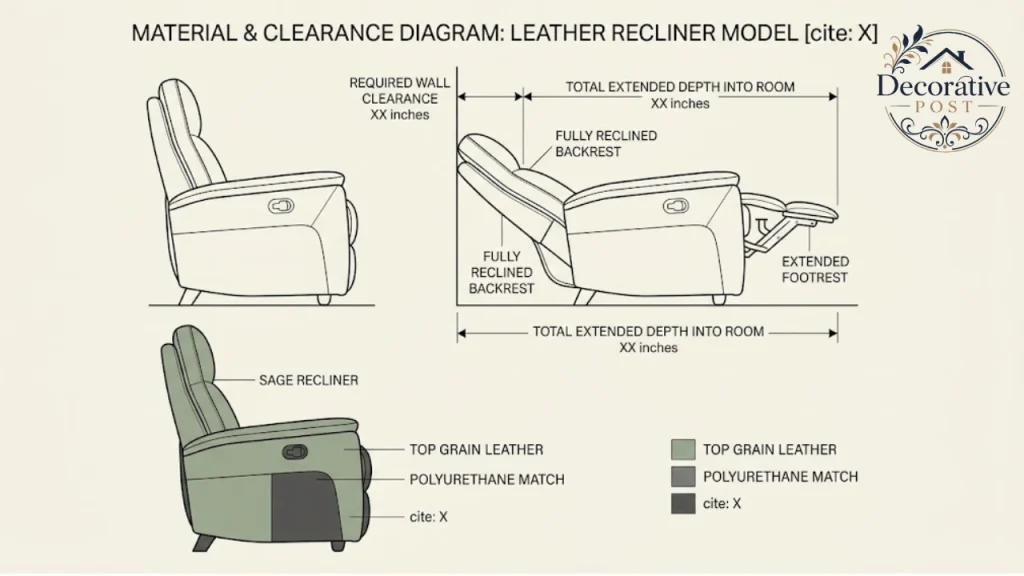
Wall clearance. The most commonly ignored measurement and the one that ruins the most purchases. A standard recliner needs several inches behind it to open fully. Wall-hugger models recline forward instead and need only a few inches in a small room.
Extended depth. How much floor the chair occupies when fully open. Frequently over 65 inches. Measure from your wall into the room and mark it with tape before ordering.
Seat height. Lower chairs look better; higher chairs are easier to get out of. If anyone using it has knee or hip trouble, higher wins and it is not close.
Weight capacity. Commonly 250 pounds on standard models. Big and tall lines go considerably higher. This is a structural rating, not a suggestion.
Overall width. Recliners are wider than they look because the arms carry the mechanism. A chair that measures fine on paper can still dominate a small room visually.
Measuring properly before you order
Twenty minutes with a tape measure prevents the most expensive furniture mistake there is.
Mark the chair’s reclined footprint on the floor with painter’s tape: full extended depth, full width. Live with the outline for a day and walk around it.
Check the delivery path, not just the room. Doorways, stair turns, and the tightest corner between the front door and the final position. Recliners are bulky, and most do not disassemble.
Check the socket if you are buying power. Cords are short, and an extension lead trailing across a living room is both ugly and a trip hazard.
Think about what sits beside it. A side table needs to clear the arm when the chair is reclined, and a floor lamp behind it needs to clear the headrest at full extension.
If the chair will sit near a fireplace, mind the clearance there too; the same thinking that goes into planning a fireplace hearth applies to anything upholstered placed near it.
How it compares to the obvious alternatives
Three brands come up repeatedly in the same shopping trip.
La-Z-Boy. The biggest direct competitor and the closest match on price and positioning. Larger range, more fabric options, more showrooms. Build quality is broadly comparable, and the choice usually comes down to which specific chair fits your body and your room rather than which badge is better.
Stressless. A different proposition entirely. Norwegian, substantially more expensive, built around an ergonomic reclining system rather than a traditional footrest mechanism. If your priority is long-term back support and you have the budget, it is a genuine step up. If you want a conventional recliner look, it is not what you want.
Flexsteel, Catnapper, Homestretch. Mid-market competitors that appear in the same dealer showrooms. Often better value per dollar, with less brand recognition attached.
Costco house brands and direct-to-consumer options. Cheaper, sometimes significantly. The compromise is usually in the mechanism and the frame rather than the upholstery, and mechanisms are what fail.
The honest summary: a barcalounger is a competent mid-market recliner with a famous name. You are not overpaying dramatically for the badge, but you are not getting something a competitor cannot match either. Sit in several before deciding.
What actually goes wrong
No product review is useful without this section.
Power mechanisms fail more often than manual ones. More components, more to go wrong. Motors, transformers, wiring harnesses, and hand controls are all replaceable, but check what the warranty covers and for how long before buying power.
Pushback mechanisms wear. Over years, the chair can become easier to recline than it should be, eventually reclining under light pressure. This is normal wear rather than a defect.
Polyurethane sections crack before leather does. Expect the vinyl sides and back to show age sooner than the seating surfaces, particularly in direct sunlight.
Leather dries without conditioning. Top grain leather in a centrally heated room needs occasional attention, or it stiffens and eventually cracks at flex points.
Squeaks develop. Usually the mechanism needs lubricating rather than replacing. A light spray on the pivot points fixes most of it.
Keep the paperwork. Replacement mechanisms and parts are available through the company’s support channels, and a serial number makes that process straightforward rather than frustrating.
Living with one: care and maintenance
Leather recliners reward small amounts of regular attention and punish neglect slowly.
Vacuum the crevices monthly with a brush attachment. Grit works into the seams and acts as an abrasive every time you sit down.
Condition leather two or three times a year with a product made for upholstery leather. Little and often beats an annual soaking.
Keep it out of direct sunlight if you possibly can. UV fades leather unevenly and hardens polyurethane, and a chair positioned in a sunbeam will show it within two summers.
Wipe spills immediately. Leather is forgiving for about thirty seconds and considerably less forgiving after that.
Protect the floor underneath. Recliners are heavy, and the back feet take enormous load when the chair opens. Felt pads are essential on wood and worth it under a rug. Our guide to cleaning hardwood floors covers the damage that heavy furniture does over time.
A rug under the chair helps both the floor and the room. If the chair is the only heavy piece in a corner, a DIY area rug anchors it visually and stops it from looking marooned.
The vintage question
Old Barcaloungers turn up constantly at estate sales and online marketplaces, often for very little, and people want to know whether they are worth having.
Frequently yes, with caveats. Chairs from the brand’s earlier decades were built with heavier frames and genuinely full leather, and a sound example can be better made than a comparable new chair.
Check the frame first. Sit in it, recline it fully, and listen. Wobble or cracking means walk away; frame repair is rarely economical.
Check the mechanism second. Worn mechanisms can sometimes be sourced, but matching a decades-old assembly is difficult and often impossible.
Upholstery is the easy part, and also the expensive part. Reupholstering a recliner in leather frequently costs more than a new mid-range chair, so do that maths before falling in love.
The ones genuinely worth restoring are the mid-century models with distinctive lines, which suit contemporary rooms better than their replacements do. A well-restored period chair sits comfortably in a grandmillennial interior, where older pieces are the point rather than the compromise.
Making it work in the room
Recliners have a reputation for ruining living rooms, and it is partly deserved. They are bulky, and most are specified in colours chosen to hide wear rather than to look good.
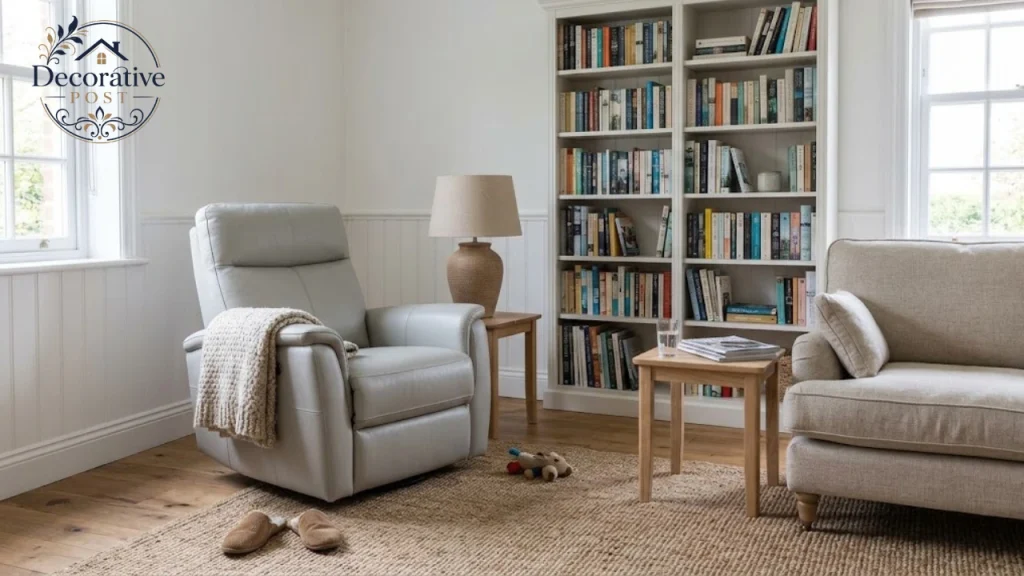
Choose a lighter or more interesting colour than you think you should. Cream, grey and the various blues in the current range all read as furniture rather than as a recliner, and the darkest browns are the ones that look most dated.
Angle it rather than squaring it to the wall. A chair at forty-five degrees in a corner reads as deliberate; the same chair flat against a wall reads as functional.
Pair it with something. A single recliner floating alone always looks like an afterthought. A side table, a floor lamp, and a rug turn it into a reading corner, which is the principle behind most of what makes a cozy living room work.
Mind the sightlines in an open plan. The back of a recliner is its least attractive side, and in a combined entryway and living space you often see it from the door first.
Balance the visual weight. A heavy leather chair on one side of a room wants something substantial opposite it — a bookcase, a sofa, or art scaled to match, as covered in our guide to decorating walls.
Who should buy one, and who should not
Buy one if you want a conventional recliner from an established brand with dealer support and available parts, at a mid-market price, and you intend to sit in it before buying.
Buy one if you need a specific configuration: big and tall, lift, swivel pedestal, because the range covers these properly and many cheaper brands do not.
Look elsewhere if your priority is ergonomic support for a bad back. Stressless and similar systems are designed around that problem in a way traditional recliners are not.
Look elsewhere if you want full leather throughout at this price point. You will usually do better buying a smaller brand’s all-leather model than a bigger brand’s partial.
Look elsewhere if the room genuinely cannot take a recliner. No amount of styling rescues a chair that blocks a walkway, and a well-chosen armchair with a footstool does most of the same job in half the footprint.
A buying checklist
Work through these in order, and you will not get it wrong.
Measure the reclined footprint and tape it on the floor. Check the delivery path while you are at it.
Decide the mechanism before you shop. Manual for value and reliability, power for daily long use or limited mobility.
Check the material description word for word. Find out whether it is all leather or leather with a polyurethane match, and decide whether you mind.
Sit in it for ten minutes, not thirty seconds. Recliner comfort reveals itself slowly, and the chair that feels best immediately is often not the one that feels best at minute eight.
Check the weight capacity against everyone who will use it.
Read the warranty on the mechanism specifically, separately from the frame and the upholstery. Those three are usually covered for different periods.
Ask about floor models. The discount is substantial, and the chair is identical.
The most sensible way to think about a barcalounger is as a reliable mid-market chair carrying an unusually famous name. The name buys you dealer networks, available parts, and a safe resale position. It does not buy you the chair your grandfather had, and anyone selling you that story is selling you history rather than furniture.
Judge it by the ten minutes you spend sitting in it. That is the only test that has ever predicted whether someone still likes their recliner five years later.
FAQs:
Is BarcaLounger a good brand?
It is a competent mid-market recliner brand with wide dealer support and available replacement parts. Build quality is comparable to La-Z-Boy and below premium ergonomic brands such as Stressless. The name carries more weight than the current product strictly justifies.
Who owns BarcaLounger now?
The brand was acquired out of a bankruptcy sale in 2010 by the private equity firm Hancock Park Associates. The current company is a different business from the one founded in Buffalo in the nineteenth century.
Are BarcaLoungers made in the USA?
Some are. The relaunched company announced a US-made line in 2011, but the range is not exclusively domestic. Check the specifications for the individual model you are considering rather than assuming.
How much does a BarcaLounger cost?
Single recliners typically run $900 to $2,000 depending on mechanism and material. Manual fabric models sit at the lower end; power models with headrests and USB ports at the upper end. Loveseats and sofas run higher.
Is BarcaLounger leather real leather?
Partly, on most models. The common specification is top-grain leather on seating surfaces with colour-matched polyurethane on the sides and back. Models described as “all leather” use leather throughout and cost more.
What is the difference between BarcaLounger and La-Z-Boy?
They compete directly at similar price points with comparable build quality. La-Z-Boy has a larger range and more showrooms; BarcaLounger has the older heritage. The decision is better made by sitting in specific chairs than by comparing brands.
How much space does a recliner need behind it?
A standard model needs several inches of wall clearance to recline fully. Wall-hugger models recline forward and need only a few inches, which makes them the better choice in small rooms.
Are old BarcaLoungers worth restoring?
Sometimes. Earlier models used heavier frames and full leather, and mid-century designs suit contemporary rooms well. Check the frame and mechanism first; reupholstery often costs more than a new mid-range chair.