

Most abbreviations have one meaning and a couple of stragglers. This one has about a dozen, and they have nothing to do with each other.
Dih shows up in group chats, Geneva Convention commentaries, Hong Kong rail data, algebra textbooks, and archaeological surveys of northern India. No shared root. No family resemblance. Just the same three letters, reused.
So the question worth answering is not what it stands for. It is which one you have just
Quick reference
| Where you saw it | What it means |
|---|---|
| Text message, game chat, video comments | A respelling of a vulgar word, built to dodge moderation filters |
| French or Spanish legal writing | International humanitarian law |
| Hong Kong transit data or signage | Diamond Hill station code |
| Maths textbook, written Dihₙ | The dihedral group |
| South Asian history or place names | A settlement mound |
| Japanese government documents | Defense Intelligence Headquarters |
The rest of this explains each one, starting with the reason most people are here.
The texting meaning
In informal digital writing, dih is not an abbreviation at all. Nothing is being shortened.
It is a respelling one letter changed from a common vulgar word, specifically so that automated moderation does not recognize it. That is the entire mechanism, and it is worth understanding because it explains the term’s whole lifecycle.
There is no innocent secondary reading in casual contexts. If it appeared in a comment thread or a group chat, it means what it looks like it means.
You will see it mostly in gaming chat, short-form video comments, and messages between younger users. It is crude rather than coded, and it carries no particular subcultural weight.

If you’re a parent, teacher or moderator
Most pages covering this term are written for the people already using it. If you arrived here because you saw it on a child’s screen, here is a straight answer without the lecture.
It is vulgar, not dangerous. There is no hidden meaning involving drugs, self-harm, predatory contact, or anything else that would warrant immediate concern. It is a swear word with one letter changed.
What it does indicate is a young person in spaces where moderation is being actively worked around. That is a more useful observation than the word itself, and it is usually the more productive conversation to have.
Filter-avoidance spellings are also a reasonable prompt to check what platform-level controls are in place, since the existence of these respellings is evidence that the platform’s own filters are being routed around daily.
If the word is new to you, it will likely be obsolete within a year or two. These spellings turn over fast.
Why these respellings keep appearing
This is the genuinely interesting part, and no other page explains it.
Automated moderation works largely on pattern matching. A platform maintains a blocklist; a post containing a listed string gets held, hidden, or scored down.
Users respond by altering the string just enough to escape the match while remaining obvious to a human reader. Swap a letter, drop a vowel, substitute a numeral, or insert a symbol.
The platform adds the new variant to the list. Users produce another. The cycle has run continuously since the earliest moderated forums, and it is why leetspeak conventions from the 1990s and today’s single-letter swaps are the same behavior in different clothes.
The consequence for anyone trying to keep up: these terms have deliberately short lifespans. A respelling is useful precisely until it is widely known, at which point it gets blocked and replaced.
That is also why crowdsourced slang dictionaries age so badly on terms like this and why a dated, reviewed page is worth more than a popular but undated one.
In French and Spanish: international humanitarian law
Entirely unrelated and probably the most-used sense of the three letters worldwide.
In French, DIH is droit international humanitaire. In Spanish, derecho internacional humanitario. English-language sources abbreviate the same concept as IHL.

This is the body of law governing the conduct of armed conflict. It covers the Geneva Conventions and their additional protocols, protections for civilians, wounded combatants and prisoners of war, and limits on permissible weapons and methods of warfare.
It is distinct from human rights law, which applies in peacetime as well. The distinction matters in academic work and is a common early point of confusion for law students.
If you met this initialism in a Red Cross document, a European legal journal, or a Latin American university syllabus, this is your answer. It is read letter by letter, not as a word.
Measured by total usage across two major languages and an entire professional field, this sense almost certainly outweighs the slang one; it simply generates fewer searches, because the people using it already know what it means.
In Hong Kong: Diamond Hill station
DIH is the official station code for Diamond Hill on the Hong Kong MTR network, serving the Kwun Tong line and the Tuen Ma line in Wong Tai Sin District.
Transit systems assign short codes to stations for internal use operational documents, signalling systems, timetable databases and open data feeds. They rarely appear on passenger maps, which is why most travelers never encounter them.
If you hit this version, you were almost certainly reading technical documentation or working with transit data rather than planning a journey.
In mathematics, the dihedral group
In group theory, “dih” denotes the dihedral group, usually written Dihₙ or Dₙ depending on the textbook.
Here is what that actually means, which Wikipedia’s disambiguation page does not tell you.
Take a regular polygon a square, say. Ask how many ways you can move it so it ends up occupying exactly the same space. You can rotate it by 90, 180, or 270 degrees, or leave it alone. You can also flip it across four different axes.
That is eight operations in total, and together they form the dihedral group of the square. The same logic applies to any regular polygon, and the group grows with the number of sides.
It is a foundational object in abstract algebra, and it appears wherever rotational symmetry needs formal description in crystallography, molecular structure, pattern classification, and computer graphics.
One warning worth having. The notation is inconsistent across sources. Some texts write Dihₙ for an n-sided polygon; others write D₂ₙ for the identical group, counting elements rather than sides. Establish which convention a book uses before working through its exercises, because the two look interchangeable and are not.
In archaeology: settlement mounds
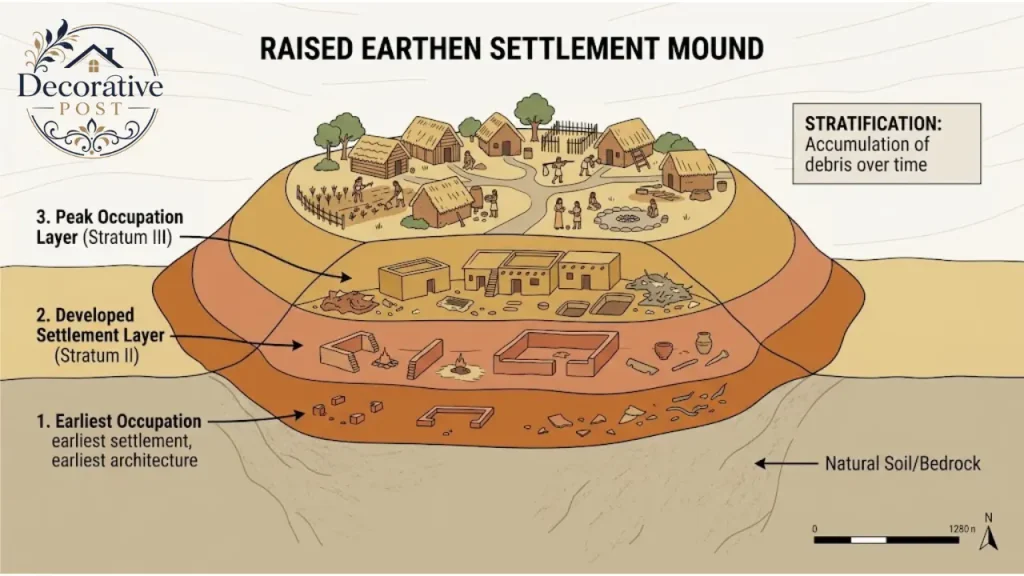
In the Mithila region, which spans parts of Bihar in India and the Terai belt of Nepal, a dih is a mound or raised site marking historical settlement.
These matter because elevated ground preserves stratigraphy. Successive periods of occupation leave layers, and the mound accumulates upward over centuries, which makes these sites unusually readable to archaeologists.
A large number of modern villages in the region sit directly on or beside one, which complicates excavation considerably; the site is still occupied.
The word also survives in place names. There is a village called Dih in Raebareli district, Uttar Pradesh, and the element recurs as a suffix throughout settlement names across the wider region.
In Japan: Defense Intelligence Headquarters
DIH abbreviates Defense Intelligence Headquarters, the signals intelligence agency of the Japanese government.
It operates under the Ministry of Defense and is Japan’s largest intelligence organization, responsible for signals intelligence, imagery analysis, and defense-related assessment.
Narrower uses
Each of these stays inside its own field.
Chemistry. Shorthand for 1,3-diiodo-5,5-dimethylhydantoin, an iodinating reagent used in organic synthesis.
Linguistics. In the ISO 639 standard, “dih” is the three-letter language code for Kumeyaay, an indigenous language of southern California and northern Baja California.
Finance. DIH Holding US, Inc. is a Nasdaq-listed rehabilitation robotics company, though it trades as DHAI, not DIH, which trips people up regularly.
Heritage studies. Occasionally used for digital intangible heritage, the practice of recording cultural traditions in digital form.
Geography. The Kurdish name for Eruh, a city in Siirt Province, Turkey.
Swiss rail. The Drahtseilbahn Interlaken Heimwehfluh is a funicular in the Bernese Oberland.
A note on where this term actually lives
Context is not only about language. It is about the platform, and that is worth separating out.
The slang sense is almost entirely confined to spaces with automated moderation and a young user base. Short-form video comments, multiplayer game chat, messaging groups.
It is rare in email, rare in forums with active human moderators, and effectively absent from anywhere people use their real names. Obfuscated spellings exist to beat machines, not people, so they cluster where machines do the policing.
The formal senses behave in the opposite way. International humanitarian law appears in published, attributed, edited writing. Station codes appear in structured data. Mathematical notation appears in typeset documents.
That split is useful if you are trying to date or source an instance. Informal, anonymous, and machine-moderated points one way. Formal, attributed, and edited points the other way.
What it is not
A few plausible guesses worth ruling out, because people arrive having assumed them.
It is not a standard English word, and it will not appear in a general dictionary as a headword in the slang sense.
It is not a medical abbreviation in common clinical use, despite the superficial resemblance to several genuine ones.
It is not a variant of DIY. The letters are adjacent on a keyboard, and this substitution happens often enough to be worth stating plainly.
It is not an acronym in the strict sense in most of its uses, since an acronym is read as a word. Most of these are initialisms, read letter by letter, and one is not an abbreviation at all.
Why three letters collect so many meanings
There are only 17,576 possible three-letter combinations in the Latin alphabet. Set against every organisation, station, chemical, language and mathematical object that wants a short label, that is a small number.
Collisions are not unusual. They are inevitable.
What makes this particular string noticeable is the spread. Most colliding abbreviations stay within adjacent domains two scientific bodies, say, or several companies. These meanings cross informal slang, treaty law, public transport, pure mathematics and field archaeology with nothing in common.
That spread is also why context resolves it so quickly. Because the domains are so far apart, the surrounding text almost never leaves genuine doubt.
Narrower collisions are the dangerous ones. When two meanings sit in the same field, context cannot separate them which is how someone asks for “dove white” paint and goes home with a lilac-grey instead of Benjamin Moore’s White Dove. Three manufacturers sell near-identically named whites, and only the product code tells them apart.
Searching an ambiguous abbreviation efficiently
If you hit a three-letter string you cannot place, there is a faster method than scrolling a disambiguation list.
Add the domain, not the string. Searching the abbreviation alongside a context word law, station, group theory, slang, archaeology collapses a dozen possible meanings to one in a single query.
Search the expansion when you can guess it. If the surrounding text is French, searching the likely full phrase confirms it immediately and gives you better sources than the abbreviation ever will.
Check the casing in the original. All caps in a formal document usually signals an organisation or a code. Lowercase in running prose usually signals an ordinary word in some language.
Look at what sits beside it. Abbreviations travel in packs. A three-letter code surrounded by other three-letter codes is part of a system, and identifying the system identifies the code. Paint codes work the same way OC-17 means nothing alone, but sitting in a fan deck it places the colour precisely, which is why our ceiling paint guide quotes codes rather than names.
Treat crowdsourced slang dictionaries as a last resort rather than a first one. Entries are unverified, frequently joking, and almost never dated, which matters a great deal for terms with short lifespans.
Why this page exists
A fair question, given that an encyclopedia disambiguation page already lists most of these.
Listing is not explaining. Knowing that “dihedral group” is one of the meanings does not help if you do not know what a dihedral group is, and the pages currently ranking for this term name their entries without defining a single one.
The gap is wider for the slang sense, where the available sources are either unverified crowdsourced entries or nothing at all. Neither serves someone trying to make a reasonable judgment about what they have just read.
So the intent here is narrower than an encyclopedia’s. Not every meaning the string has ever carried the handful you are realistically going to meet, explained well enough to be useful, with a way of telling them apart.
That is the same standard we apply across our home and design glossary, where the terms are the ones that actually come up mid-project rather than the ones that fill a dictionary.
How to tell which one you’ve hit
Working out which dih you are looking at is easier than the list above suggests. Register and formatting give it away faster than content does.
Informal digital writing a comment, a chat message, a reply thread is the slang sense, essentially without exception. No formal body uses a three-letter code in a group chat.
French or Spanish text about conflict, treaties or humanitarian organisations is international humanitarian law.
Capitalised, sitting among other three-letter codes in a timetable, dataset or operations document is a station code.
Written with a subscript number is the mathematical group. The subscript is the giveaway; no other sense uses one.
Lowercase, in writing about South Asian settlement history, is the archaeological term.
Beside a ticker symbol or share price is the holding company and note that the ticker itself is different.
When two readings genuinely seem possible, the language of the surrounding text usually settles it. The legal sense appears almost exclusively in French and Spanish; the slang sense almost exclusively in English.
Where this problem shows up closer to home
Ambiguous shorthand is not only an internet problem. Anyone who has renovated has hit the same wall, usually at a trade counter.
Paint is the worst offender, because names and codes coexist and only one of them is reliable. Asking for a colour by name across brands is how people end up with the wrong white, which is why our White Dove guide leads with the code rather than the name.
Plumbing and heating have their own version. Electric and hydronic baseboard units look similar and need completely different handling, and conflating them is a safety issue rather than a vocabulary one the distinction is set out in our guide to cleaning baseboard heaters.
Cleaning products are the same story. “Mould remover” covers products with incompatible chemistry, and mixing two of them is genuinely dangerous, as the warning in our shower mould guide explains.
Even measurements are ambiguous. A vanity sold as 21 inches deep is rarely 21 inches once installed, because the stated figure excludes the countertop overhang a distinction covered in our piece on bathroom vanity depth.
The common thread is that shorthand saves time right up until it does not. Codes, specifications and full expansions are slower to say and considerably cheaper to be wrong about.
How to say it
Worth a line, because people ask aloud more often than they type it.
The legal, defence and transport senses are initialisms, read letter by letter: dee-eye-aitch.
The mathematical abbreviation is normally read as the full word, “dihedral”, rather than spelled out.
The slang respelling is pronounced as the word it is standing in for it is a spelling change, not a pronunciation change.
The archaeological term is a word in its own right, pronounced roughly as it looks.
Three letters, a dozen meanings, and no overlap between them. Once you know which domain you are in, the ambiguity disappears entirely which is the one convenient thing about a collision this wide.
FAQs
What does DIH mean in texting?
It is a deliberately altered spelling of a vulgar word, changed by one letter so automated moderation filters do not recognise it. In informal digital writing it has no innocent alternative meaning.
Is DIH a bad word?
In casual digital use, yes it stands in for a vulgar term. In formal contexts such as French legal writing, Hong Kong transit data or mathematics, it is entirely unrelated and carries no such meaning.
What does DIH stand for in French?
Droit international humanitaire, meaning international humanitarian law the law governing armed conflict, including the Geneva Conventions. The Spanish equivalent is derecho internacional humanitario.
Is DIH an acronym or an initialism?
t depends on the sense. The legal, defence and transport uses are initialisms, read letter by letter. The slang use is neither, because it abbreviates nothing it is a respelling of an existing word.
What is Dih in mathematics?
The dihedral group, which describes every rotation and reflection that maps a regular polygon onto itself. A square’s dihedral group contains eight such operations.
Is DIH a station code?
Yes. It is the code for Diamond Hill station on the Hong Kong MTR, serving the Kwun Tong and Tuen Ma lines.
What is a dih in archaeology?
A settlement mound in the Mithila region of India and Nepal. The raised ground preserves stratified layers of earlier occupation, making these sites archaeologically valuable.
Should I be worried if my child used DIH?
It is vulgar rather than dangerous, with no hidden meaning involving drugs, self-harm or predatory contact. It does suggest the child is in online spaces where moderation filters are routinely worked around, which may be the more useful thing to look at.