

Every other system in your house tells you when it has stopped working. The furnace fails, and the house gets cold. The water heater fails, and the shower runs cold. The sump pump fails and the basement floods.
A radon mitigation system fails, and nothing happens at all. The pipe stays where it is, the house feels identical, and the gas it was removing quietly comes back.
That is the thing worth understanding about these systems, and it is the part most articles skip in favour of describing the installation.
The short version
A radon mitigation system is a fan and a pipe. The fan creates suction beneath your foundation slab, and the pipe carries soil gas up and out above the roofline before it can enter the house.
The EPA recommends installing one if your home tests at or above 4 picocuries per litre, and suggests considering action between 2 and 4. Professional installation typically runs $1,200 to $2,500, and running costs are usually under $100 a year in electricity.
A well-designed system frequently brings levels below 2 pCi/L. The catch is in the last section of this article, not the first.
Why this is worth doing
Radon is a naturally occurring radioactive gas produced by uranium decaying in soil and rock. It is colourless, odourless, and tasteless, which is the entire problem: there is no sensory warning of any kind.
It seeps into buildings through cracks in slabs, gaps around pipes, sump pits, hollow block walls, and crawl space floors. Houses are slightly negatively pressured relative to the ground beneath them, so they actively draw it in.
It is recognised as a leading cause of lung cancer, second only to smoking, and the risk is substantially higher for smokers. Reducing exposure is the only available intervention, and it works.
Outdoor air carries a low background level that nobody can do anything about. What matters is the concentration indoors, where you spend most of your time, and that is entirely fixable.
Testing comes first, always.
Nobody should install anything before testing, and anyone offering to sell you a system without a test result is not someone to hire.
Short-term tests run two to seven days with a charcoal or electret device, placed in the lowest lived-in level of the house with windows and doors kept closed. They are cheap and fast.
Long-term tests run more than ninety days and give a far better picture, because radon levels swing considerably with season, weather, and how the house is being used. Winter readings are typically higher than summer ones.
Continuous monitors are reusable electronic devices, from around $150, that give rolling readings. They are the most useful option for anyone who wants to keep an eye on things rather than test once.
If a short-term test returns between 4 and 10 pCi/L, it is worth confirming with a second test before committing money. Single short-term readings can be unrepresentative, and a confirmation test costs far less than a system you did not need.
Above 10, most guidance treats the first result as sufficient to act on.
How sub-slab depressurization actually works
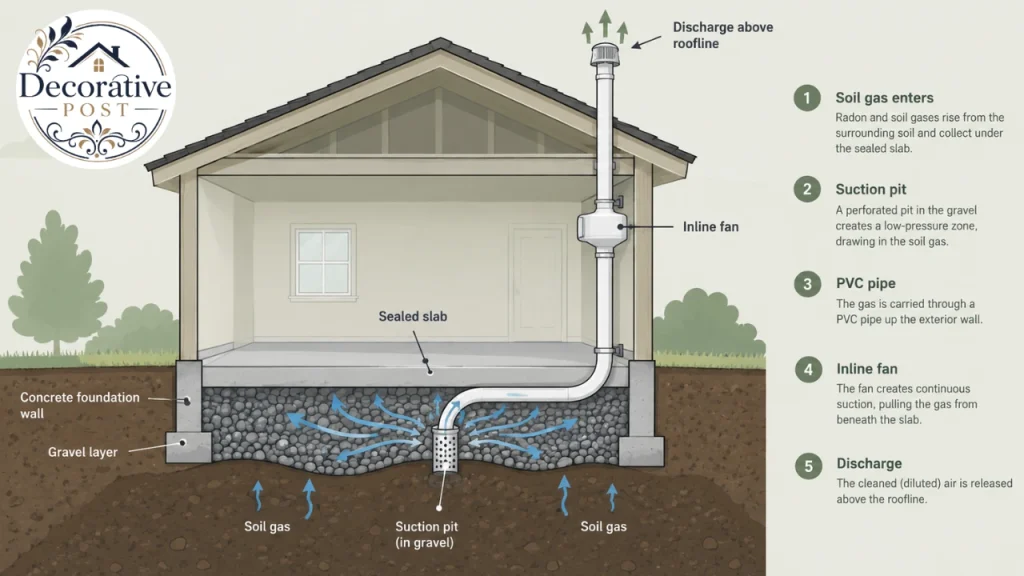
The dominant radon mitigation system design, and the one that works in the large majority of homes, is active sub-slab depressurization.
A hole is cored through the basement slab, and a pit is excavated in the gravel or soil beneath it. PVC pipe is sealed into that hole and routed either up through the house to the attic, or out through the rim joist and up the exterior wall.
A fan is fitted into the pipe run in the attic or outside, never in a lived-in space, nd runs continuously. It draws air from the gravel layer beneath the slab and discharges it above the roofline.
The mechanism is pressure rather than extraction. The fan makes the area under the slab slightly more negative than the air inside your basement. Soil gas follows that pressure gradient into the pipe instead of up through cracks in the floor.
That is why the fan runs permanently. Switch it off, and the pressure differential reverses within hours.
Sealing matters as a supporting measure. Cracks, the gap around the sump pit, and openings around service penetrations all get sealed not because sealing alone fixes radon, but because it stops the fan wasting its suction on indoor air and lets it work on the soil instead.
The other system types
Not every house suits a standard slab system, so a radon mitigation system may take one of several forms.
Sump pit systems. Where a sump exists, it is often the most effective suction point available. The pit is capped with an airtight lid, and the pipe draws from it, giving the fan access to the drain tile network around the whole foundation.
Drain tile depressurization. Similar principle, drawing directly from the perimeter drain loop. Highly effective because the suction field extends around the entire footprint.
Block wall depressurization. Hollow concrete block walls act as a chimney for soil gas. These systems depressurise the wall cavity itself, sometimes alongside a slab system.
Crawl space membrane systems. A heavy polyethylene membrane is laid across the crawl space floor, sealed at the edges and around piers, and the fan draws from beneath it. This is the standard approach for crawl spaces, and it works well, and the sealed membrane usually improves the damp problems that come with them — the same moisture logic covered in our guide to preventing mould.
Exterior systems. The pipe runs up the outside wall rather than through the house. Nothing is visible indoors, and the fan noise stays outside. Less attractive from the street, and more exposed to freezing in cold climates.
Attic systems. The pipe runs through interior wall cavities or a closet to a fan in the attic, then out through the roof. Almost entirely hidden, usually the most expensive, and the preferred choice in a finished home.
Which one suits your house depends on the foundation, and that is a judgment for a certified installer after a walkthrough, not something to decide from a website. Split-level properties are a common complication, since a bi-level home often has two slabs at different depths needing separate suction points.
Passive systems, and why so many of them do nothing
Many newer homes are built with a passive system already in place, and this causes a specific and common misunderstanding.
A passive system has the pipe but no fan. It relies on the stack effect: warm air rising inside the pipe, creating a slight natural draw. It costs very little to include during construction,n and it is genuinely worthwhile infrastructure.
What it is not is a guarantee. Passive systems typically achieve far less reduction than active ones, and plenty of homes with correctly installed passive systems still test above the action level.
If your house has a radon pipe and you have never tested, test. The presence of a pipe tells you the builder provided a rough-in, not that your radon levels are acceptable.
The good news is that activation is straightforward. Adding a fan and an electrical connection to an existing passive run is a short job, and it is considerably cheaper than a full retrofit.
What the parts do
A radon mitigation system has six components, and knowing them makes every conversation with a contractor easier.
| Component | What it does |
|---|---|
| Suction point | The cored hole and excavated pit beneath the slab where the system draws from |
| PVC pipe | Carries soil gas from the suction point to the discharge above the roofline |
| Fan | Runs continuously, creating the pressure differential. Rated by the suction and airflow the house needs |
| Manometer | A U-shaped tube of coloured liquid mounted on the pipe. The only indicator that the system is running |
| System label | Required tag showing installer name, licence number and install date |
| Sealing materials | Caulk and sealant closing cracks, the sump lid, and service penetrations |
The fan is sized to the house. A tight slab over clean gravel needs modest suction; a house over dense clay or with a poorly connected sub-slab layer needs considerably more. Oversizing wastes electricity and pulls conditioned air out of the house; undersizing fails to establish the pressure field.
Reading the manometer, which almost nobody does
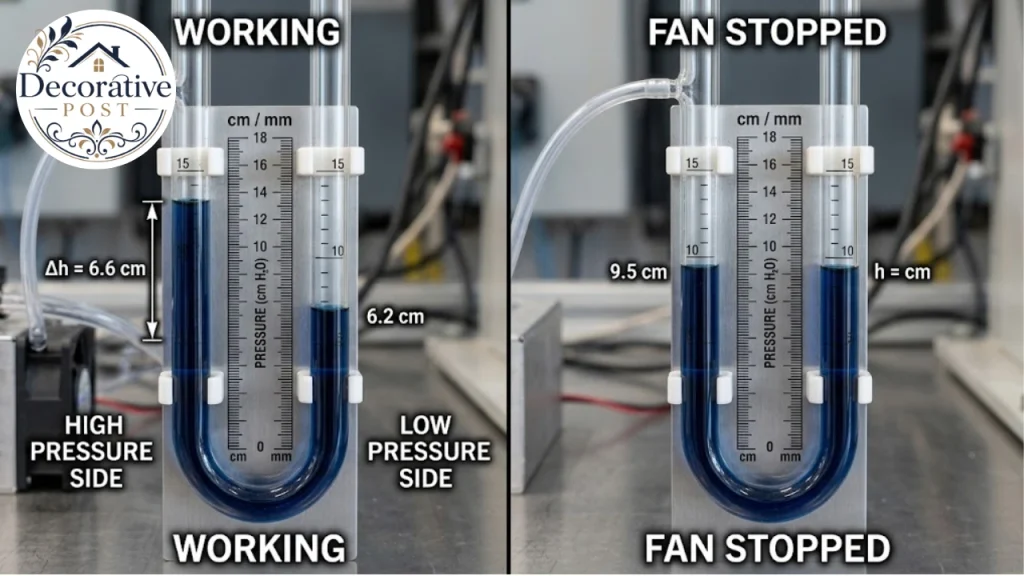
The manometer is that small plastic U-tube of coloured liquid attached to your pipe. It is not decoration, and it is not a radon reading. It shows pressure difference, which is a proxy for one thing only: whether the fan is pulling.
When the system is working, the liquid sits at different heights in the two columns. The offset is the suction the fan is producing.
When the liquid sits level in both columns, the fan has stopped. That is the entire diagnostic. Equal columns mean no suction, which means no system, which means the radon is coming back.
Photograph it the day the system is commissioned, while you know it is working correctly. That picture is your reference point, and a reading that has drifted substantially from it tells you something has changed: a blockage, a leak in the pipe run, or a fan beginning to fail.
Check it when you check the smoke alarms. Twice a year, thirty seconds, and it is the difference between a system that protects you and a decorative pipe.
Some systems also carry an audible or light alarm. These are worth having, and worth testing occasionally, because a silent alarm and a working system look identical.
Cost, and what drives it
Professional installation typically runs $1,200 to $2,500 in the United States for a standard active system.
| Factor | Effect on price |
|---|---|
| Foundation type | SA simple full basement is cheapest. Crawl spaces, multiple slabs, and additions cost more. |
| Interior vs exterior routing | Exterior is usually cheaper; attic routing costs the most |
| Number of suction points | Large or compartmentalised footprints may need two or more |
| Finished basement | Routing through finished space adds labour and restoration work |
| Fan sizing | Higher-capacity fans for difficult soils cost more |
| Electrical work | A new dedicated circuit adds to the total |
Running costs are modest. The fan draws a small continuous load, typically under $100 a year, plus a marginal heating or cooling penalty from the conditioned air that inevitably gets pulled along with the soil gas.
Fans last roughly five to ten years and cost a few hundred dollars to replace. Budget for it the way you would budget for a water heater, because it is a consumable part rather than a permanent one.
It is worth adding this to whatever running list you keep of seasonal jobs. Our guide to smart home maintenance covers the same principle for the other systems that fail without telling you.
Should you install it yourself?
Kits for a DIY radon mitigation system exist, and the physical work is not beyond a competent person. The EPA nonetheless recommends a certified contractor, and the reasoning is worth understanding rather than dismissing.
Diagnostics decide everything. A professional performs a communication test measuring whether suction at one point actually extends across the whole slab. Without it, you are guessing at the number and placement of suction points, and a system drawing from the wrong spot can achieve almost nothing while appearing to run perfectly.
Fan sizing is not intuitive. Matching fan capacity to sub-slab permeability is the difference between a system that works and one that hums expensively.
Discharge placement is a safety matter. The outlet must be above the roofline and well clear of windows, doors, and any air intake, or you are moving the gas from under the house to outside a bedroom window.
Certification matters for resale. Many states license professionals, and a documented, certified installation is a straightforward disclosure during a sale. A homemade system invites questions.
Where DIY genuinely makes sense: sealing cracks, capping a sump pit, improving crawl space ventilation, and testing. All of those help, and none of them carries the same risk of quiet failure.
Testing after installation and why the contractor’s test isn’t enough
The system is not finished when the pipe is up. It is finished when a test confirms it worked.
A post-mitigation test should be done within thirty days of installation, and no sooner than twenty-four hours after the fan has been running. A two- to seven-day measurement is the usual recommendation.
Your contractor will likely test to check their own work, which is appropriate. Guidance from state health departments also recommends that you obtain an independent follow-up measurement of your own.
That is not an accusation against installers. It is simply that the person who installed the system has an interest in the result, and an independent reading costs very little.
If the post-mitigation test still shows elevated levels, the system needs adjustment, usually an additional suction point, a larger fan, or more sealing. A reputable contractor will address this, and it is worth confirming before you hire that their quote covers achieving a result rather than merely installing hardware.
Living with it over the years
This is the section the contractor websites do not write, because it describes the fifteen years after they leave.
Retest every two years. This is the EPA’s recommendation, and it is the single most important ongoing habit. Soil conditions change, foundations settle, renovations open new pathways, and fans degrade.
Retest after any fan replacement or system repair, for the same reason you tested the first time.
Retest after significant renovation. Finishing a basement, adding an extension, replacing windows, or air-sealing the house all alter pressure relationships. Anything that makes the house tighter can increase radon entry. Worth bearing in mind if you are planning a home addition or converting the basement into living space.
Check the manometer twice a year and listen for the fan.
Expect to replace the fan once or twice over the life of the house. It is the same consumable-part thinking that applies to heating systems: the hardware lasts decades; the moving parts do not.
Do not switch it off. Not in winter to save energy, not because it is slightly noisy, not while decorating. Levels return within hours.
Do not block the discharge or let it be enclosed when soffits, roofing or cladding are worked on.
Common misconceptions
Air purifiers do not remove radon. They filter particulates; radon is a gas. No consumer air cleaner is a substitute for mitigation.
Opening windows is not a solution. It helps while they are open and does nothing when they are shut, which is most of the year.
New houses are not exempt. Tighter construction can concentrate radon rather than prevent it. Age tells you nothing useful.
Your neighbour’s test result does not apply to your house. Radon varies enormously between adjacent properties depending on soil, foundation and construction details.
A mitigation system does not treat radon in well water. Waterborne radon is a separate problem requiring aeration or granular activated carbon treatment. If you are on a private well in a high-radon area, test the water separately.
Basements are not the only concern. Slab-on-grade and crawl space homes get elevated radon too.
Does it hurt resale value?
The opposite, generally.
Buyers increasingly test during inspection, and a house with a documented system and recent test results removes an unknown from the transaction. A system discovered mid-sale, with no paperwork, creates one.
Keep the installation documentation, the system label details, and every test result in one folder. That file is worth more at closing than the system looked when it went in.
In a finished basement, the visible pipe is the usual aesthetic objection, and it is easily solved. Boxing it into a corner or incorporating it into built-in shelving hides it entirely, provided the manometer stays accessible and visible.
What to do this week
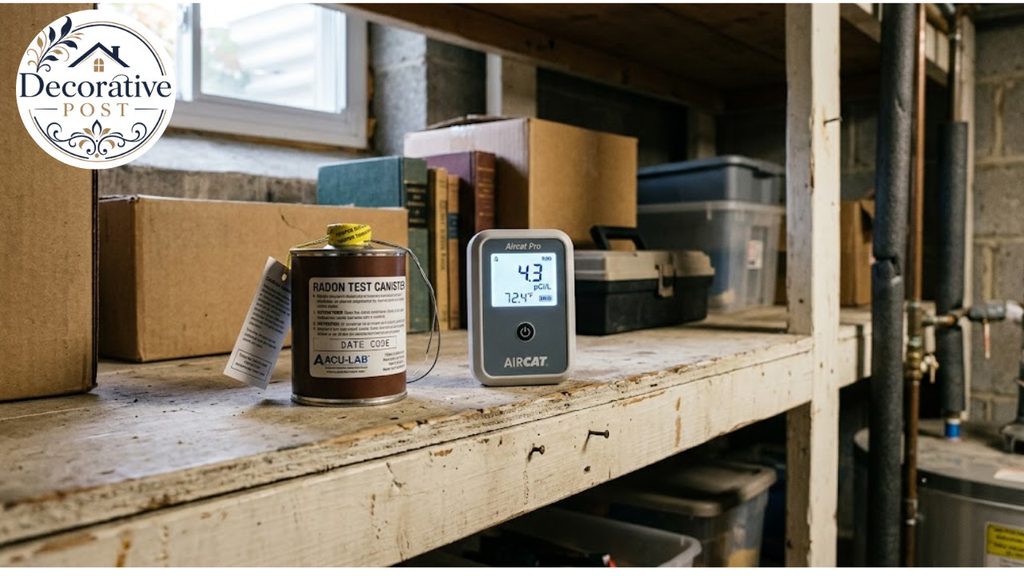
If you have never tested, buy a test. That is the whole first step, and everything else is contingent on the result.
If you tested above 4 pCi/L, get two or three quotes from certified mitigation professionals and ask each what result they guarantee, not just what hardware they will install.
If you have a passive pipe and no fan, test before assuming it is handling anything.
If you already have a system, go and look at the manometer right now. If the liquid is level in both columns, call someone this week.
A radon mitigation system is unusually good value as home improvements go: a four-figure cost, under $100 a year to run, and a measurable reduction in a serious health risk. It asks almost nothing of you afterwards.
What it asks is that you remember it exists. Everything else in the house complains when it breaks. This one depends on you checking.
FAQs:
How does a radon mitigation system work?
A fan creates suction in the soil beneath the foundation slab and vents soil gas through a PVC pipe to above the roofline. The pressure difference means radon follows the pipe out rather than entering through cracks in the floor.
How much does a radon mitigation system cost?
Professional installation typically costs $1,200 to $2,500 in the US, depending on foundation type, pipe routing, and the number of suction points needed. Electricity to run the fan is usually under $100 a year.
How do I know if my radon mitigation system is working?
Check the manometer, the U-shaped tube of coloured liquid on the pipe. If the liquid sits at different heights, the fan is pulling. If both columns are level, the fan has stopped. Confirm with a radon test every two years.
Does a radon mitigation system run all the time?
Yes. The fan runs continuously because switching it off allows the pressure difference to reverse and radon levels to return within hours.
How long does a radon fan last?
Typically five to ten years. Replacement costs a few hundred dollars, and a radon test should follow any fan replacement.
Is a passive radon system enough?
Often not. Passive systems have the pipe but no fan and achieve far less reduction. Many homes with correctly installed passive systems still test above the action level, so test before assuming it is sufficient.
Do air purifiers remove radon?
No. Air purifiers filter particles, not gases. A mitigation system that removes radon before it enters the house is the only effective approach.
Should I test again after the system is installed?
Yes, within thirty days of installation and at least twenty-four hours after the fan starts, using a two- to seven-day measurement. An independent test, in addition to the contractor’s, is recommended; then retest every two years.