

It is ten past five. The fridge has half a cabbage, some chicken, and a jar of something. Nobody wants to go to the shop.
Most pages that promise easy recipes for dinner answer this by handing you seventy photographs and asking you to choose. That is not help. That is another decision on a day that has had enough of them.
So this page does it differently. One formula that works with whatever you have, then a set of complete recipes printed in full, so you never have to click away to find out how any of them are actually made.
What “easy” means on this page
Everyone promising easy recipes for dinner uses the word. Almost nobody defines it, which is how you end up with a six-hour braise filed under “quick.”
Here, easy means all four of these: under 35 minutes, ten ingredients or fewer including salt and oil, one or two pans, and no technique you would need to look up.
If a recipe below fails any of those, it is not here. That is the whole standard.
Every recipe also carries a swap line, because the ingredient you are missing is the entire reason most recipes get abandoned halfway.
The formula that replaces most recipes
If you learn one thing from this page, make it this. Most easy recipes for dinner are variations on a single structure. Nearly every fast dinner is the same four-part structure, wearing different clothes.
Something with protein. Something green. Something with fat and flavor. Something filling.
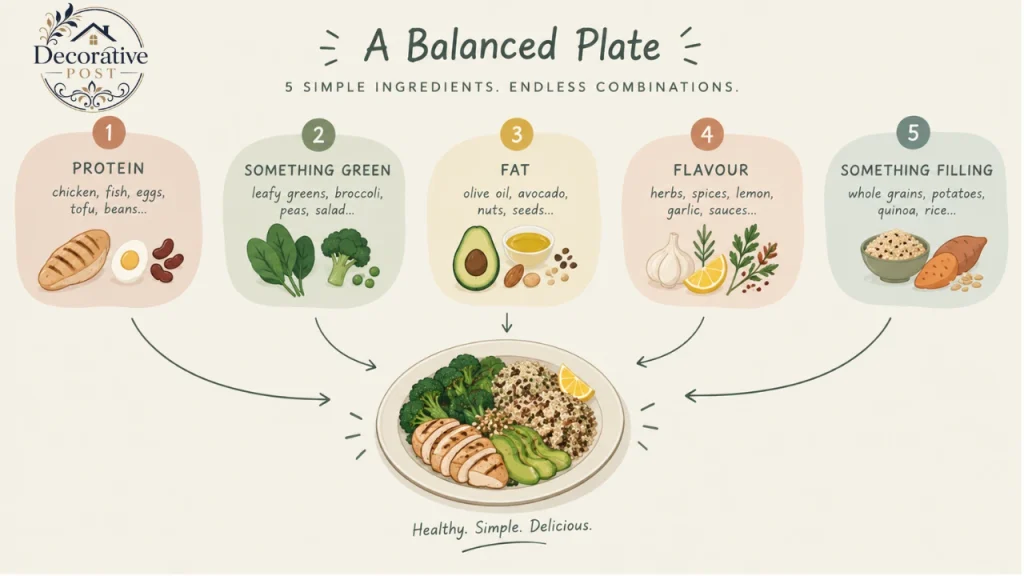
Chicken, broccoli, garlic butter, rice. Chickpeas, spinach, curry paste, and coconut milk, naan. Sausage, peppers, mustard and cream, pasta. Eggs, whatever salad is dying, chilli oil, toast.
Once you see it, your fridge stops being a puzzle. You are not asking, “What recipe do I have the ingredients for?” “You are asking which four slots are filled and what connects them.
The connector is the part people underrate. Fat plus acid plus salt turns ingredients into a meal butter and lemon, soy and sesame, yogurt and garlic, and tomato and olive oil.
Start the longest-cooking thing first. Everything else follows. That single sequencing habit is most of what separates confident cooks from anxious ones.
The fifteen-minute tier, for when you have nothing
These are not really recipes. They are the answers for nights when cooking is not happening and a shop is out of the question.
Egg fried rice. Leftover cold rice, two eggs, frozen peas, soy sauce, and spring onion. Hot pan, eggs scrambled and set aside, rice fried hard until it crackles, everything back in. Eight minutes. Swap: any cooked grain; any frozen vegetable.
Garlic butter noodles. Pasta on. Meanwhile, melt a generous amount of butter with four sliced garlic cloves over low heat until pale gold, not brown. Drain the pasta, reserving a cup of water, and toss everything with parmesan and enough pasta water to make it glossy. Ten minutes. Swap: olive oil for butter; any hard cheese.
Beans on toast, properly. A tin of white beans, warmed in olive oil with garlic, chili flakes, and a spoonful of the tin liquid until creamy. Crushed slightly. Thick toast, lemon, and good oil. Seven minutes and better than it has any right to be. Swap: chickpeas; butter beans.
Tuna pasta. Tinned tuna in oil, the oil included, tossed through hot pasta with capers, lemon zest, parsley, and black pepper. No cooking beyond the pasta. Twelve minutes. Swap: tinned sardines, anchovies, and more lemon.
Quesadillas. Tortillas, grated cheese, whatever else is leftover, chicken, tinned beans, and sweetcorn. Dry pan, both sides, and and press flat. Six minutes. Swap: any wrap or flatbread.
None of these will impress anyone. All of them end the problem.
Twenty to thirty minutes, properly cooked
Honey garlic chicken thighs
Six boneless chicken thighs, skin on if you have them. Salt them well.
Hot pan, a little oil, thighs skin down. Leave them alone for eight minutes moving them is why skin does not crisp. Flip, four more minutes.
Remove the chicken. Into the same pan go four sliced garlic cloves for thirty seconds, then three tablespoons honey, two tablespoons soy sauce, and one tablespoon vinegar. Bubble until syrupy, about two minutes.
Chicken back in, turned to coat. Rice or bread underneath.
Swap: chicken breast, cut thinner and cooked four minutes a side. Maple syrup for honey.
Sausage, peppers, and white beans
Six sausages, browned in a wide pan and set aside. Two sliced peppers and an onion into the fat, cooked down for eight minutes until soft and catching at the edges.
A tin of white beans, drained, plus a splash of water and a spoonful of mustard. Sausages back on top, cut into chunks. Five minutes together with a lid on.
Parsley if you have it. Bread to mop.
Fifteen-minute black pepper beef
Thinly sliced steak or beef mince, tossed with a tablespoon of soy sauce and a teaspoon of cornflour.
Very hot pan. Beef in a single layer, two minutes without touching it, then stir until browned. Out of the pan.
Sliced onion and a head of broccoli cut small, three minutes with a splash of water, and the lid on. Back in with the beef, two tablespoons soy, one tablespoon vinegar, and an aggressive amount of coarsely ground black pepper.
Over rice or noodles.
Creamy tomato chickpeas
Onion and garlic softened in oil. Two tablespoons of tomato purée cooked out for a minute until it darkens this step is doing more work than it looks like.
A tin of chopped tomatoes, a tin of chickpeas, a teaspoon of smoked paprika. Simmer fifteen minutes.
Off the heat, stir in a few spoons of cream, yogurt, or coconut milk. Spinach wilted through at the end.
Crispy chicken and rice skillet
Four chicken thighs, salted and browned skin-down, in a wide pan with a lid. Eight minutes, then out.
Into the fat: a chopped onion, five minutes. Then 300 g of rice, stirred for a minute until it turns translucent at the edges.
600 ml hot stock, a bay leaf if you have one. Chicken back on top, skin above the liquid. Lid on, lowest heat, eighteen minutes. Rest five minutes before lifting the lid.
Twenty-minute dal
200 g red lentils, rinsed, into a pan with 700 ml water, a teaspoon of turmeric, and a good pinch of salt. Simmer fifteen minutes until collapsing.
Meanwhile, heat three tablespoons of oil or ghee in a small pan. Add a teaspoon of cumin seeds, then four sliced garlic cloves, then a pinch of chili. Thirty seconds, until the garlic is gold.
Pour the hot oil over the lentils. Lemon at the end. Rice or flatbread alongside.
What to cook on the nights you have slightly more time
Not every weeknight is a scramble. Some evenings you have forty minutes and want to feel like you cooked something.
The trick is choosing recipes where the extra time is hands-off rather than hands-on. A braise that sits in the oven for half an hour costs you ten minutes of attention and tastes like it cost an hour.
Chicken thighs braised with white beans, stock, and whatever herb you have. Sausages roasted with grapes and red onion. A tray of cauliflower roasted hard until the edges blacken, then tossed with tahini and lemon.
The common factor is one preparation step followed by a long gap. That gap is when the table gets cleared and the day gets put away, which is most of why those meals feel different from a twelve-minute skillet.
Keep one or two of these in the rotation rather than ten. They are for the evenings you choose them, not the ones you are rescued by.
A pot of white chicken chili belongs in this tier too one round of chopping, then a long unattended simmer, and it feeds you twice.
Sheet pan dinners, where the oven does the work
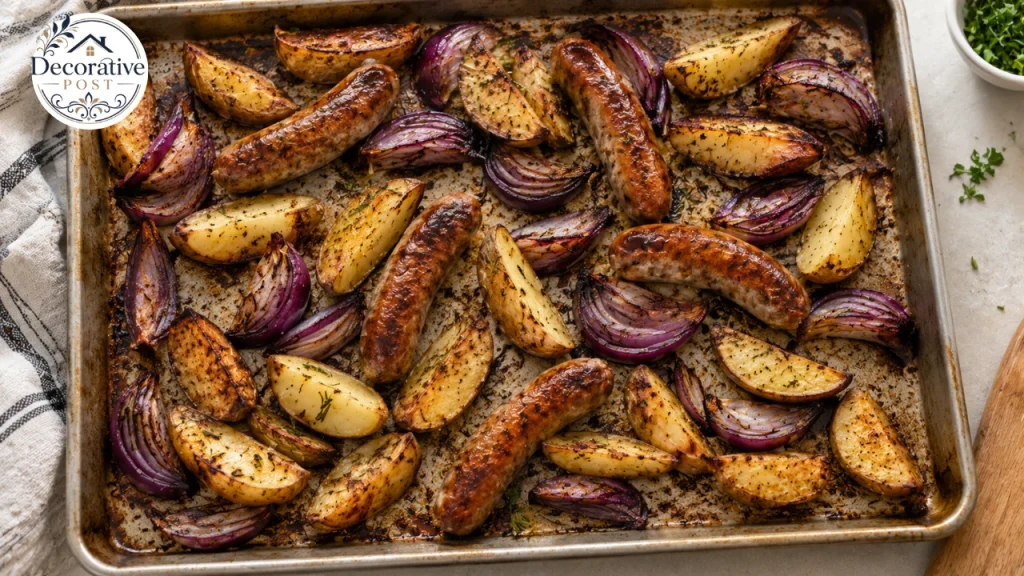
These are the easy recipes for dinner to reach for when you want the evening back. The appeal is not speed it is absence. Twelve minutes of chopping, then thirty minutes where you are not in the kitchen at all.
Two rules make the difference between a good tray bake and a soggy one, and both come down to how you load the tray. The same logic that makes deep modern kitchen cabinets worse than shallow ones for everyday storage: things you cannot see or reach get neglected.
Do not crowd the tray. Ingredients need space, or they steam instead of roasting. Two trays beat one overloaded one every time.
Match the cooking times. Potatoes need forty minutes; courgettes need fifteen. Either cut the slow things smaller or add the fast ones partway through.
If you have an air fryer, the same principles apply at half the time our air fryer potatoes method is the fastest side on this page.
Sheet pan sausage and potatoes
Baby potatoes halved, red onion in wedges, oil, and salt. Twenty minutes at 220°C.
Add six sausages and a sliced pepper, and toss everything in twenty minutes more. Mustard and a spoon of crème fraîche stirred together as a sauce.
Lemon herb salmon traybake
Broccoli or green beans and halved cherry tomatoes on the tray with oil and salt, ten minutes at 200°C. It is the kind of light, bright plate that suits a coastal kitchen in summer.
Push aside, add four salmon fillets with lemon slices on top, and twelve minutes more. The vegetables finish as the fish does.
One-pot pasta, and why it is worth knowing
The ordinary method uses two pans and loses all the starch down the drain. Cooking pasta in its own sauce keeps that starch, which is what makes a sauce cling.
One-pot tomato and basil pasta
Into a wide pan: 400g pasta, a tin of chopped tomatoes, a thinly sliced onion, four crushed garlic cloves, a good glug of olive oil, a teaspoon of salt, and 900ml water.
Bring to a hard boil and cook uncovered, stirring often, for about twelve minutes until the pasta is done and the liquid has reduced to a sauce.
Basil and parmesan off the heat. That is the entire method.
The stirring matters more here than usual, because pasta sitting on the base will stick. Otherwise it is nearly unsupervised.
When you are cooking for one or two
Almost every recipe online serves four to six, and halving is not always straightforward.
Three things scale badly and are worth knowing about. Pan size halve the ingredients but keep the pan big, or you will steam instead of browning. Aromatics do not halve the garlic, nobody has ever wished for less. Cooking times they change far less than quantities do, so go by appearance rather than the clock.
The fifteen-minute tier above is already single-portion friendly. Of the longer recipes, the black pepper beef is written for two, and the chickpeas halve cleanly.
The better strategy for one is often not to halve at all. Make four portions of something that reheats the chickpeas, the sausage and beans, the one-pot pasta and eat it twice. Cooking once for two nights is the single biggest time saving available to a solo cook.
The shopping list that makes all of this possible
The reason some people can cook without a recipe is not skill. It is that their cupboards are stocked so the gap is always small.
Tins: chopped tomatoes, chickpeas, white beans, coconut milk, tuna. Dry: pasta, rice, noodles, stock cubes, breadcrumbs. Fridge: eggs, butter, parmesan or cheddar, yoghurt, mustard. Freezer: peas, spinach, mixed veg, a bag of chicken thighs. Flavour: garlic, onions, soy sauce, vinegar, honey, smoked paprika, chilli flakes, olive oil.
That list is about thirty items, most of which keep for months. With it in the house, the four-part formula always has something to fill every slot.
Keeping it visible matters as much as owning it. A deep cupboard where tins go to die is the reason people own four jars of the same thing the organisation principles in our guide to kitchen decor and storage apply directly, and shallow shelving beats deep shelving for food every time.
Feeding people who will not eat things
Picky eating is the reason good easy recipes for dinner fail in practice. The food was fine; the audience objected.
The tactic that works better than any specific recipe is deconstruction. Cook the components separately and let people assemble.
Tacos do this naturally. So do rice bowls, pasta with sauce served alongside rather than stirred through, and traybakes where everything is distinguishable rather than mixed.
Nobody has to be negotiated with. The plain eater takes plain things, everyone else takes everything, and you cooked once.
The second tactic is sauce on the side. A huge amount of rejection is about sauce, not about the food underneath it.
The part everyone forgets: where you eat it
This is the bit the recipe sites never mention, and it changes the experience more than the recipe does.
A perfectly good dinner eaten on a cluttered table under a hard overhead light feels like a chore. The same food on a cleared table with a lamp on feels like an evening.
It costs nothing. Clear the surface, turn the big light off, light something. A simple table centerpiece that lives there permanently removes the “setting up” step entirely, which is the step that stops people bothering on a Tuesday.
If the cooking smells linger longer than you want them to, a simmer pot on the back ring clears a kitchen faster than an open window.
Even on weeknights when the food took twelve minutes, this is the difference between eating and having dinner. And when you do want to make more of it, the ideas in our home bar and dining and living space guides scale the same principle up.
Leftovers are a strategy, not an accident
The fastest dinner of the week is the one you already cooked on Sunday.
This is not about elaborate meal prep with matching containers. It is about cooking slightly more than you need, two or three times a week, and knowing what each surplus becomes.
Roast chicken becomes quesadillas, fried rice, or a quick soup with stock and whatever vegetable is left. Cooked rice becomes egg fried rice, which is the single most useful leftover in any kitchen.
Any tomato-based sauce becomes a base for beans, a bake, or a tray of roasted vegetables. Plain cooked pulses become a salad with lemon and oil, or get crushed onto toast.
The trick is to store the surplus in a way that makes it visible. A clear container at eye height gets eaten. An opaque one at the back of a shelf becomes compost on Friday.
Pastry is the underrated version of this. A sheet of puff in the freezer turns leftovers into dinner, and our savoury puff pastry recipes are mostly assembly rather than cooking.
Cook double, eat once, and the second meal costs you eight minutes rather than thirty. Over a week that is more time saved than any individual quick recipe will give you.
A note on equipment
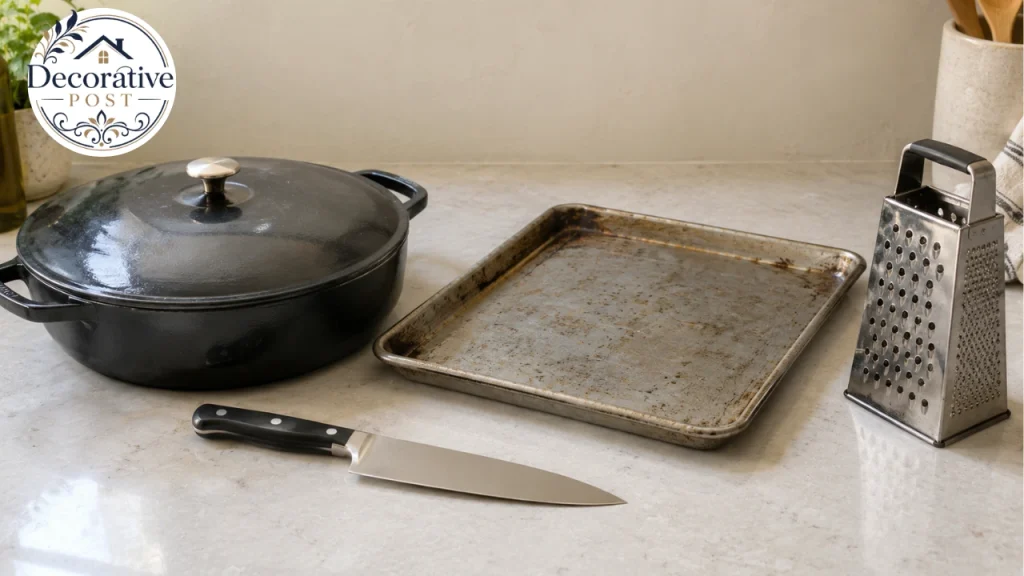
You need less than the internet suggests. Four things cover everything on this page.
A wide, heavy pan with a lid the single most useful object in a kitchen, and the one that does skillet dinners, braises and one-pot pasta alike.
A large baking tray, ideally two, with a rim. Flimsy trays warp in a hot oven and send oil running to one corner.
A sharp knife, which matters more than how many knives you own. A blunt knife is why chopping feels like a chore.
A box grater, for cheese, garlic, ginger and onion when you cannot face dicing.
If you cook on an induction hob, pan material matters more than pan price, and our guide to the best induction cookware covers what actually works on it.
Everything else is optional. Slow cookers and air fryers are genuinely useful if you already own one, and genuinely unnecessary if you do not.
Five mistakes that make easy food taste average
Underseasoning. The most common reason home cooking tastes flat. Salt the water, salt the protein before it hits the pan, taste before serving.
Crowding the pan. Browning needs space and dry heat. A crowded pan steams, and steamed chicken is grey chicken.
Not getting the pan hot enough. Most people start cooking too early. Give it another minute.
Skipping the acid. A squeeze of lemon or a splash of vinegar at the end lifts almost anything. It is the single most reliable fix for food that tastes dull but fine.
Starting everything at once. Longest-cooking first. Sequencing is the whole skill.
One practical afterthought: oil spatters travel further than you think. If you cook on open shelving over wood, our guide to cleaning hardwood floors covers what lifts grease without stripping the finish.
Build a rotation, stop deciding
The people who never need to search for easy recipes for dinner are not better cooks. They have about eight meals they can make without thinking, and they rotate them.
Pick five from this page. Make each one twice over the next fortnight. By the second attempt you will not be reading the method.
That is the point at which easy recipes for dinner stops being a search you perform and becomes something you simply know. Five meals, a stocked cupboard, and the four-part formula for the nights when none of the five fit what is in the fridge.
It is a smaller list than you think, and it covers almost every Tuesday you will ever have.
FAQs
What is the easiest dinner to make?
Egg fried rice or garlic butter pasta both under ten minutes, both from pantry staples. If there is leftover cooked rice in the fridge, egg fried rice is the fastest full meal available.
What can I make for dinner with no ingredients?
Eggs, pasta, tinned beans and tinned fish cover almost every empty-fridge night. Beans warmed in olive oil with garlic on thick toast, or tinned tuna tossed through pasta with lemon, are both complete meals in about ten minutes.
What can I cook in 20 minutes?
One-pot pasta, black pepper beef with broccoli, honey garlic chicken thighs, or creamy tomato chickpeas. Anything using thin cuts of protein or tinned pulses will cook inside twenty minutes.
What are some quick dinner ideas for a family?
Deconstructed meals work best with mixed audiences tacos, rice bowls, or sheet pan dinners where components stay separate so picky eaters can self-select without a separate meal being cooked.
How do I cook dinner without a recipe?
Use the four-part formula: something with protein, something green, something with fat and flavour, something filling. Connect them with fat, acid and salt, and start the longest-cooking element first.
What should I keep in the cupboard for easy dinners?
Tinned tomatoes, chickpeas, white beans, coconut milk and tuna; pasta, rice and noodles; eggs, butter and hard cheese; frozen peas and spinach; garlic, onions, soy sauce, vinegar, honey and olive oil.