

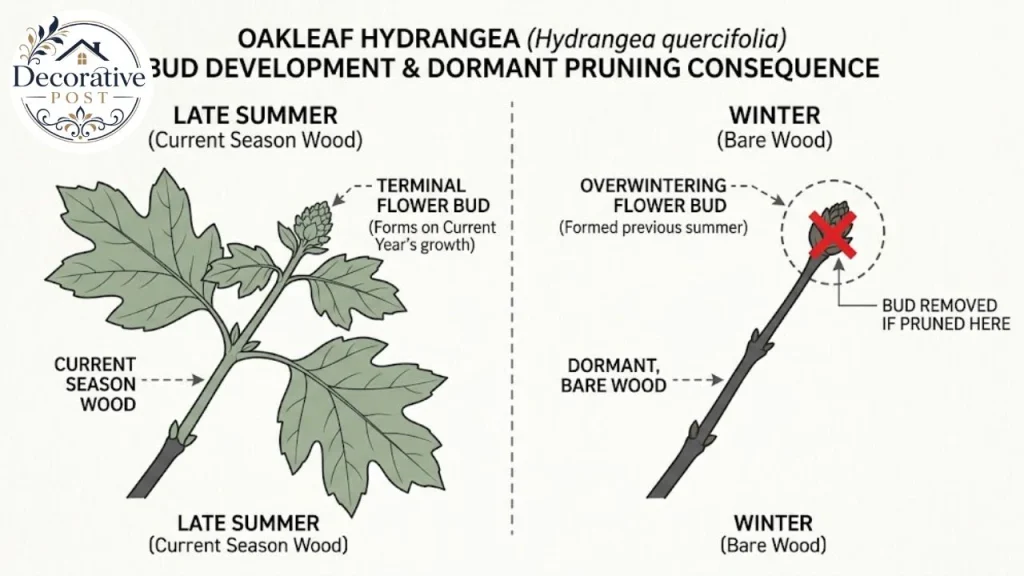
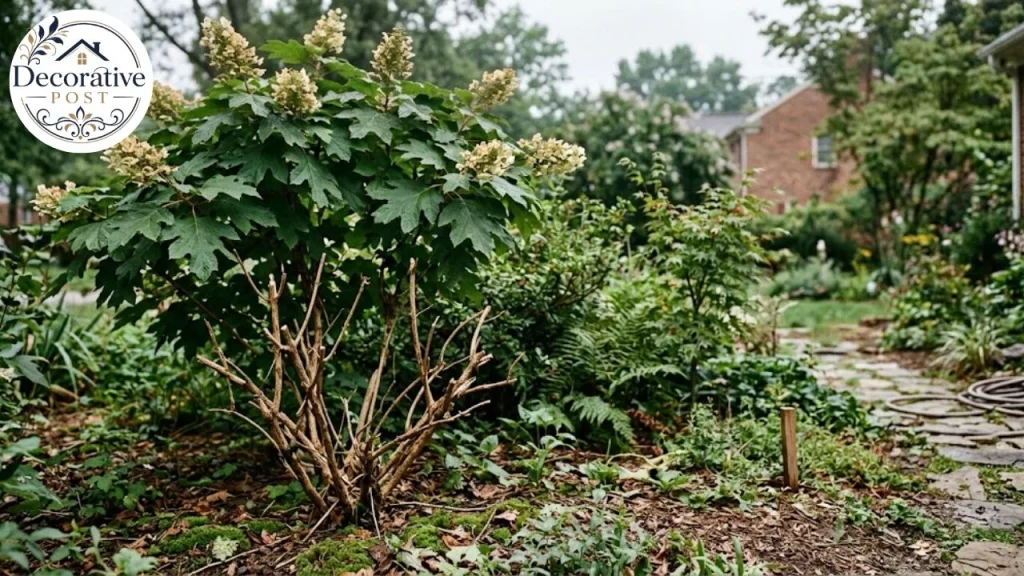
Hydrangea quercifolia flowers on old wood. Next June’s buds form in late summer on this year’s growth and sit on the plant all winter. Tidy the shrub in March, and you have cut off every flower before it opened.
That single fact explains more disappointment with this plant than drought, shade, soil and pests combined. Everything else about it is forgiving.
The short answer
Oakleaf hydrangea is a native North American shrub hardy in zones 5 to 9, growing anywhere from 2 to 12 feet depending on cultivar.
It prefers morning sun with afternoon shade. It wants loose, fertile, well-drained soil at a pH of roughly 4.5 to 6.5, and it will not tolerate wet feet.
White flower panicles open around June, age to dusky pink, then dry to papery brown. Unlike bigleaf hydrangeas, the colour does not change with soil pH; no amount of aluminium sulphate turns these blue.
Prune immediately after flowering, never in spring. That is the whole method.
Why it earns garden space four times a year
Most flowering shrubs give you two good weeks. The oakleaf hydrangea works in every season, which is the real argument for planting it.
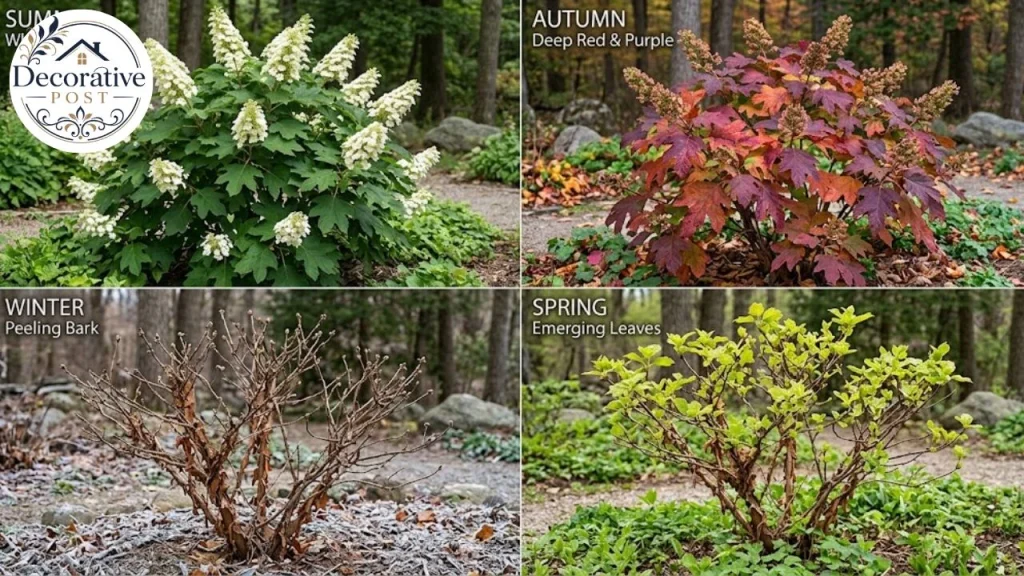
Summer. Large upright pyramidal panicles, opening creamy white around May into June, then ageing through dusky pink over weeks rather than days. The flowers last months, not a fortnight.
Autumn. This is the headline feature. The oak-shaped leaves turn deep red, purple or mahogany as temperatures fall, and the colour rivals anything in the garden. Few shrubs do flowers and autumn foliage this well.
Winter. Attractive exfoliating bark, revealed once the leaves drop. Peeling cinnamon-brown strips over paler wood, which is genuinely worth looking at in February. The dried flower heads also persist and hold snow.
Spring. The distinctive lobed foliage emerges, unlike anything else in a typical border.
That four-season performance is why it appears so often in designed planting rather than just plant catalogues. Few shrubs justify their footprint across twelve months.
The pruning rule, in full
Worth being precise about, because the margin for error is narrow and the cost is a whole season.
Prune immediately after the flowers fade. That is the window. Flowering finishes, you prune, and the plant has the rest of the summer to put on growth that will set buds for next year.
Never prune in late winter or early spring. By then the buds are already on the plant. Removing that wood removes the flowers, and the shrub will look healthy all season while producing nothing.
Why this happens. Old-wood bloomers set their flower buds in late summer or autumn on the current season’s growth. Those buds overwinter. A shrub that looks like bare twigs in March is in fact carrying next summer’s entire display.
What to actually cut:
Dead, damaged, or diseased branches, back to the base with clean cuts. This can be done any time of year without penalty.
Crossing or rubbing branches, which cause wounds and invite disease.
Dense inner growth, thinned to improve airflow. This matters because the main diseases here are fungal, and airflow is the cheapest prevention.
Anything exceeding the space you have, for containment.
How much to take. Less than you think. This is a shrub that looks best when allowed its natural form, and heavy annual pruning produces a plant that never develops character. Many mature specimens need nothing but deadwood removal for years at a time.
Sanitise tools before and after. Fungal spores transfer readily on blades.
If yours is already overgrown
The problem case, and there are two approaches.
Gradual renewal is the safer route. Remove a third of the oldest stems at the base, immediately after flowering, and repeat for the following two years. You keep flowers throughout and end with a rejuvenated plant.
Hard renewal means cutting the whole shrub back severely. It will recover, because the root system is strong, but you will lose at least one full season of flowers and possibly two.
If the shrub is simply in the wrong place rather than overgrown, moving it is often the better answer. They transplant reasonably well when dormant, and a plant sized correctly for its position needs almost no pruning.
If you have pruned at the wrong time
It happens, and the answer is simply to wait.
The shrub is not damaged. It will grow normally through the season, set buds in late summer on that new growth, and flower the following year.
One lost season, no lasting harm. The only thing to avoid is pruning again in frustration, which repeats the cycle.
Where to plant it
Site selection does more for an oakleaf hydrangea than any amount of aftercare.
Morning sun and afternoon shade are ideal, and it reflects where the species grows naturally in hardwood forests with dappled light and moist, humus-rich soil.
In cooler climates, it takes more sun happily, and more sun generally means better autumn colour and more flowers.
In zone 7 and warmer, full sun causes real struggle. Afternoon shade is close to essential in hot regions, and a plant in full southern exposure will scorch and wilt regardless of watering.
Deeper shade is tolerated better than by most hydrangeas, but at the cost of fewer flowers and noticeably weaker autumn colour. A woodland position gives you a handsome foliage shrub rather than a flowering one.
Drainage is the hard limit. This plant dislikes wet feet, and root rot is the main cause of outright failure. The same moisture logic that governs a basement applies to a planting hole, in that water with nowhere to go causes the damage rather than the water itself. Heavy clay or anywhere water sits after rain needs improving before planting, not after.
A quick check: dig a hole, fill it with water, and see whether it has drained within an hour. If water is still standing, choose another spot or build the soil up.
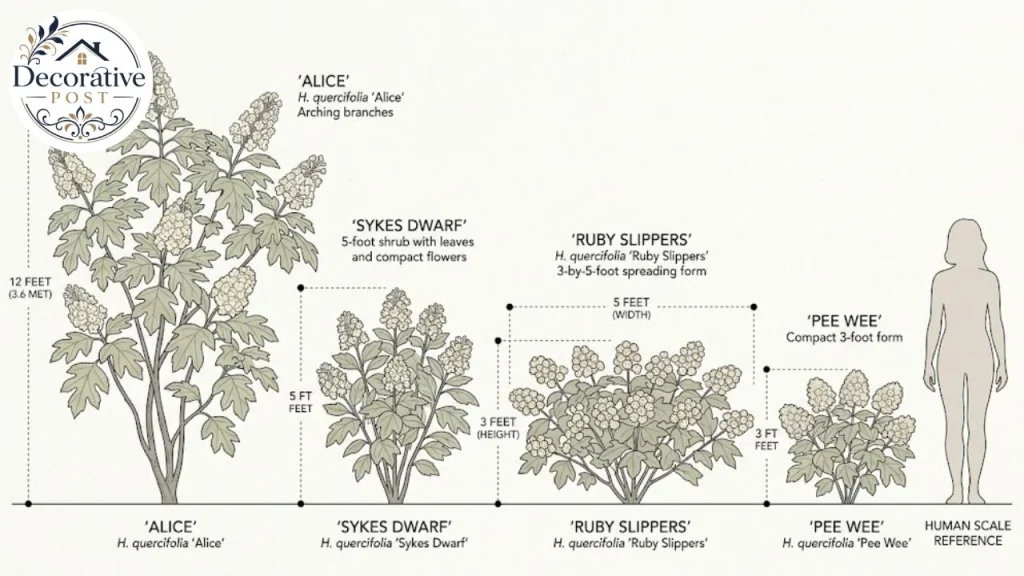
Mind the eventual size. ‘Alice’ reaches 12 feet in both directions, which is a very different proposition from the 3-foot ‘Pee Wee’. Reading the label properly at purchase prevents the pruning problem entirely.
Planting it properly, step by step
Worth setting out, because the first hour determines the next twenty years.
Timing. Autumn or early spring, when the plant is dormant or just waking. Avoid planting in midsummer heat, which forces a young root system to establish under the worst possible conditions.
Dig wide rather than deep. Two to three times the width of the container, and no deeper than the root ball itself. Shrubs planted too deep struggle, and the crown should sit level with or very slightly above the surrounding soil.
Improve the whole area, not just the hole. Digging a rich pocket in heavy clay creates a sump that holds water around the roots. Work compost through a broad area instead, or build the bed up.
Loosen the root ball. Container-grown shrubs often circle their roots. Tease the outer roots free with your fingers so they grow outward rather than continuing to spiral.
Backfill with the native soil, amended with compost, and firm gently rather than compacting hard.
Water deeply at planting, then keep watering through the first full growing season. This is the single most important aftercare period.
Mulch two to three inches deep, kept clear of the stems. Mulch piled against the base holds moisture where you do not want it and invites rot.
Space it for its mature width, not its current size. A gallon pot looks lost in a six-foot gap, and the temptation to plant close is what creates the pruning problem later.
Soil, water and feeding
Three things, none complicated.
Soil. Loose, fertile and well-drained, slightly acidic at pH 4.5 to 6.5. Working compost or well-rotted manure through the planting area is the single most useful preparation.
Watering in year one. Water heavily while the plant establishes;s this is the period that determines whether it thrives. A new shrub in its first summer is the most common casualty of a dry August.
Watering afterwards. Moderate is sufficient. Established plants survive drought but may not flower through it, so a dry spell during bud formation in late summer costs you next year’s display.
Water at the base, not overhead. Drip irrigation is ideal. Wet foliage invites the fungal problems described below, and overhead watering is the usual cause.
Feeding. Compost or manure at planting, then again in spring or autumn. Alternatively, use a 10-10-10 or a flowering-shrub fertilizer.
Stop feeding before August. Late feeding pushes soft growth that will not harden before winter and may be killed by frost, taking its flower buds with it.
Mulch is worth the effort. It holds moisture, moderates soil temperature, and suppresses competition, all of which this plant appreciates. Gravel works as well as bark where surface drainage needs help, using the same material covered in our guide to pea gravel areas. The general seasonal rhythm in our garden tips guide applies here, and with shrubs the timing of water matters more than the quantity.
The color question nobody asks correctly
A specific correction, because it causes repeated disappointment.
People buy aluminum sulfate to turn hydrangeas blue and apply it to an oakleaf hydrangea, and nothing happens. The product is not faulty.
Flower color in this species does not respond to soil pH. That mechanism belongs to bigleaf hydrangeas, H. macrophylla, where aluminum availability controls blue versus pink.
These stay white. They open creamy white, age to dusky pink as the flowers mature, and finish papery brown. That progression is natural aging, not a pH effect, and it happens in any soil.
So the only color decision you make here is at the nursery, in choosing a cultivar. After that, the plant does what it does.
Soil pH still matters for plant health; it wants slightly acidic ground, but not for flower color.
Sterile and fertile flowers, and why it matters
A detail that changes how you think about the plant.
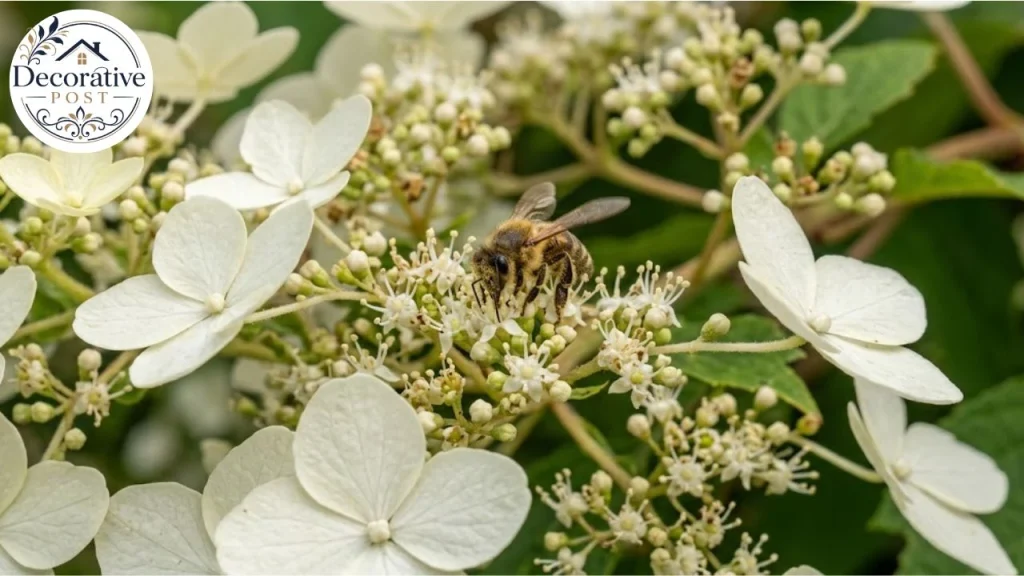
Look closely at a panicle, and there are two kinds of flowers. The large showy ones that make the display are sterile. The tiny inconspicuous ones tucked among them are fertile.
The fertile florets are what pollinators come for. Native bees, syrphid flies, es and honeybees all work these flowers, and they are doing it on the parts most people never notice.
This is worth knowing if you are planting for wildlife. Cultivars bred for larger, denser sterile displays often carry proportionally fewer fertile florets, which makes them more spectacular and less useful ecologically.
‘Snowflake’, with its doubled sterile flowers, is the most dramatic and the least valuable to insects. The straight species and the more open cultivars are the better pollinator plants.
Being a North American native, it supports local insect populations in ways imported ornamentals often do not. Worth weighing alongside the aesthetics.
Cultivars, with their real sizes
Size is the specification that matters most when choosing an oakleaf hydrangea, because this is a shrub people routinely plant too close to a path or a house.
| Cultivar | Size | Notes |
|---|---|---|
| ‘Alice’ | Up to 12 ft tall and wide | Huge 12–14 inch panicles. A specimen shrub, not a border filler |
| ‘Snowflake’ | 4–6 ft | Doubled sterile florets, looser and wilder habit. The most ornamental, least pollinator-friendly |
| ‘Ruby Slippers’ | 3 ft tall, 5 ft wide | Compact and notably wide. Strong flower colour change to deep rose |
| ‘Pee Wee’ | About 3 ft tall and wide | 4–5 inch panicles. The choice for small gardens and containers |
Growth is slow to moderate, roughly one to two feet a year. That is a virtue rather than a drawback; these are shrubs that improve for decades rather than peaking in year three.
A practical rule when buying: take the stated mature width, and leave that much space from any path, wall or neighbouring shrub. A 12-foot ‘Alice’ planted three feet from a fence becomes an annual pruning problem, and pruning is precisely what costs you flowers.
Pests, diseases and the deer problem
Short list, with one entry that is a genuine deal-breaker.
Deer. This is the serious one. The species is not deer-resistant, and deer can completely defoliate a shrub. If you have grazing pressure, either fence it, treat it with repellent on a strict schedule, or plant something else. A defoliated plant also loses its autumn colour and its flower buds.
Aphids and spider mites. Occasional rather than routine. A hose blast handles most infestations; insecticidal soap deals with the rest. Mites favour hot, dry conditions, so a stressed plant in too much sun is more vulnerable.
Fungal leaf spot. Brown or purple blotches on foliage. Reduced considerably by keeping the leaves dry and improving airflow through the plant.
Powdery mildew. White dusty coating, usually in humid weather with poor air circulation. Same prevention:n thinning, spacing, root-level watering.
Remove and bin infected foliage rather than composting it. Fungal spores survive a domestic compost heap comfortably.
The same early-intervention principle that works for most garden pests applies here, and our guide to the Japanese beetle covers why dealing with the first arrivals matters far more than treating a population.
Propagating it
There are three ways to propagate an oakleaf hydrangea, in order of reliability for a home gardener.
Layering is the easiest and the most likely to succeed. Bend a l, low-growing,w flexible stem to the ground, nick the underside where it touches, pin it down, and cover with soil. Leave it a full season, and it roots while still attached to the parent. Sever and lift the following year.
Cuttings work well. Take softwood cuttings in early summer from non-flowering shoots, strip the lower leaves, and root in a free-draining mix with humidity. Rooting hormone improves the strike rate.
Seed is possible but slow, and seed should be sown promptly for decent germination. Named cultivars will not come true from seed, so this only makes sense for the straight species.
Layering costs nothing and needs almost no equipment, which makes it the obvious choice for most people. One parent plant becomes three or four over a few years.
Using it in a planting scheme
The shape and scale dictate how it is best deployed, and it is often placed badly.
It is a structural shrub, not a filler. Coarse bold foliage, substantial presence, and enough character to anchor a corner. Treat it as a small multi-stemmed tree rather than a bedding plant.
Give it space to be itself. The natural form is its main asset,t and clipping destroys it. Anything that needs annual shaping to fit is in the wrong place.
Pair it with fine foliage. The leaves are large and bold, so neighbouring plants with narrow or delicate leaves create contrast. Ferns, grasses, hostas and astilbe all read well beside it in part shade.
Position for the autumn colour. This is the thing people forget. The foliage is at its best in October and November, so a position where you see it from a window or along a path in low autumn light earns far more than one at the back of a border.
Use the winter bark. Place it where the exfoliating stems are visible from inside the house. A shrub that looks good in February from a kitchen window is worth more than one you only visit in July.
For a shaded corner, it works alongside the planting covered in our guide to May flowering; the hydrangea takes over as the spring material fades, and September flowering plants carry the display on once its panicles have browned.
In a container, the compact cultivars are viable. Use a pot at least 18 inches deep with genuine drainage, positioned where a front porch or entry gets morning light rather than afternoon glare.
Cut flowers and dried arrangements.
An underused quality, and the drying behaviour is unusually good.
Fresh cut. Take stems when the flowers are fully open and firm, early in the morning. They are thirsty;y cut the stem end at an angle and get them into water quickly, and the wilting problem covered in our guide to keeping hydrangeas from wilting applies to this species as much as any other. Some people split or crush the woody stem end to improve uptake.
Drying. This is where the species excels. Leave the panicles on the plant until they begin to feel papery, then cut and hang upside down in a dry,ry dark place with air movement. They hold their form for months.
Harvesting at the right stage matters more than the drying method. Cut too early, and they wilt rather than dry; too late and they shatter.
The ageing colour is the advantage: a panicle cut at the dusky pink stage dries to a muted rose-brown that is more interesting than anything white dries to.
Dried panicles work well in winter arrangements where fresh material is scarce, and our guide to table centrepiece ideas covers using dried stems alongside seasonal material.
Pruning for cut flowers is the same trap as any other pruning. Every panicle you take is wood that would have set buds. Taking a few is fine; harvesting heavily costs you the following year.
A year with it
Read this as a sequence rather than fixed dates, since timing shifts by several weeks across zones 5 to 9.
| Period | What to do |
|---|---|
| Late winter | Nothing. Resist tidying. The buds are on the plant |
| Early spring | Foliage emerges. Feed with compost or a balanced fertiliser |
| Mid spring | Mulch. Check for winter dieback and remove only dead wood |
| Late spring | First panicles open creamy white |
| Summer | Peak flowering. Water at the base in dry spells. Watch for mildew in humid weather |
| Immediately after flowering | The pruning window. Shape, thin,n and contain now, if at all |
| Late summer | Flower buds forming for next year. Stop feeding. Keep water consistent |
| Autumn | Foliage turns red and purple. Cut panicles for drying if wanted |
| Early winter | Leaves drop, revealing exfoliating bark |
The two entries that decide everything are the pruning window and late-summer watering. Those are the weeks when next year’s flowers are made.
Common mistakes
Pruning in spring. The central error, and the reason most non-flowering plants fail to flower.
Planting in full sun in a warm zone. Scorch, wilt,lt and stress, regardless of irrigation.
Planting in soil that holds water. Root rot is the main cause of outright death,ath and it cannot be reversed.
Buying ‘Alice’ for a small space. Twelve feet is twelve feet, and the resulting annual pruning removes the flowers.
Applying aluminium sulphate. It will not turn these blue. That mechanism belongs to a different species.
Overhead watering. Wet foliage invites leaf spot and mildew.
Feeding into late summer. Soft growth, frost damage, lost buds.
Ignoring deer pressure. They will strip the shrub, and the plant loses flowers, foliage colour, and buds in one visit.
Is it the right shrub for you?
Three questions settle it.
How much space do you genuinely have? Measure it, then choose a cultivar whose mature width fits. This decision prevents most of the problems above.
What is the light like, specifically in the afternoon? Morning sun with afternoon shade is the target. Full afternoon sun in a warm zone is the one condition this plant genuinely struggles with.
Do you have deer? If yes and you are not willing to fence or treat consistently, choose something else. This is not a shrub that tolerates browsing.
If those three answers work, this is among the most rewarding shrubs available to a temperate gardener: flowers that last months, autumn colour that rivals a maple, winter bark worth looking at, and a native plant that feeds local pollinators.
The oakleaf hydrangea asks for one thing in return, and it is restraint with the secateurs in March. Leave the bare twigs alone, prune the moment the flowers fade, and it will do the rest for decades.
FAQs:
When should you prune an oakleaf hydrangea?
Immediately after the flowers fade. The plant blooms on old wood and sets next year’s buds in late summer, so pruning in late winter or early spring removes the entire coming display. Dead wood can be cut out at any time.
Why is my oakleaf hydrangea not blooming?
Most often because it was pruned in spring, which removes buds formed the previous autumn. Other causes are too much shade, drought during late-summer bud formation, frost damage to buds, or deer browsing.
Do oakleaf hydrangeas change colour with soil pH?
No. Flower colour does not respond to soil pH in this species; that mechanism belongs to bigleaf hydrangeas. Oakleaf blooms open creamy white, age to dusky pink, and dry papery brown regardless of soil.
How big does an oakleaf hydrangea get?
Between 2 and 12 feet depending on cultivar, growing roughly one to two feet a year. ‘Alice’ reaches 12 feet tall and wide; ‘Pee Wee’ stays around 3 feet. Check the cultivar before buying.
How much sun does an oakleaf hydrangea need?
Morning sun with afternoon shade is ideal. Cooler climates tolerate more sun, which improves flowering and autumn colour, while in zone 7 and warmer full sun causes scorch and stress.
Are oakleaf hydrangeas deer resistant?
No. Deer can completely defoliate a shrub. If you have grazing pressure, fencing or consistent repellent use is necessary.
What zones do oakleaf hydrangeas grow in?
USDA zones 5 through 9. They are native to the southern United States and grow naturally in hardwood forests with moist, humus-rich soil.
Can you grow an oakleaf hydrangea in a pot?
Yes, using a compact cultivar such as ‘Pee Wee’ or ‘Ruby Slippers’ in a container at least 18 inches deep with good drainage. Water more frequently than in open ground and protect the pot from freezing solid in cold zones.