

A 1 washer dryer is a single machine that washes and dries in the same drum, with no load to move and, in most models, no vent to cut through a wall. It is a space-saver first and a laundry machine second.
The catch is capacity. Most combos can dry only about half the load they can wash, and a full wash-and-dry cycle commonly takes three to five hours. Whether that is a fair trade depends almost entirely on how much laundry your household produces.
For one or two people in a flat, a condo, or a house with no vent route, it can be the right answer. For a family doing a load a day, it is usually the wrong one.
Reading the keyword correctly
People who search for a 1 washer dryer mean at least three different things. Some want one appliance that does both jobs. Some want a washer and a dryer sold as a matched pair. Some want the two units stacked on top of each other.
This article is about the first: a single drum, a single door, a single cycle from dirty to dry. If you want two machines in one footprint, that is a different product, and the guide to stackable washer dryers covers it, including the installation headroom problem that combos avoid entirely.
The word “combo” matters because it is the label you will see on retail pages. “All-in-one” is the same product wearing a friendlier name.
How one drum does both jobs
The washing half behaves like any front-loading machine. Clothes tumble, rinse,e and spin, and the quality of the wash is comparable to a standalone front-loader.
The drying half is where the engineering gets interesting, and it comes in three forms.
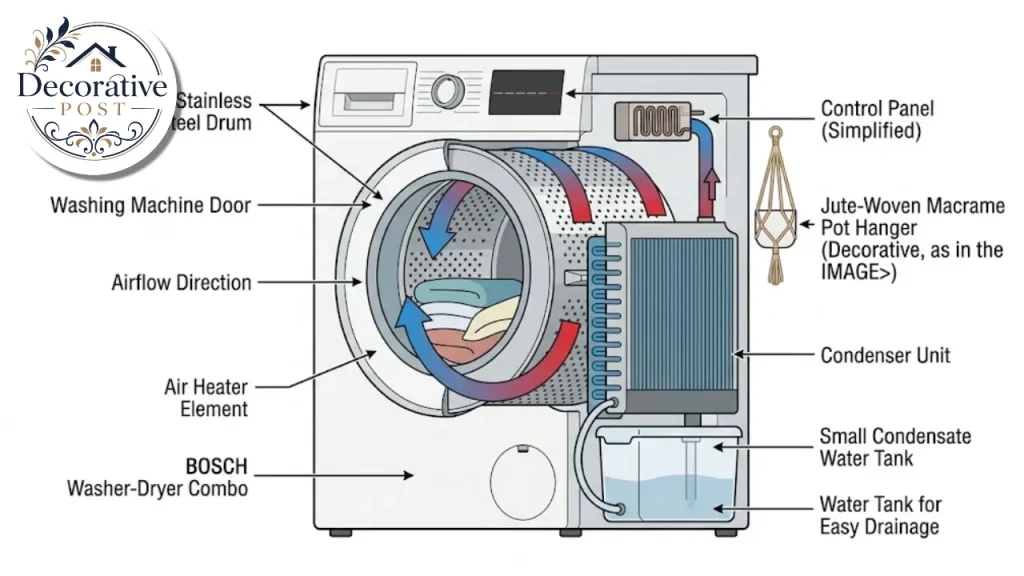
A condenser combo heats air, passes it through the wet clothes, then cools that air so the moisture condenses out. The water is either drained away or collected in a tank. Because the air recirculates, nothing leaves the building, so no vent is needed.
A heat pump combo does the same job with a refrigeration loop, much like a dehumidifier. It dries at lower temperatures, uses no water to condense, and is more energy-efficient, but it is slower than a vented dryer.
A vented combo works like a traditional dryer. An internal heater and fan warm the air, and the moist air leaves through an exhaust duct. It is faster, but it needs a vent route and, in the US, a 240-volt outlet.
Most combos you will meet are ventless. That is the reason they exist for renters and condo owners who cannot cut a duct hole.
The capacity trap
This is the single most important number on the spec sheet, and the one least likely to be on the front of the box.
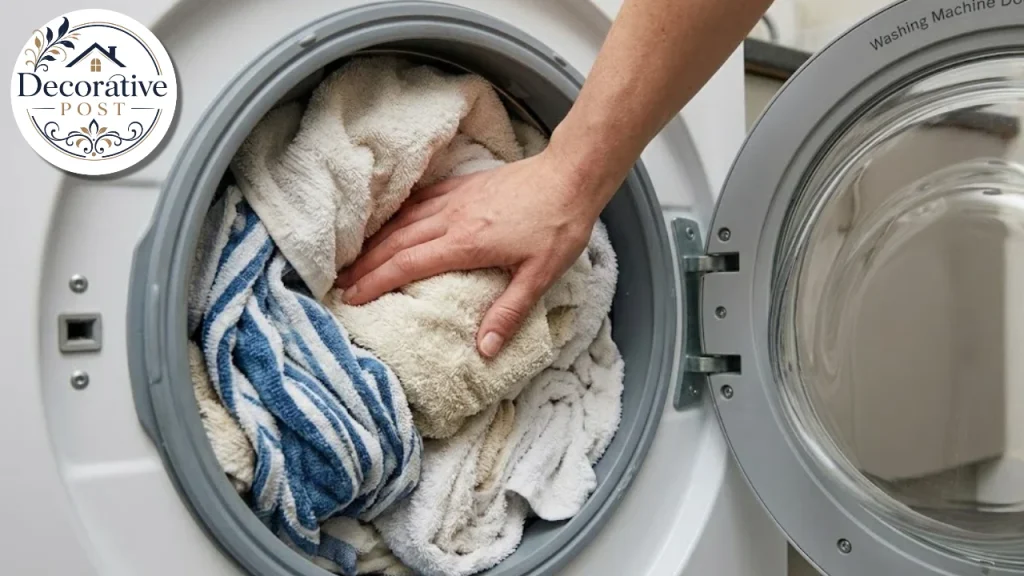
A combo can usually wash roughly twice as much as it can dry. Drying needs air to move through the clothes, so the drum cannot be packed the way it can for washing. A full wash load therefore has to be split in two before it is dried.
One repair guide recommends filling the drum to 50 to 70 percent of its wash capacity for wash-and-dry cycles. CHOICE, the Australian consumer testing body, says the same thing from the other direction: most combos dry about half what they wash.
Drum sizes vary. Typical ventless front-loading combos hold about 2.4 to 2.7 cubic feet. Larger newer models reach 4.8 cubic feet for the GE and Whirlpool ventless units, and 5.3 for Samsung’s Bespoke combos.
Manufacturers rarely print the dry capacity separately, so read the manual rather than the headline figure. A “5.3 cubic foot” label describes the wash drum.
Here is the practical translation. A single person with a mixed week of clothes will rarely notice. A household washing towels and bedding will hit the limit every time.
How long it actually takes
Time is the other half of the trade, and sources disagree enough that you should plan for the long end.
Samsung’s own figures for a 10-pound test load are 68 minutes for its vented combo and 98 minutes for its ventless one, against about 120 minutes for the GE ventless model. Those are manufacturer test conditions with a small load.
Independent and repair-trade sources land higher. A full wash-and-dry cycle commonly takes three to five hours, or three to six in another review. The drying portion alone is two to three hours, and CHOICE reports some models taking up to 13 hours.
The strongest lever you have is spin speed. Selecting the highest spin removes more water before drying starts, which shortens the heated part of the cycle.
The back-to-back problem
A combo cannot start a new wash while it is still drying the last load. With separate machines, load two is washing while load one dries. With a combo, everything runs in sequence.
Here is what that looks like across a week. Five loads at four hours each is twenty hours of machine time, all of it in one drum. With a washer and a dryer running in parallel, the same five loads can finish in well under half that.
This is why a combo that feels fine for one person feels like a bottleneck for four. The machine is not slower per load. It is simply unable to overlap them.
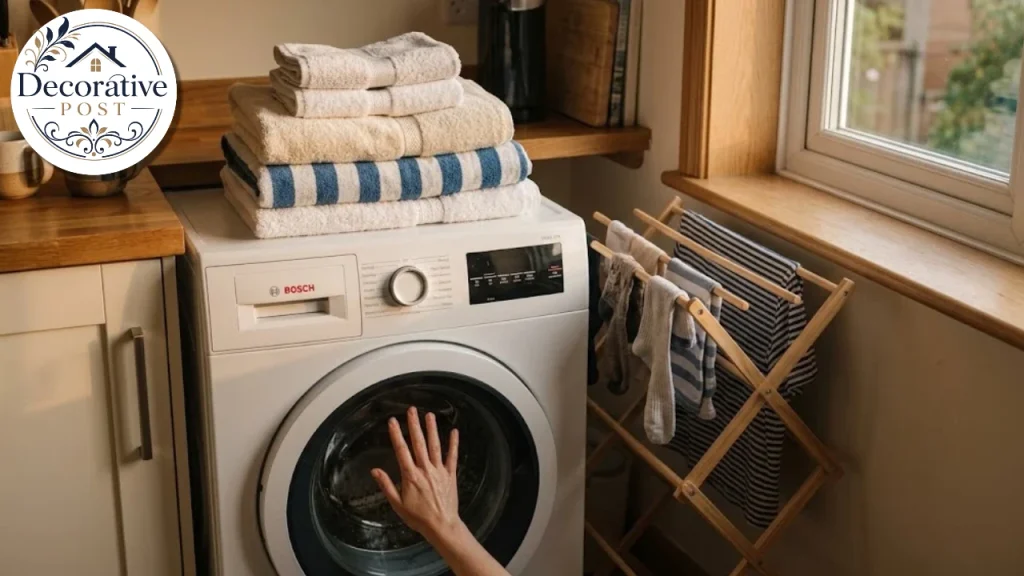
Some owners solve it by running wash-only cycles in bulk and drying selectively, or by air-drying the bulky items. Combos allow wash-only and dry-only cycles separately, which is genuinely useful for hand-washed items and for things that go outside to dry.
A realistic week, worked through
Numbers make the capacity problem concrete, so here is a simple illustration. It is arithmetic, not a case study.
Take a two-person household that washes four loads a week: two of everyday clothes, one of towels and one of bedding. Assume the drum washes 10 pounds and dries about half that.
The clothes loads are fine, since they are light and fit inside the dry limit. The towels and the bedding are the problem. Each is heavy when wet, and each needs splitting into two dry batches.
That turns four wash loads into six dry cycles. At three to five hours for a combined cycle, the week now holds well over twenty hours of machine time, and the machine cannot be used for anything else during it.
Nothing is broken in that picture. This is what a 1 washer dryer is designed to do, and it is why the same machine feels generous to a person living alone and cramped to a couple with a baby.
Energy and water, with the numbers that disagree
You will see wildly different energy claims, and it is worth knowing why.
CHOICE found that on a cold wash, a condenser combo uses roughly ten times as much energy to dry as it does to wash. Its overall energy use is comparable to a standalone front-loader paired with a condenser dryer.
Family Handyman says ventless units use as little as 40 percent of the energy of conventional ones. Samsung says its AI Energy Mode can cut energy use by up to 30 percent, from its own testing with an 8-pound load.
These are not contradictory so much as different comparisons. Against a vented dryer, a heat pump combo saves energy. Against a separate condenser dryer, a condenser combo roughly breaks even. Against a clothes horse, nothing beats air.
On water, expect 13 to 17 gallons per wash cycle, plus 1 to 3 gallons for condensation cooling on condenser models. Heat pump models skip that last figure. Note that the water used for drying is usually not counted in the efficiency rating, which covers washing only.
The sensible reading: if you dry regularly, a heat pump model is the better buy. If you dry only occasionally, the difference barely matters.
Heat pump or condenser, in plain terms
The choice matters more than most buyers realise, because it decides both the running cost and what the dry cycle does to your clothes.
A condenser combo heats air hotter and cools it with water, so it uses more energy and a little water for every dry. It costs less up front, and it is the right call if you dry only now and then.
A heat pump combo reuses its own heat, dries at lower temperatures,s and uses no water to condense. It is gentler on fabric and cheaper to run, but slower and several hundred dollars dearer.
The break-even is how often you dry. If the answer is most weeks, buy the heat pump. If it is a few times a month, the condenser will probably never repay the difference.
Who it suits
A 1 washer dryer fits small households best. One or two people, a flat or condo with limited floor area, and laundry that is mostly everyday clothes.
It also suits renters and owners without vent access. A ventless combo needs hot and cold water, a drain shared with the washer, and a standard 120-volt grounded outlet. A GFCI receptacle is recommended. No duct, no 240-volt circuit.
Mobility is an underrated reason. Never moving wet laundry from one machine to another removes a physical task, and for some people that alone justifies the choice.
It can also be the better answer in places where a vented dryer is a fire-safety concern, since there is no lint-filled duct to clean.
Who should skip it
Large households. A family generating several loads a day will find the sequential cycle unworkable.
Anyone with bulky bedding, towels, or heavy fabrics as a regular load, because those are the loads that exceed the dry capacity first.
Anyone who dries almost everything outdoors or on a rack. Line drying is cheaper and faster, and a combo is then just a washer with a feature you do not use.
Anyone who needs gas drying. Combos are generally available only as electric, ventless units.
What the spec sheet should tell you
Before you compare prices, find these five things.
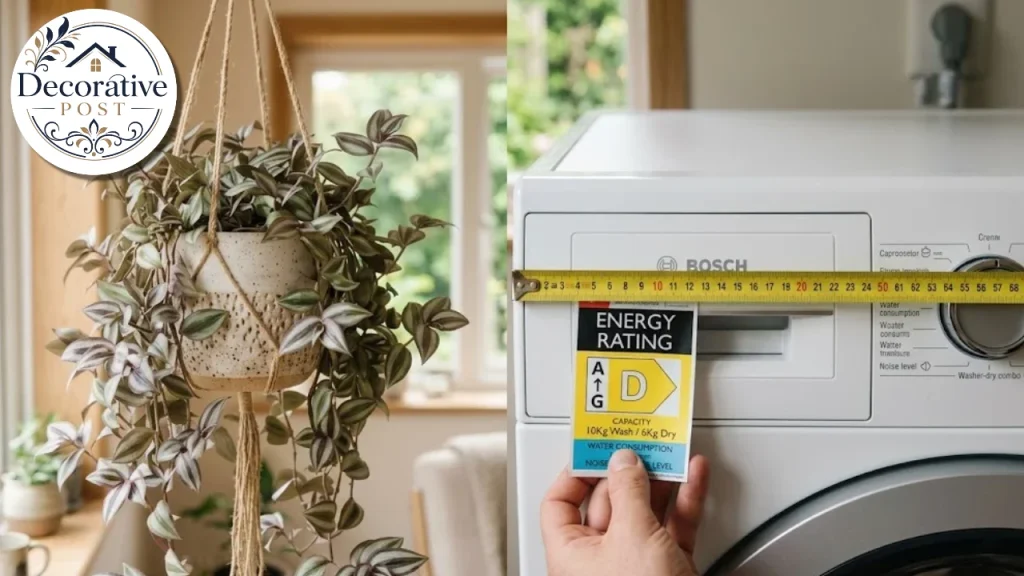
The separate drying capacity, in pounds or kilograms, not just the drum volume. The drying method: condenser, heat pump, or vented. The electrical requirement: 120 volts for ventless, 240 volts for vented. The physical size. And whether the manufacturer publishes a combined wash-and-dry time for a stated test load.
On size, Samsung’s two Bespoke combos measure 27 inches wide, 34½ deep,p and 43¾ high. The GE ventless is 28 wide, 32 deep, and 46.7 high. Both fit a standard under-counter or closet footprint with room to spare for hoses.
On price, heat pump models run roughly $500 to $1,000 more than condensation-only ones, and premium units such as Miele start around $2,000. Purchase and running costs for a combo are broadly similar to a separate front-loader plus a condenser or heat pump dryer.
Questions to ask before you buy
Retail staff often know the drum volume and little else, so arrive with specific questions about a 1 washer dryer.
What is the dry capacity in pounds, separately from the wash capacity? How long does the combined cycle take on a normal load, not the shortest test cycle?
Is the dryer a condenser, a heat pump, or vented? Does it need 120 or 240 volts, and is a GFCI outlet required? Does the box include the water and drain hoses?
What does the warranty cover on the drum, the compressor,r and the door seal, and for how many years? Is there a technician in your area who services this brand?
The last question matters more than it sounds. A combo that fails leaves you without both washing and drying, so local repair availability is part of the price.
Where it can go
A combo’s greatest strength is placement. It needs a water supply, a drain, and an outlet, which opens up rooms a vented dryer never could.
A kitchen corner works well, with the machine tucked beside a run of cabinetry. The wall behind it takes splash and steam, so the same logic that governs a kitchen backsplash applies, especially sealed, wipeable surfaces at the water connections.
A bathroom alcove is the other common choice, and the small bathroom vanity layout guide helps with the clearance questions that come up when a laundry appliance shares a wet room.
A hall closet is the compact option. Built-in shelving above and a deliberate door treatment make it read as a utility cupboard rather than an appliance, and the approach to custom built-ins carries over directly.
A basement works too, with one caveat. Combos add humidity to the room they live in, so a space already managing moisture needs the right drainage and ventilation first, which is the order the basement finishing sequence recommends.
Installing it properly
Every new unit ships with transit bolts, usually three or four, that lock the drum for the journey. They must come out before first use. A machine run with the bolts in will shake itself apart.
Level the machine carefully and recheck it every six months. A combo works the drum harder than a standard washer, because the drying heat and the tumbling are in the same housing.
Check the water line and drain hose, which are usually not included in the box. A kinked drain hose is one of the most common faults, and the pump has to handle both wash and condensation water, so it works harder than a standalone washer’s.
Give the door room to swing fully open and plan to leave it ajar between cycles, which brings us to the maintenance problem.
The upkeep nobody mentions
A combo is a washing machine that is also warm and humid, which is a recipe for mould if neglected. The routine is short, but it has to happen.
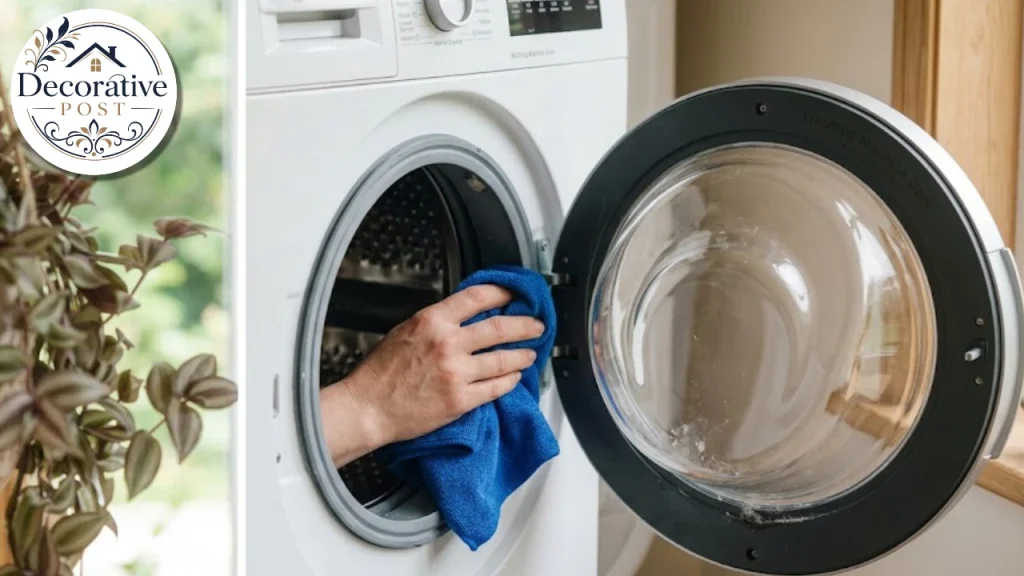
After every use, leave the door ajar and wipe the gasket folds. Moisture trapped in the rubber seal is where odour starts.
Every week, empty pockets before washing and use HE detergent only. Wipe the gasket folds as well.
Every month, clean the drain filter and the condenser. Lint coating the condenser, or a partly blocked condenser drain, is the most common cause of drying performance dropping off.
Then run a hot cleaning cycle with a machine cleaner, or the vinegar your manual permits. Some manufacturers advise against vinegar on rubber seals, so check before you pour.
Every six months, inspect the drain hose for kinks, check the inlet connections for leaks, and confirm the machine is still level.
If a musty smell appears despite this, the underlying problem is the same one covered in the shower mould guide: a warm, damp, sealed space that never gets to dry. Ventilation and air gaps solve it.
Using it well
A few habits make the difference between a machine that works and one that frustrates.
Fill it to 50 to 70 percent of the wash capacity for wash-and-dry cycles. Overloading is the single most common cause of damp clothes.
Choose the highest spin your fabrics tolerate. Less water entering the dry phase means less time spent drying.
Dry like with like. A mixed load of towels and a shirt dries unevenly because the machine stops when its sensor reads the average as dry.
Pull delicates and anything with elastic out before drying, and air-dry them. Heat shortens the life of both.
And take stains seriously. Drying heat can set a stain permanently, which is the same reason the candle wax on fabric guide warns that the wrong heat step makes dye worse. Check a garment after the wash phase and before the dry phase if there was any doubt.
Lifespan and repairs
A 1 washer dryer tends to wear out sooner than separate machines. Estimates for combo units run 8 to 12 years, against 12 to 14 for separate washers and 13 to 15 for dryers. One review puts ventless combos at 8 to 10 years.
The reason is simple. One drum, one set of bearings, and one door seal do the work of two machines, and the drying heat is hard on the seal.
The usual failure points are the condenser or its drain, the drain pump, the door gasket, the heating element or heat pump compressor, and the drum bearings. Heat pump models add compressor and refrigerant problems that reduce drying before they stop it altogether.
One repair shop’s guidance is worth keeping in mind. Repair if the cost is under 35 percent of replacement. On a standard model, consider replacing when the repair goes past $400.
Because a combo is one machine, a failure leaves you with no washing and no drying. Households that cannot afford a week without laundry should factor that in.
Combo, separate machines, or stacked
Think of it as three answers to the same space problem.
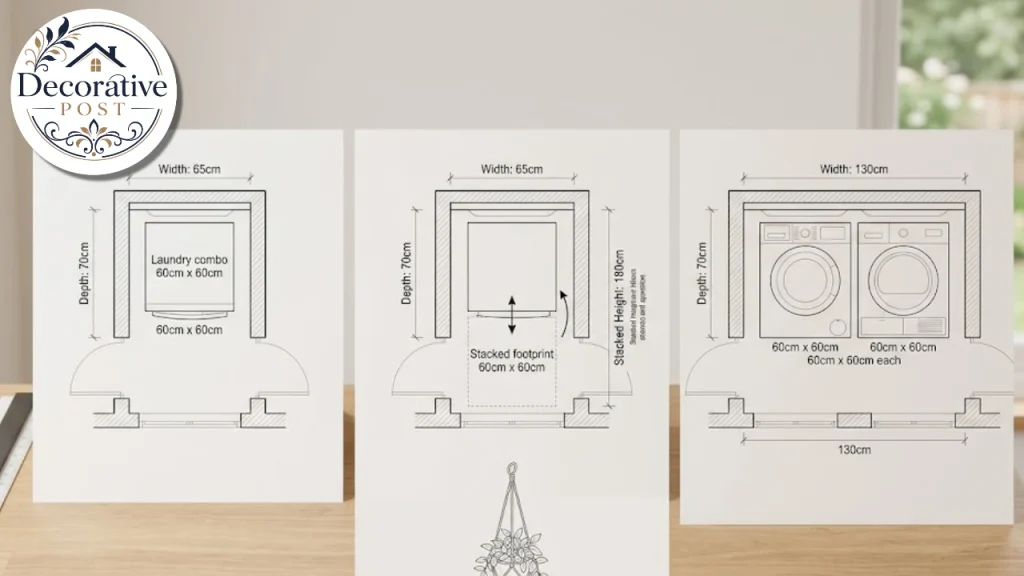
A combo gives you the smallest footprint and the most flexible placement, with slow drying and limited capacity.
A stacked pair gives you full-capacity separate machines in about the same floor area, at the cost of vertical clearance, a model-specific stacking kit, and a vent.
A side-by-side pair gives you the best capacity and parallel loads, and needs the most room.
If floor area is the constraint and you wash small loads, choose a combo. If ceiling height is generous and you wash large loads, choose a stack. Be honest about which describes you.
The mistakes that cost the most
Buying on the headline drum size and discovering the dry capacity is half of it.
Overfilling the drum, then wondering why everything is damp.
Forgetting the transit bolts.
Skipping the monthly condenser and drain filter clean, then blaming the machine when drying slows.
Closing the door tight between cycles.
Expecting a combo to dry a family’s laundry in a day.
Choosing a condenser model for heavy drying when a heat pump costs less to run.
Ignoring the 120-volt versus 240-volt distinction before ordering.
What to take from it
A 1 washer dryer is a well-defined tool. It trades speed and capacity for floor space and placement freedom, and it is excellent at that trade.
If your laundry is light, your space is tight,t and you can live with a long cycle, it will serve you well for most of a decade. If your laundry is heavy, you will spend the same decade watching a drum.
The test is simple. Count your loads in a normal week, halve the biggest ones, and ask whether the machine could finish them all in a day.
FAQs:
What is a 1 washer dryer?
A single machine that washes and dries in the same drum. It is also sold as a washer-dryer combo or all-in-one, and most models are ventless, so no outside duct is needed.
Does a combo dry as well as a separate dryer?
Generally no. CHOICE says combos do not match a standalone dryer, and Tom’s Guide lists damp clothes as the biggest drawback. Heat pump models are gentler on fabric but slower.
How long does a wash-and-dry cycle take?
Commonly three to five hours, and up to six in some reviews. Manufacturer tests with a 10-pound load show 68 to about 120 minutes, but those are small-load conditions.
How much can it dry compared with how much it washes?
Usually about half. Fill the drum to 50 to 70 percent of its wash capacity for a wash-and-dry cycle.
Does a washer dryer combo need a vent?
Ventless models do not. They need hot and cold water, a drain, and a standard 120-volt grounded outlet. Vented combos need an exhaust duct and a 240-volt outlet.
Is a heat pump combo worth the extra cost?
If you dry regularly, yes. Heat pump models cost roughly $500 to $1,000 more but use far less energy than condenser ones, and they dry at gentler temperatures.
How long does a washer dryer combo last?
Estimates run 8 to 12 years, against 12 to 14 for a separate washer and 13 to 15 for a separate dryer.
Why does my combo smell musty?
Trapped moisture, usually in the door gasket folds. Leave the door ajar after every use, wipe the gasket, and run a monthly hot cleaning cycle with a machine cleaner.
Can I run a wash without drying?
Yes. Most combos allow wash-only and dry-only cycles, which suit hand-washed items and anything you want to air-dry.