

Most people treat dirty windows as a cosmetic problem that can wait until next spring. For the most part, that is true.
There is one exception, and it is the reason this article exists. If your windows are being hit by sprinkler spray or runoff from unsealed concrete, the minerals in that water work into the microscopic surface of the glass.
Leave it long enough and the staining becomes permanent etching at which point no cleaning product, no professional, and no amount of money fixes it. The glass gets replaced.
That is the one deadline in an otherwise flexible job. Everything else in here is about getting good work at a fair price.
The short answer
Professional window cleaning services typically run $8 to $40 per window, with most homes landing between $100 and $500 for a full interior and exterior clean.
Expect roughly $4 to $8 per pane, or $10 to $15 for an average window. Upper storeys add $3 to $5 each. Screens, tracks and storm windows are usually priced separately.
Twice a year suits most homes. Get three written quotes, confirm insurance, and get the scope in writing before anyone brings a ladder.
What it actually costs
Published cost data puts window cleaning services at $8 to $40 per window, with the spread driven almost entirely by window type, height and condition.
| Window count | Typical total |
|---|---|
| 5–6 windows | $100 – $120 |
| 8–10 windows | $160 – $200 |
| 13–15 windows | $260 – $300 |
| 18–20 windows | $360 – $400 |
| 23–25 windows | $460 – $500 |
The per-window figure varies more than most people expect, and it is worth knowing why before you read a quote.
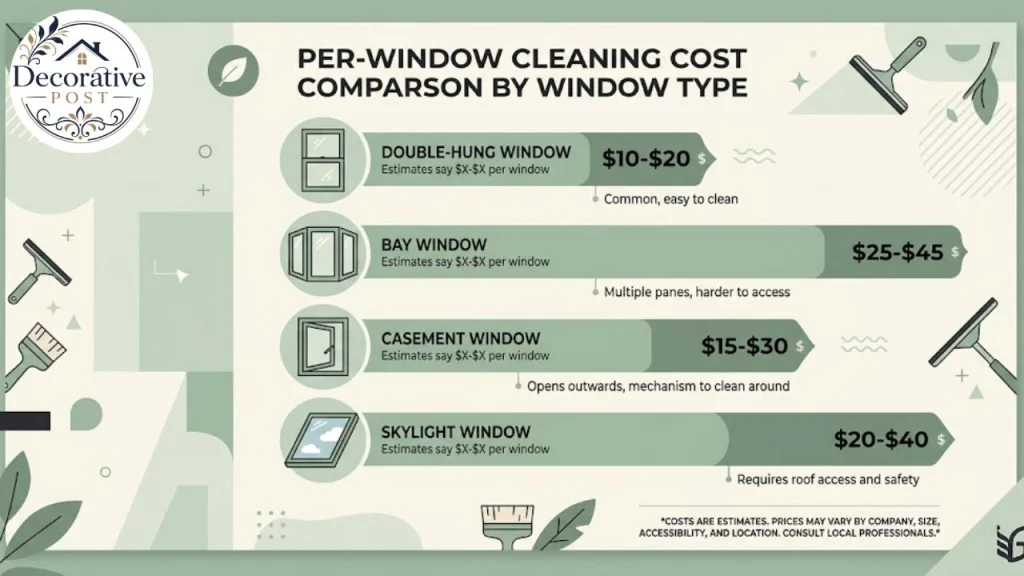
| Window type | Per window |
|---|---|
| Double-hung or single-hung | $8 – $16 |
| Bay, bow or picture | $15 – $25 |
| Awning or casement | $15 – $30 |
| Skylights | $25 – $35 |
Skylights cost triple a standard window for obvious reasons they are on a roof, they need different equipment, and the consequences of a mistake are considerably worse.
Why exterior costs five times more than interior
This is the split nobody explains, and it reframes how you read a quote.
Exterior cleaning averages roughly $6.40 to $12.80 per window. Interior cleaning averages $1.60 to $3.20.
So the outside of your windows is four to five times more expensive than the inside, and the exterior work makes up most of any quote you receive.
The reason is access and conditions. Inside, a cleaner stands on a floor in controlled conditions with no weather and no height risk. Outside, they are on ladders, working around landscaping, dealing with baked-on mineral deposits, pollen, pollution and insect residue.
Two useful conclusions follow. If budget is tight, exterior-only is a legitimate request and will cost most of the full price anyway. And interior-only is cheap enough that adding it to an exterior job is rarely worth declining.
What raises the price
Quotes vary between companies for the same house, and these are usually the reasons.
Height. Anything above ground level adds roughly $3 to $5 per window. Third-storey work or anything needing lift equipment goes up sharply from there.
Hard water stains. Add $10 to $30. This is labour rather than product mineral deposits need scrubbing, soaking or chemical treatment rather than a squeegee pass.
Condition. Windows that have not been cleaned in years need two passes. Dried paint, rust runs and construction residue need scraping, which is skilled work and priced accordingly.
Access obstacles. Landscaping, air conditioning units, fencing, conservatory roofs, anything that has to be worked around or moved.
Historic or fragile glass. Older glazing needs gentler methods and sometimes different products. A good company will charge more and be right to.
The add-ons, priced separately
This is where quotes diverge most, and where people feel misled afterwards.
| Add-on | Typical cost |
|---|---|
| Screens | $5 – $10 per window |
| Storm windows | $30 – $40 per window |
| Sills and tracks | $0.05 – $5 per window |
| Window treatments | $2 – $7 per foot |
| Shutters | $25 – $100 per hour |
| Blinds | $150 – $350 per home |
| Curtains | $120 – $300 per set |
Storm windows are the one that catches people out. At $30 to $40 each they can cost more than the window behind them, because they have to be removed, cleaned on both sides, and refitted.
Screens are the second. Many quotes exclude them entirely, and a house cleaned without its screens cleaned looks noticeably unfinished.
Ask explicitly whether frames, sills and tracks are included. Some companies treat them as part of the job; others itemise them. Neither is wrong, but you need to know which you are buying.
Hard water: the part with a deadline
Here is the thing worth acting on, and almost no consumer-facing page about window cleaning services explains it properly.
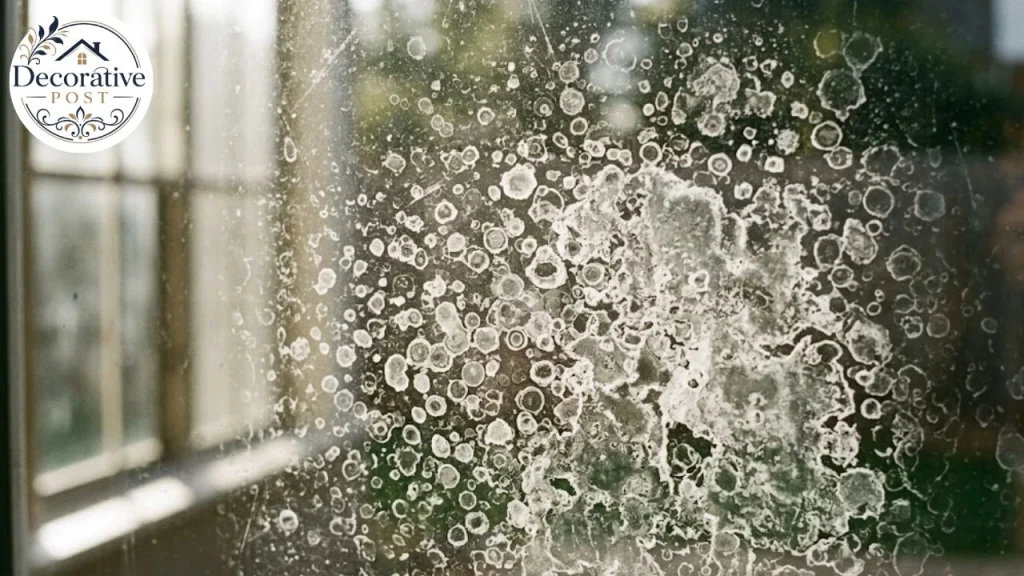
Hard water staining is not dirt sitting on glass. Minerals work into the microscopic crevices in the glass surface, which is why ordinary cleaning does not shift them and why they get worse rather than plateauing.
Left uncorrected long enough, the staining becomes permanently etched into the glass. At that point restoration no longer works and replacement is the only option.
Where the minerals come from:
Irrigation sprinklers spraying mineral-rich water onto windows is the most common residential cause, and the most preventable.
Runoff from unsealed concrete or precast façades, which absorb moisture and release minerals onto nearby glass.
Ageing steel or aluminium frames releasing oxides.
Proximity to major roads or airports, where pollutants contribute to acid rain.
Infrequent cleaning, which simply allows deposits to build.
What restoration involves. A specialist either removes the deposits with a non-acidic rubbing compound or burns them off with an acidic cleaner. Both are aggressive, expensive, time-consuming, and intended as one-time applications repeated treatment damages glass.
A reputable contractor tests a small area first to judge whether restoration will work at all.
Fix the source first. Restoring the glass without addressing the sprinkler or sealing the concrete means the staining returns. Adjust the sprinkler heads. It takes ten minutes and prevents a four-figure problem.
If you have visible white spotting that does not wipe off, get it looked at this season rather than next. That is the one genuinely time-sensitive thing in window maintenance.
Traditional squeegee or water-fed pole
Most window cleaning services use one of two methods, and companies will advocate for whichever they own.
Traditional. Soap solution, scrubber, rubber squeegee, detail cloth for edges. A clean squeegee used with good technique leaves no streaks, and for interior work it remains the standard.
The advantage is contact. The cleaner is at the glass, can see what they are doing, and can scrape localised marks as they find them.
Water-fed pole with purified water. Water is filtered to remove minerals, then applied through a brush head on a telescopic pole from the ground. Because the water contains nothing to leave behind, the glass dries spot-free with no squeegeeing.
The advantages are safety and reach. Upper-storey windows get cleaned without a ladder, which removes the single biggest risk in the trade. No chemicals are involved.
The trade-off is that the cleaner is not at the glass and the windows dry rather than being wiped, which some people dislike on ground-floor windows where they can inspect the result closely.
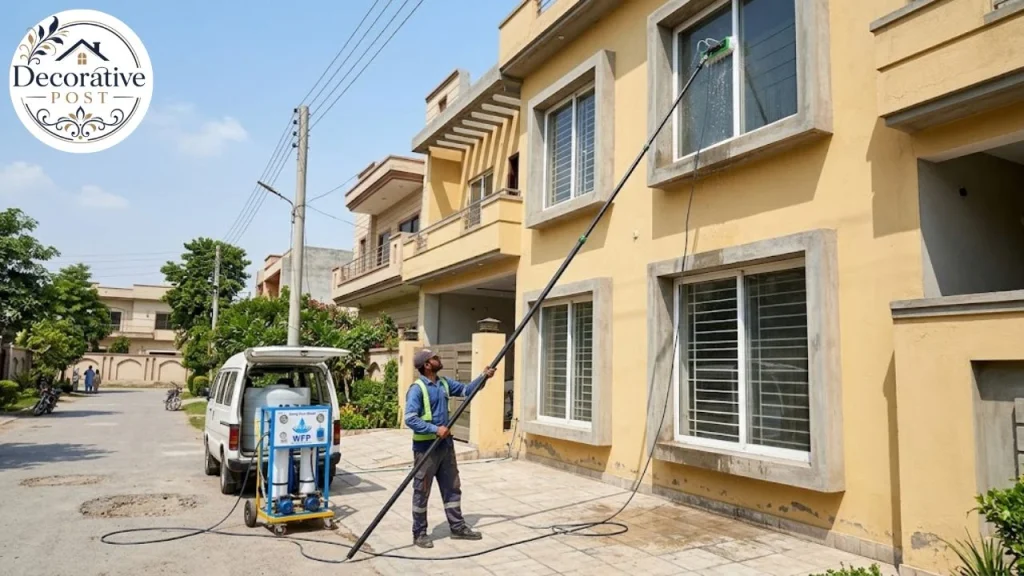
Most good companies use both pole systems for height, traditional for interiors and reachable glass. A company that insists one method is universally superior is selling its equipment rather than assessing your house.
The ten questions to ask
Work through these before signing anything. The answers separate real window cleaning services from a man with a bucket.
Are you licensed and insured? Ask for proof of general liability and workers’ compensation. Hesitation here is the clearest red flag in the trade.
How long have you been doing this, and on houses like mine? Three-storey Victorian glazing is not the same job as a single-storey new build.
What exactly is included? Interior, exterior, frames, sills, tracks, screens. Get it listed.
What method and products do you use? You are checking that they have an answer, not grading it.
How will you reach the high windows safely? Ladders, poles, lifts, harnesses. Mention of OSHA or industry safety standards is a good sign.
How often do you recommend for my situation? A company that says four times a year for an ordinary house is upselling.
How is it priced, and is the estimate free? Per window, per pane, or flat rate. All are fine; vagueness is not.
Can you provide references? Recent and local, not a testimonial page.
Do you offer a satisfaction guarantee? A free re-clean for streaks or missed spots is the industry norm.
Will I get a written agreement? It should cover scope, price, cancellation, rescheduling and weather delays.
Insurance, and why it is not a formality
The question people skip, and the one with the largest downside.
Window cleaning involves ladders, height and glass. If an uninsured worker falls on your property, you may be liable for their medical costs. If they break a window or damage a frame, you absorb it.
Two separate coverages matter. General liability covers damage to your property. Workers’ compensation covers injury to their staff. A company may carry one and not the other.
Ask for a certificate of insurance rather than a verbal assurance. Legitimate companies produce it immediately because they are asked constantly.
Also ask directly about the damage policy. A responsible company covers damage it causes and will say so plainly.
Red flags
Patterns worth walking away from.
Reluctance to show documentation. The single most reliable warning sign.
A bid substantially below the others. Usually means no insurance, corner-cutting, or a quote that will grow once work starts.
Vague scope. “We’ll do the windows” is not a scope. Which windows, which surfaces, screens or not.
Verbal-only agreement. Fine for a neighbour, not for a company on a ladder above your patio.
No guarantee. If streaks appear after they leave, you want a stated remedy rather than a conversation.
Review patterns. One bad review is noise. Repeated complaints about missed spots or property damage are data.
How often windows actually need cleaning
The honest answer, which is less than most companies suggest.
Twice a year suits most homes. Spring and autumn is the usual rhythm, and published guidance supports this as sufficient for the majority of households.
Late spring is the better of the two dates, once pollen has finished. Cleaning mid-pollen means doing it again.
Three times a year or more is justified in specific circumstances: coastal properties with salt spray, homes beside busy roads, properties with sprinklers hitting the glass, or anywhere hard water staining is already appearing.
Quarterly is commercial frequency. For a house it is usually unnecessary unless appearance is doing a job a property for sale, a holiday let between guests, or a home used for business.
Weather matters more than the calendar. An overcast day is better than bright sun, because sun dries the solution before it can be squeegeed and causes exactly the streaking you are paying to avoid.
Seasonal timing, and what it saves you
When you book matters more than people assume, both for the result and the price.
Late spring, after pollen drops, is the single best residential window. Cleaning mid-pollen means a visible film within a fortnight and a job you paid for twice.
Early autumn is the second slot, clearing summer dust and insect residue before the light gets low and you start noticing every streak.
Avoid booking in bright midday sun. Solution dries on the glass before it can be squeegeed, which causes exactly the streaking you are paying to prevent. An overcast day genuinely produces a better result.
Winter is viable in mild climates and a poor idea where it freezes. Water on glass below freezing is a safety problem on the ground as much as a quality problem on the pane.
Shoulder seasons are cheaper. Most companies are busiest in late spring and early summer. Booking in early spring or mid-autumn often gets you a better rate and a more flexible slot, simply because the diary is emptier.
If you have a specific date in mind a party, a viewing, guests arriving book two weeks ahead of it rather than two days. That buffer leaves room for a weather delay without wrecking your plan.
What you can do yourself, and what you shouldn’t
A reasonable division of labour.
Worth doing yourself: ground-floor interiors, tracks and sills, screens if you can remove them easily. None of it requires skill, and it reduces what you pay for.
Interiors in particular are cheap to have done but also genuinely easy. A microfibre cloth and a squeegee handle most of it.
Not worth doing yourself: anything requiring a ladder above single-storey height. This is the one that matters, and it applies equally to anything else at that height the warnings in our guide to balcony railings come from the same place.
Falls from ladders are the main source of serious injury in this work, which is precisely why professional operations have moved toward water-fed poles. A homeowner on an extension ladder, reaching sideways, holding a bucket, is the worst version of that risk.
Genuinely not DIY: hard water stain removal. The chemicals are aggressive, the technique matters, and a botched attempt can permanently damage the glass you were trying to save.
If you are working through the rest of the house anyway, the same seasonal logic covered in our guide to smart home maintenance applies here the jobs that are easier done before you need them.
Getting the most from the appointment
Small preparations that change the outcome.
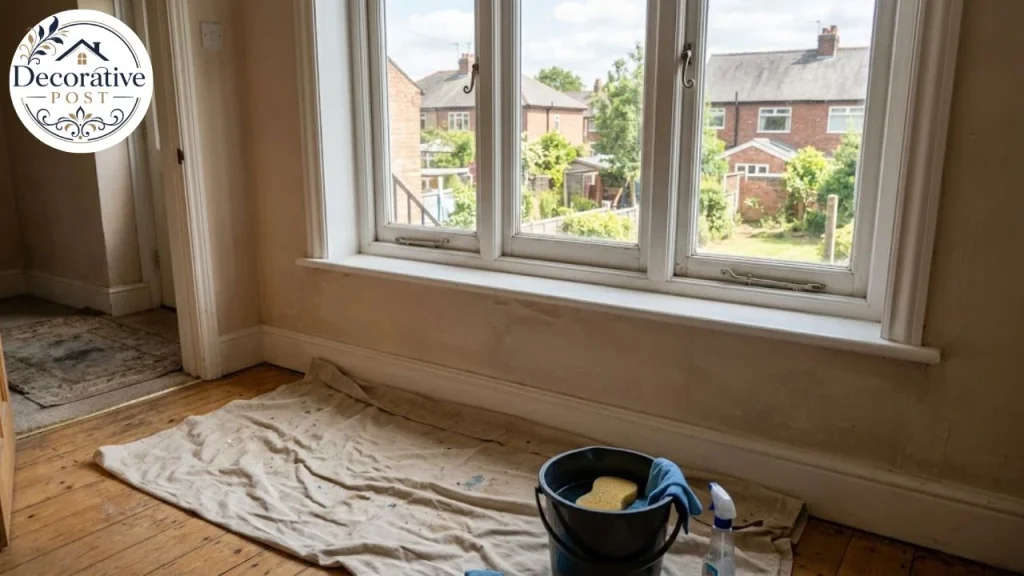
Clear the sills. Ornaments, plants and framed photographs on interior sills slow the job and create breakage risk. Move them the night before.
Move furniture back from windows. A cleaner needs working room, and a sofa pushed against a bay window means the job gets done awkwardly.
Unlock and unstick. Windows that need to be opened for frame or track access should actually open. Painted-shut sashes are a common delay.
Secure pets. Doors open repeatedly during interior work.
Hard floors beneath interior windows are worth protecting too, since solution does drip our guide to cleaning hardwood floors covers what water sitting on a finish actually does.
Point out the problem spots. The paint speck, the sap mark, the one that never comes clean. A cleaner who knows about it beforehand can bring what it needs.
Be around for the walkthrough. Ten minutes at the end, checking the work in daylight, is when problems get fixed for free.
Clear the exterior route. Garden furniture, hoses, bins and bicycles against the wall all have to be moved by someone. A front porch full of planters is the usual culprit, and moving them yourself is faster than paying someone to do it.
What good work looks like
How to inspect it before the van leaves.
Look from an angle, not straight on. Streaks are nearly invisible head-on and obvious at thirty degrees. Move your head.
Check in daylight, not evening. Low sun reveals every flaw, which is why you want to inspect before they leave rather than at six the next morning.
Check the edges and corners. This is where rushed work shows. The centre of a pane is easy; the perimeter takes care.
Check the sills for drips. Dried solution on a painted sill is a sign of a cleaner who did not detail.
Check inside and out on the same pane. It is easy to attribute an exterior streak to the interior and vice versa.
Check the frames. Solution left to dry on uPVC or painted frames leaves marks, and on older timber it can lift paint.
If something is wrong, say so immediately. Every reputable company would rather re-do a pane on the spot than receive a complaint a week later.
Commercial window cleaning, briefly
Commercial window cleaning services differ enough to be worth distinguishing, because pricing and frequency both change.
Commercial work is usually contracted on a schedule monthly, fortnightly, sometimes weekly for retail frontage and priced per visit at a lower per-window rate because of volume and repetition.
Higher buildings bring rope access, cradles and lift equipment, which require specialist certification and insurance well beyond residential cover.
Commercial glass also suffers more from the mineral problem described earlier, because large façades with unsealed concrete above them channel mineral-laden runoff directly onto the glass. For those buildings, the recommendation runs to exterior cleaning two to three times a year specifically to prevent etching.
If you are hiring for a shopfront or office, ask about scheduling flexibility around trading hours and whether they will work outside them.
When clean windows are not the problem
Worth saying, because people sometimes pay for the wrong thing.
Condensation between the panes is a failed seal in a double-glazed unit. No cleaning reaches it, because the moisture is inside the sealed cavity. That is a glazing repair.
Cloudiness that does not change when wet is usually etching or a degraded coating rather than dirt.
Scratches cannot be cleaned out. Light scratching can sometimes be polished by a glass specialist; deeper damage cannot.
A permanent haze on the inside of a window in a kitchen or bathroom is often accumulated cooking residue or hairspray, which needs degreasing rather than standard glass cleaning. Mention it when booking.
Dark patches at the edges of older glazing can be seal failure beginning. Worth having looked at rather than cleaned.
If you are unsure, send a photograph when requesting a quote. A good company will tell you honestly that cleaning will not fix it, and that honesty is a reason to hire them for the work it will fix.
Windows and the room behind them
Clean glass changes a room more than most decorating decisions, and for considerably less money.
The effect is light. Dirty windows cut visible transmission noticeably, and the loss is gradual enough that people stop registering it. A house after a first proper clean in several years looks repainted.
That is worth knowing if you are planning work. Clean the glass before choosing paint colours a north-facing room reads very differently through clean glass, and a colour chosen in dim light often disappoints afterwards. Our guide to how White Dove behaves in different light covers why that matters more than people expect.
It also affects what you put at the window. Heavy treatments on a window that is already short of light compound the problem; our bathroom wallpaper and wall decorating guides both come back to the same point about reflected light.
And if the glass is clean but the room still feels dark, the problem is usually layering rather than daylight the lamp-and-rug thinking in our cozy living room guide does more than another window ever would.
Choosing between three quotes
The practical method, once you have the numbers in front of you.
Normalise the scope first. Three quotes are only comparable if they cover the same windows and the same surfaces. Usually they do not, and the cheapest one has excluded screens.
Check the per-window maths. Divide each total by the window count. A figure well outside the $8 to $40 range in either direction warrants a question.
Weight insurance heavily. An uninsured quote is not cheaper, it is unpriced risk.
Ask about the hard water spots specifically. How each company answers tells you a great deal about their experience. “We’ll see how it goes” is a worse answer than “we’d test a corner first and tell you whether it will come out.”
Prefer written over verbal, always. Even a short email confirming scope and price is enough.
Do not automatically take the cheapest. The middle quote from an insured company with references beats the lowest quote from someone who cannot produce a certificate.
Hiring window cleaning services well is mostly a documentation exercise. The work itself is not complicated; the difference between companies is whether they are insured, whether the scope is written down, and whether they will stand behind the result.
Ask the ten questions, get it in writing, and adjust your sprinklers while you wait for the quotes. That last one is free and it is the only part of this with a deadline.

FAQs:
How much do window cleaning services cost?
Professional cleaning typically runs $8 to $40 per window, with most homes between $100 and $500 for a full interior and exterior clean. Expect around $4 to $8 per pane, or $10 to $15 for an average window, with upper storeys adding $3 to $5 each.
How often should windows be cleaned professionally?
Twice a year suits most homes, usually spring and autumn. Three or more times a year is justified for coastal properties, homes near busy roads, or anywhere sprinklers hit the glass and hard water staining is appearing.
Is professional window cleaning worth it?
For exterior and upper-storey windows, generally yes; the main risk in this work is falls from ladders, and professional crews have equipment that removes that risk. Ground-floor interiors are cheap to have done but also easy to do yourself.
Why does exterior window cleaning cost more than interior?
Exterior averages roughly $6.40 to $12.80 per window against $1.60 to $3.20 for interior. The difference is access, height risk, weather, and the baked-on mineral and pollution deposits that only accumulate outside.
Do window cleaners clean screens and tracks?
Sometimes. Screens typically add $5 to $10 per window, and storm windows $30 to $40, while sills and tracks may be included or itemised. Always confirm in writing which surfaces a quote covers.
Can hard water stains be removed from windows?
Early staining can often be removed by a specialist using a rubbing compound or acidic cleaner, both of which are one-time treatments. Once the minerals have permanently etched the glass, replacement is the only option, which is why acting early matters.
What is water-fed pole window cleaning?
Purified water is applied through a brush on a telescopic pole from ground level. Because the water contains no minerals, the glass dries spot-free without squeegeeing. It is safer than ladder work and better for upper storeys.
Should window cleaners be insured?
Yes, with both general liability and workers’ compensation. Without them, you may be liable for injury on your property or absorb the cost of any damage. Ask for a certificate of insurance rather than a verbal assurance.