

Wallpaper can do something tile and paint rarely manage on their own: give a bathroom a distinct personality before you add a single accessory. That makes bathrooms especially tempting places to use pattern. A plain powder room can become memorable with one oversized botanical.
A white family bathroom can feel warmer with a quiet block print. An awkward little room can suddenly look deliberate rather than leftover. The catch is moisture. The best bathroom wallpaper ideas therefore solve two problems at once.
They make the room look better, but they also respect where steam, splashes, condensation, and daily wear actually happen. Choosing the print is only half the decision. The material, placement, ventilation, wall condition, and surrounding finishes matter just as much. Here is how to get both sides right.
Can You Really Use Wallpaper in a Bathroom?
Yes, but “bathroom” covers several very different environments. A powder room containing only a toilet and basin creates far less humidity than a primary bathroom where two people take hot showers every morning. A children’s bathroom may have decent ventilation but far more water splashing around the sink and tub.
That difference should determine what you install. Vinyl-coated and solid-vinyl wallcoverings are commonly recommended for kitchens and bathrooms because they are more durable and washable than delicate untreated papers.
Wallpaper specialists also advise good ventilation and avoiding areas subject to constant direct water exposure. Think of wallpaper as suitable for a humid zone, provided the product is designed for it, rather than as an automatic substitute for tile inside a true wet zone.
An exhaust fan matters here for more than comfort. Adequate bathroom ventilation helps remove moisture and humidity from the room. If the mirror stays fogged for a long time after every shower, solve that moisture problem before hanging an expensive wallcovering.
Choose the Wallpaper for the Bathroom You Actually Have
Before looking at pattern, classify the room.
Powder room
This is the easiest place to be adventurous because there is no shower creating repeated clouds of steam. Traditional wallpaper, dramatic prints, murals, and more delicate finishes become realistic possibilities, assuming the manufacturer approves the application.
Guest bathroom with occasional showers
You have considerable freedom, but a washable, bathroom-suitable wallcovering is still the safer option.
Busy family bathroom
Durability starts to matter more than novelty. Look at vinyl, vinyl-coated, washable, or otherwise manufacturer-rated moisture-resistant options.
Children’s bathroom
Treat the lower wall as the danger zone. Tile, beadboard, or durable paneling below with wallpaper above can give you pattern without placing vulnerable seams where splashes occur constantly.
Poorly ventilated bathroom
Fix ventilation first. Wallpaper is not a sensible way to disguise an existing condensation or mold problem.
Shower enclosure
Ordinary decorative wallpaper is not a replacement for a waterproof shower-wall system. Keep it outside direct, sustained water exposure unless you are using a specialist product explicitly designed and installed for that application. That distinction is more useful than searching for one supposedly universal “waterproof wallpaper.”
Which Wallpaper Material Is Best?
A beautiful sample can be misleading when viewed away from the conditions in which it will live. For most full bathrooms, start your search with products described by their manufacturer as moisture resistant, washable, vinyl, solid vinyl, vinyl-coated, or suitable for bathrooms.
Wallpaper Direct notes that vinyl papers resist moisture and splashes and are particularly suitable for bathroom use. Graham & Brown similarly identifies vinyl-coated and solid-vinyl papers as durable, washable options for kitchens and bathrooms.
Decorating Ideas At Home
Decorating Ideas At Home is a home décor and interior design resource offering creative inspiration, practical decorating tips, room makeover ideas, DIY projects, furniture guidance, and stylish solutions for creating beautiful and comfortable living spaces.
ThinkSono
ThinkSono is a technology-focused keyword associated with innovative healthcare solutions, medical technology, and ultrasound-related tools. The term can be used when discussing healthcare innovation, diagnostic technology, medical devices, and digital health solutions.
legalcasenewz
legalcasenewz is a legal information and news-focused keyword covering topics such as legal cases, court decisions, law updates, legal analysis, and important developments in the justice system.
What about peel-and-stick wallpaper?
It can be a good option, particularly for renters, but “peel and stick” describes the installation method rather than guaranteeing performance in humidity. Some removable wallpaper manufacturers specifically say their products are moisture resistant but not waterproof.
Read the technical information for the exact product. Also check the surface requirements. Removable adhesive that performs perfectly on a smooth, properly cured painted wall may behave differently over chalky paint, texture, damaged drywall, or a wall that remains damp.
What about grasscloth?
Natural grasscloth looks beautiful because of its irregular fibers and visible seams, but those same organic qualities make it a more complicated choice around moisture.
If you want that textured look in a busy bathroom, a bathroom-rated faux grasscloth or vinyl interpretation is usually easier to live with. Architectural Digest’s current bathroom selections include moisture-conscious faux-grasscloth and performance-vinyl options for precisely this reason.
Where Wallpaper Works Best
The safest placement often produces the best design. Wallpaper above wall paneling is a particularly useful combination because the lower portion of the room takes much of the physical abuse. The wallpaper then brings color and pattern at eye level. Other strong locations include:
- behind the toilet in a powder room
- the wall around a vanity when protected from constant splashing
- the upper half of all four walls
- an alcove away from direct water
- the ceiling of a small powder room
- a feature wall opposite the shower
- all walls of a well-ventilated half bath
Avoid forcing wallpaper into an area simply because the pattern looks good in a photograph. A narrow tiled backsplash above the sink can be the difference between a wallpaper installation you enjoy and one you constantly wipe after every hand wash.
How to Choose Pattern Scale in a Small Bathroom
One of the most repeated decorating rules is that tiny rooms need tiny patterns. It is not a reliable rule. A small repeat can create a quiet, continuous surface, which works beautifully when you want the bathroom to feel gentle and detailed.

But a large motif can be equally successful. Because fewer repeats are visible, oversized flowers, branches, birds, or abstract shapes can make the wall feel more like artwork than visual clutter. Designers frequently use bold patterns in powder rooms for exactly this immersive effect.
When evaluating bathroom wallpaper ideas for a small room, look at three things instead: Contrast. Strong black-and-white contrast will feel more energetic than sage on cream regardless of motif size. Density. A pattern packed with tiny objects can feel busier than a much larger design surrounded by generous negative space.
Sight line. If the wallpaper is visible from a hallway, consider how the pattern reads from several feet away, not only while standing at the sink. Always order a sample and tape it vertically to the wall. A swatch lying flat on a desk tells you surprisingly little about how the pattern will behave around a mirror, towel rail, doorway, and toilet.
Use an Oversized Botanical in a Tiny Powder Room
A small powder room does not need to whisper. Large leaves, climbing stems, palms, or oversized flowers can turn four ordinary walls into an immersive garden. Keep the vanity fairly simple so the print has room to lead.
This is particularly effective in windowless bathrooms where attempting to imitate an airy, sun-filled room can feel artificial. Leaning into atmosphere often creates a more convincing result.
Try a Moody Floral Instead of Safe Gray
Deep green, navy, aubergine, charcoal, and oxblood backgrounds make floral wallpaper feel less sweet and more architectural. Pair the pattern with warm metal, a stone sink, dark wood, or a painted vanity pulled from one of the quieter colors in the print. The room becomes dramatic without requiring expensive structural changes.
Pair Wallpaper With Painted Paneling
This is one of the most practical treatments for a real family bathroom. Run tongue-and-groove, beadboard, or another appropriate wall treatment along the lower part of the room, then wallpaper above it.
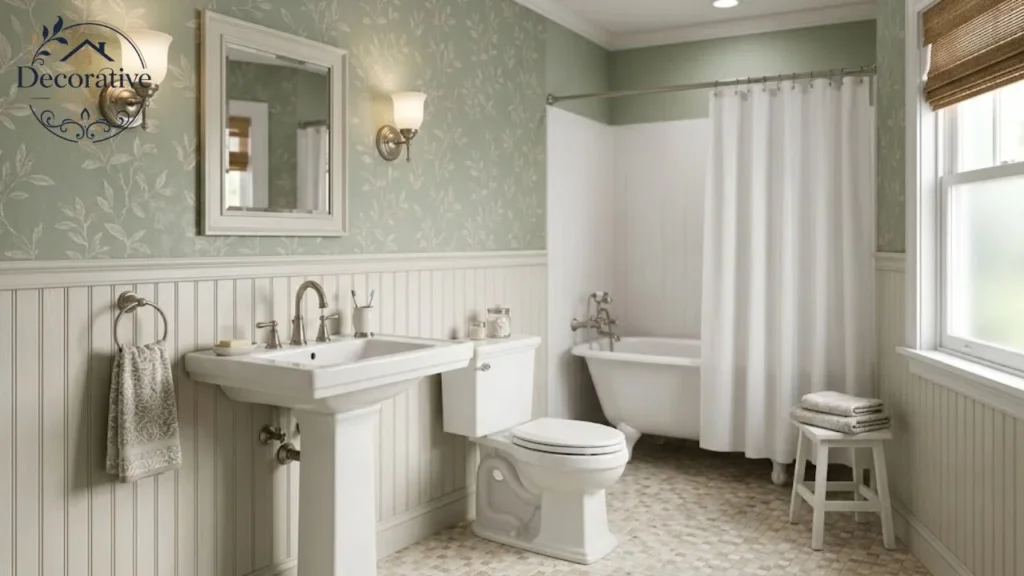
Choose the paneling paint from the wallpaper itself rather than introducing an unrelated “safe neutral.” Even a small secondary color can create a much more intentional scheme.
Use a Heritage Print With Modern Fixtures
William Morris-inspired foliage, traditional florals, damask, and Arts and Crafts patterns are particularly effective when the bathroom architecture feels plain.
The secret is contrast. Instead of reproducing a period room literally, combine a heritage print with a clean floating vanity, simple stone countertop, restrained mirror, or modern tap. Heritage-influenced wallpaper has remained prominent in current bathroom trend coverage, including pattern-drenched and panelled treatments.
Create Height With Stripes
Vertical stripes naturally emphasize the wall’s height and can bring order to a bathroom containing many visual interruptions. They are especially useful where a mirror, sconces, shelving, switches, and door trim already create a complicated elevation. For a softer look, use irregular hand-painted stripes rather than perfectly graphic ones.
Take the Wallpaper Onto the Ceiling
In a powder room, wallpapering the ceiling can make the room feel deliberately enclosed rather than simply small. You can either continue the same pattern overhead for a cocooning effect or place the print only on the ceiling and use a related paint color below.
Ceiling wallpaper already appears in leading design galleries because the “fifth wall” creates impact without taking up usable floor space.
Choose a Scenic Mural for a Windowless Bathroom
A landscape, forest, cloudscape, or panoramic mural introduces depth where the architecture provides very little. The trick is placement. Avoid chopping the most important part of the scene behind a large mirror. Map the mural to the wall before ordering so the focal area remains visible.
Use Black and White When the Floor Is Already Busy
If your bathroom has encaustic tile, patterned porcelain, terrazzo, or penny tile, adding another full color palette can quickly become chaotic.
Black-and-white wallpaper can provide pattern without introducing several more competing hues. Repeat either the black or white in the vanity, mirror frame, towels, or light fittings to hold the scheme together.
Match a Wallpaper Color to the Vanity
Do not start by asking what wallpaper goes with a blue vanity. Ask: Which blue is the vanity? A dusty slate blue and a clear cobalt require completely different companions.
Pull a minor tone from the wallpaper and repeat it on the cabinetry. This makes the paper and vanity look selected together even when they were purchased years apart.
Pair Large-Scale Wallpaper With Small Tile
Variation in scale creates breathing room. If the floor is made from tiny hexagons or penny rounds, consider a larger wallpaper motif rather than another miniature repeat. Conversely, large stone-effect floor tile can take a finer, more detailed paper.
The goal is not to make everything match. It is to stop every surface from competing at the same visual frequency.
Try Toile Without Making the Bathroom Feel Formal
Toile becomes much easier to use when the rest of the room is relaxed. Combine it with a simple wood vanity, woven basket, unlacquered-looking metal, painted trim, or an unfussy mirror. You still get narrative detail on the wall without creating a bathroom that feels like a historical reproduction.
Use Art Deco Geometry Around a Curved Mirror
Fan shapes, arches, stepped geometrics, and rhythmic linework pair naturally with rounded mirrors and globe sconces. Limit the number of competing motifs elsewhere. A geometric wallpaper already gives the room movement.
Choose a Quiet Block Print for a Spa-Like Bathroom
Not every wallpaper needs to announce itself. A hand-blocked-looking leaf, dot, wave, or tiny floral in warm beige, clay, pale green, or faded blue brings softness to bathrooms dominated by hard surfaces. This works especially well with limestone, travertine-look tile, pale oak, textured towels, and warm white paint.
· Kdarchitects.co — Architecture, interior design, home design, building design, architectural planning, and construction-related ideas.
· Rapidhomedirect.us — Home improvement, home renovation, home décor, DIY projects, furniture, household products, and practical home ideas.
· Famousparenting.us — Parenting, family life, children, pregnancy, child development, parenting tips, family activities, and advice for parents.
· Masterrealtysolutions.co — Real estate, property buying and selling, homeownership, housing, property investment, mortgages, real estate advice, and market insights.
· Pushyourdesign.co — Interior design, home décor, creative design ideas, furniture, room styling, architecture, renovation, and modern home design.
· Betterthisworld.co — Personal development, lifestyle, productivity, motivation, self-improvement, career growth, relationships, and improving everyday life.
Bring Warmth to an All-White Bathroom
If replacing white tile is unrealistic, wallpaper can prevent the room from feeling clinical. Look for a cream ground rather than pure white, then introduce ochre, rust, olive, muted blue, or brown. A warmer background helps bridge the gap between cool sanitary fixtures and wood or brass accents.
Use a Retro Print With Restraint
Wavy lines, sunbursts, stylized flowers, mustard, avocado, burnt orange, and chocolate can make a basic bathroom feel intentionally midcentury. One or two retro references are enough. A groovy wallpaper paired with a simple modern vanity often feels fresher than filling the room with reproduction furniture and accessories.
Let Green Act Like a Neutral
Green wallpaper works unusually well in bathrooms because it sits comfortably beside wood, white porcelain, cream stone, black accents, chrome, nickel, and brass. For a quiet room, choose sage or eucalyptus. For drama, use forest or emerald. For something playful, look at lime, mint, or botanical greens with pink and yellow details.
Use a Delicate Microprint in a Traditional Bathroom
Small flowers, stars, dots, vines, or sprigs can soften bathrooms with pedestal sinks, traditional taps, framed mirrors, and paneled doors. The print should read as texture from the doorway and reveal its detail when viewed up close. That change in perception gives a small room surprising depth.
Make the Vanity Wall the Focal Point
An accent wall works best when architecture gives you a logical ending point. The wall behind a vanity is usually easier to justify than an arbitrary side wall because the mirror, lighting, and basin already establish it as the visual center of the room. Frame the wallpaper rather than fighting it. Check where the motif lands before drilling for the mirror.
Wrap a Powder Room in One Pattern
Sometimes stopping after one wall makes the room look unfinished. In a compact powder room, using the same print on every wall removes the visual question of where the feature starts and stops. This is where the jewel-box approach works best: one clear idea, fully committed.
Choose Whimsical Wallpaper for a Children’s Bathroom
Animals, stars, fish, maps, fruit, clouds, and playful illustrations can grow with a child more successfully than heavily themed sanitaryware. Keep the expensive fixtures simple and let the wallpaper carry the personality. When tastes change, replacing a wall finish is considerably easier than redesigning the entire bathroom.
Use Faux Grasscloth for Texture Without Loud Pattern
Bathrooms full of tile, porcelain, glass, and polished metal often need texture more than another strong print. A bathroom-suitable faux grasscloth creates depth while remaining quiet behind mirrors and fixtures. It is particularly useful in contemporary bathrooms where a floral or scenic paper would feel too decorative.
Pick a Coastal Pattern That Is Not Literally Nautical
You do not need anchors, ropes, or seashells to make a bathroom feel coastal. Try irregular blue stripes, watery abstract marks, sea-green botanicals, sandy neutrals, or wave-like geometry. The room will reference the coast without becoming themed.
Use Wallpaper to Disguise Awkward Architecture
Sloping ceilings, boxed-in plumbing, niches, and irregular walls can become more noticeable when each plane is painted separately. A continuous pattern can visually connect those surfaces. Instead of trying to make the architecture disappear, make it part of the room’s character.
Coordinate the Wallpaper With the View Outside
If the bathroom has a garden-facing window, repeat a color or organic shape from the landscape. Botanical wallpaper beside visible greenery creates continuity. In an urban bathroom, a graphic or architectural motif may make more sense than pretending the room belongs in a country cottage.
Build the Whole Room From One Excellent Wallpaper
When none of your existing finishes need to stay, choose the wallpaper first. Then select:
- one background color for walls or trim,
- one secondary wallpaper color for the vanity,
- one dominant warm or cool metal finish,
- one quiet floor material,
- towels that repeat rather than introduce colors.
This is the easiest way to make adventurous bathroom wallpaper ideas feel designed rather than randomly decorated.
How to Coordinate Wallpaper With Existing Tile
Wallpaper shopping becomes much easier when you stop trying to find an exact “match.” Start with undertone. A creamy tile usually sits better beside warm whites, muted greens, ochres, terracottas, and earthy reds than beside icy blue-white paper.
A cool gray marble can work beautifully with blue, charcoal, silver-green, mauve, or crisp white. Then assess pattern. If the tile already contains strong veining or geometric repetition, choose wallpaper that differs in scale. Finally, examine grout.
People often ignore it, but a broad grid of dark grout is already a pattern. Your wallpaper needs to coexist with it. Bring physical samples into the bathroom and view them in morning light, evening light, and artificial light before ordering full rolls.
Peel-and-Stick Wallpaper: Excellent Tool, Not Magic Material
Renters understandably gravitate toward removable wallpaper. It can be a smart solution. Current removable products span far more sophisticated designs than early temporary wallpaper, and tested options remain widely available.
But check three things. First, does the manufacturer approve the paper for bathroom humidity? Second, is your wall surface compatible with the adhesive? Third, how wet does the room actually become?
Do not assume “vinyl,” “removable,” “washable,” “water resistant,” and “waterproof” mean the same thing. If you rent, test a sample in an inconspicuous area and follow both the wallpaper manufacturer’s instructions and your tenancy requirements.
Preparation Matters More Than Most People Expect
Even expensive wallpaper looks cheap on a badly prepared wall. The surface should be sound, smooth, clean, and dry. Repair peeling paint, cracks, holes, and obvious unevenness first. Graham & Brown recommends starting bathroom installations on a clean, dry surface free of mold, dust, and flaking paint. Before cutting anything:
- confirm the roll/batch information
- inspect every roll for defects
- identify the pattern repeat and match
- mark where the first drop will begin
- check how motifs land beside corners and fixtures
- follow the product’s specified adhesive and preparation instructions
Large repeats can create more cutting waste than expected, so calculate material using the pattern repeat rather than wall area alone. Wallpaper calculators commonly incorporate repeat information for this reason.
For complicated rooms, murals, valuable wallcoverings, or imperfect walls, professional installation can be money well spent.
Seven Mistakes That Make Bathroom Wallpaper Fail
Hanging it over a moisture problem
Wallpaper cannot repair inadequate ventilation, damp drywall, or recurring mold.
Choosing by appearance alone
The prettiest paper in the showroom may not be suitable for your particular bathroom.
Treating moisture resistance as waterproofing
Those are different performance expectations.
Installing ordinary wallpaper where water hits it repeatedly
Use an appropriate backsplash, tile, waterproof panel, or another wet-zone material instead.
Ignoring the pattern repeat
Running short halfway through a wall is frustrating. Discovering the replacement roll has a visual variation is worse.
Cutting every strip before testing the first one
Old bathrooms are rarely perfectly square. Establish the pattern and vertical alignment before committing the entire roll.
Adding too many competing finishes
Wallpaper + patterned tile + dramatic marble + colorful vanity + ornate mirror + multiple metal finishes is possible, but difficult. Usually one surface should lead.
What About Very Small Bathrooms?
Small rooms are not automatically better in pale colors. If making the bathroom physically feel open is your only goal, a low-contrast pattern with a lighter background may help maintain visual calm. If your goal is to make a forgettable powder room feel special, however, bold color can be the better decision.
That is why the strongest bathroom wallpaper ideas treat “small” as a design condition rather than a design restriction. A tiny room can be serene. It can also be theatrical. Both approaches work when they are intentional.
Before You Order: A Five-Minute Reality Check
Ask yourself: Does the manufacturer approve this material for my bathroom conditions? Will any section receive repeated direct splashing? Does the room remove moisture effectively after bathing? Have I viewed a full-size sample vertically in the actual room?
Do I know where the pattern will meet corners, mirrors, windows, and doors? Have I calculated enough material for the pattern repeat and installation waste? If those answers are clear, you are ready to think about style. And that is the point.
Good bathroom wallpaper is not about choosing between practicality and personality. The best bathroom wallpaper ideas use the practical decisions to make the creative ones last.
Frequently Asked Questions
Can you put wallpaper in a bathroom with a shower?
Yes, provided the product is suitable for bathroom conditions, the room is adequately ventilated, and wallpaper is kept away from constant direct water exposure unless the product is specifically engineered for that location.
What type of wallpaper is best for bathrooms?
Vinyl and vinyl-coated wallcoverings are strong starting points because they can offer better moisture resistance, durability, and washability than delicate untreated papers. Always verify the specific manufacturer’s instructions.
Is peel-and-stick wallpaper suitable for bathrooms?
Some are. Some isn’t. Look for an explicit bathroom/high-humidity recommendation. A peel-and-stick product can be moisture resistant without being waterproof.
Should you use wallpaper behind a bathroom sink?
It can work where splashing is limited, but a backsplash or other protective surface is safer in frequently wet areas.
What wallpaper makes a small bathroom look bigger?
There is no single pattern-size rule. Low contrast can create calm, vertical lines can emphasize height, and even large motifs can work extremely well because fewer pattern repeats are visible. Current design examples use both subtle prints and oversized patterns successfully.
Can you wallpaper every wall of a powder room?
Yes. Powder rooms are especially well suited to immersive wallpaper treatments because they do not experience shower-generated humidity.
Can you wallpaper the bathroom ceiling?
Yes, when the room and material are suitable. Ceiling treatments appear frequently in designer bathroom projects.
Does bathroom wallpaper get moldy?
Persistent moisture can contribute to mold problems in homes, so ventilation and moisture management matter. Wallpaper should not be installed over an unresolved damp or mold problem.