

Every page you will read on this says the same thing. Luxury vinyl plank is one hundred percent waterproof, so it is perfect for a basement.
The plank is waterproof. The floor is a different question, and the difference is where basement flooring projects go wrong.
The short answer
The best LVP flooring for basement use is a rigid-core SPC plank, 5 mm or thicker, with a 20 mil wear layer, installed as a floating floor over a tested slab with a vapor barrier.
SPC beats WPC below grade because its denser core moves less with temperature. COREtec, Shaw, and Mohawk SolidTech are the reliable brand tier; Lifeproof and TrafficMASTER are the budget tier that still works.
But before any of that: test the slab. That step decides whether any of these products will last.
Waterproof plank does not mean waterproof floor.
Here is the part most guides to the best LVP flooring for basement projects leave out, and it is the single most important thing on this page.
Concrete is not a barrier. A basement slab sits against damp earth and continuously passes water vapor upward slowly, invisibly, permanently.
Floating LVP is impermeable. When you lay it over a slab, that upward vapor hits the back of the plank and has nowhere to go.
The plank is fine. The sealed cavity underneath is not. Trapped moisture against a slab is how mould grows beneath a floor that looks perfect from above.
This is not a fringe concern. Most manufacturers specify a maximum slab relative humidity of roughly 75 to 85 percent for floating vinyl installations. That limit exists for exactly this reason, and it appears on almost no consumer page selling the product.
There is a second trap aimed squarely at anyone reading this. Your old flooring has been hiding the problem.
Carpet, vinyl sheet, and old tile all act as vapor traps. A slab that has been quietly coping for decades under carpet will frequently test well above specification the moment that carpet comes up and the suppressed moisture is released.
Which means the slab you are about to cover is not the slab the previous floor was sitting on, in moisture terms. It is a slab that has just been uncovered.
Test the slab before you buy anything.
Choosing the best LVP flooring for basement conditions starts here, not in the showroom. This takes a weekend of waiting and costs almost nothing. Skipping it is the most expensive shortcut in basement flooring.
The professional tests. The trade uses two ASTM standards. ASTM F2170 places probes in drilled holes to measure relative humidity inside the slab. ASTM F1869 seals a dish of anhydrous calcium chloride to the bare surface for 60 to 72 hours and weighs the moisture it absorbs, giving a vapor emission rate.
F2170 is the more predictive of the two because it reads what the slab will do over time rather than what its surface is doing today. Kits for either are available to homeowners, or a flooring contractor will test for a modest fee.
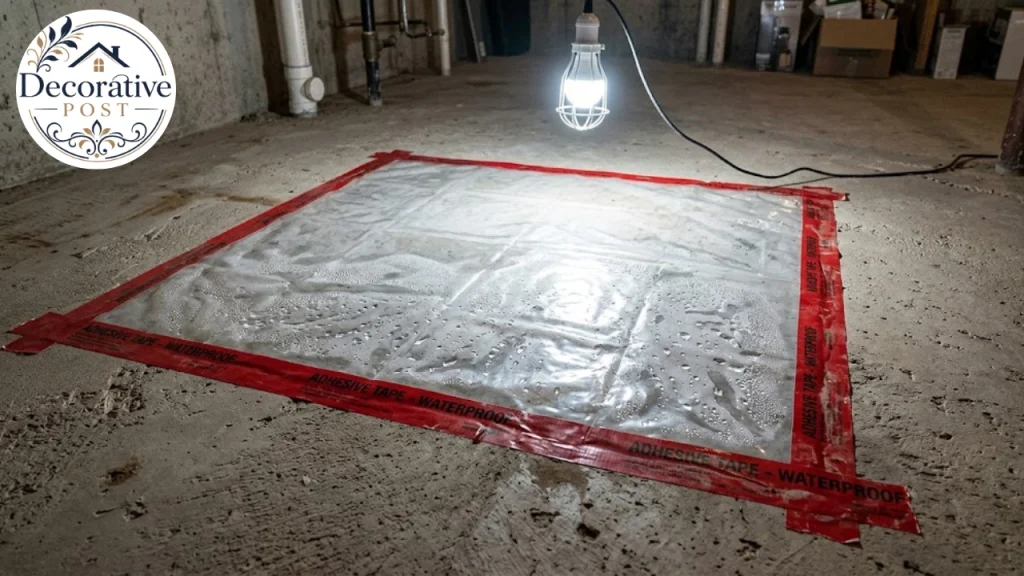
The free version. Tape a 2-foot square of clear plastic sheeting to the bare slab, sealing all four edges, and leave it for 48 to 72 hours. Condensation underneath, or a visibly darkened patch of concrete, means active vapour transmission.
Do this in several places. Slabs are not uniform, and the area near an exterior wall often reads differently from the middle of the room. Pay particular attention around a basement laundry area, where appliance leaks and drain lines add a second moisture source.
What the result tells you. A dry test means a standard floating install with a vapour barrier is fine. Visible moisture means you need mitigation: a subfloor panel system, a sealed slab, or, in serious cases, a drainage solution before any flooring goes down.
If the slab is visibly wet, flaking, or shows white powdery deposits, stop. That is efflorescence; it means water is moving through the concrete, and flooring over it will fail.
SPC or WPC: the decision that matters most
Rigid-core LVP comes in two constructions, and basements make the difference significant. This is the decision that most affects which is the best LVP flooring for basement use in your particular space.
SPC: stone-plastic composite. Limestone powder and PVC. Dense, hard, thin, and dimensionally very stable.
WPC: wood-plastic composite. A foamed core. Thicker, softer, warmer underfoot, slightly quieter.
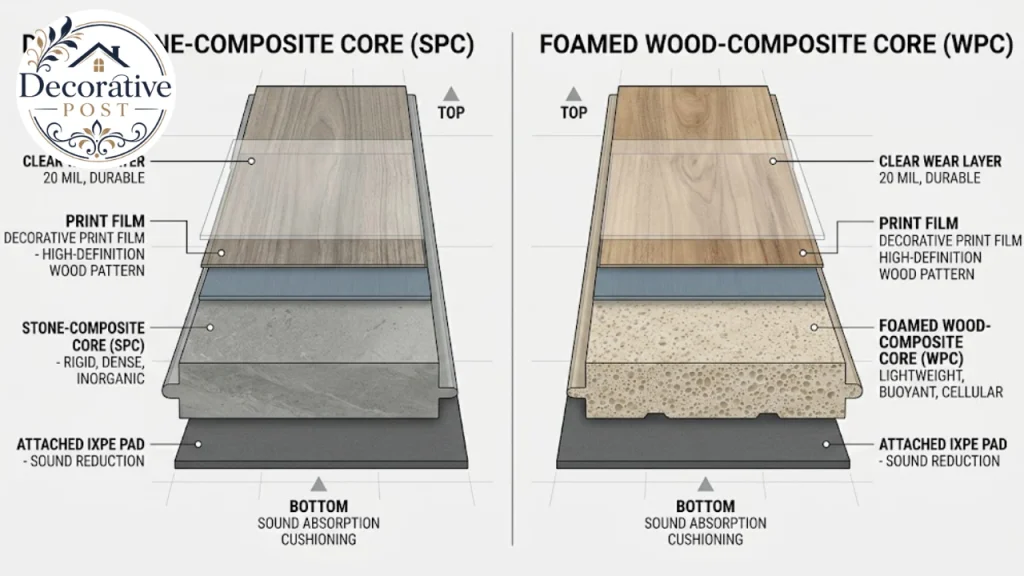
For a basement, SPC is the better choice in almost every case, and the reason is temperature rather than water. Both are waterproof. But basements swing through larger temperature ranges than the rest of the house, particularly if the space is only heated intermittently.
SPC’s denser core expands and contracts less across that swing. WPC’s foam core moves more, which over several seasons shows up as gaps at the seams or lifted edges.
SPC is also harder, which resists the dents a basement gym or a workshop will deliver. It is the sensible choice under a home bar too, where dropped glassware and bar stools work the surface hard.
WPC earns its place where comfort outweighs stability: a finished basement that is heated year-round and used as living space, where the softer, warmer surface is noticeable underfoot.
If the basement is unheated, intermittently heated, or used as a gym or utility space, SPC is the answer without hesitation.
The specs that actually matter
Ignore the marketing names. Four numbers tell you what you are buying, and they matter more than any brand claim about being the best LVP flooring for basement installs.
| Spec | Basement minimum | Why |
|---|---|---|
| Wear layer | 12 mil minimum, 20 mil preferred | The clear top layer does all the scratch and scuff work. 6–8 mil is builder-grade and will show traffic within a few years |
| Total thickness | 5mm minimum, 6–8mm better | Thicker planks bridge minor slab unevenness and feel more solid |
| Core type | SPC | Dimensional stability across temperature swings |
| Attached pad | Useful, but check | Adds comfort and some sound damping. Never add a second pad beneath one |
Wear layer is the specification people most often get wrong. It is measured in mils, not millimetres, and a 20 mil wear layer is roughly a residential-lifetime product while 6 mil is not.
Bevelled edges hide small slab irregularities better than square edges. Worth having on an older floor.
Longer, wider planks look better but are less forgiving over uneven ground. On a rough slab, a shorter plank is the easier install.
Brands worth shortlisting
No affiliate relationships here, and no stock to move. This is an honest read on which brands make a credible best LVP flooring for basement shortlist.
| Brand | Tier | Best for | Notes |
|---|---|---|---|
| COREtec | Premium | The default basement recommendation | Effectively created the rigid-core category. Consistently specified by flooring contractors for below-grade work |
| Shaw | Premium | Realism and range | Strong warranty terms, widely available, high-quality visuals |
| Mohawk SolidTech | Mid-premium | Families and pets | Good dent and scratch performance, competitive pricing |
| MSI Everlife | Mid | Design range | Broad colour selection, widely stocked through dealers |
| Lifeproof (Home Depot) | Budget-mid | DIY installs | Genuinely decent for the price. Easy to source more mid-project |
| TrafficMASTER Allure | Budget | Low-traffic, low-budget | Thinner and less forgiving. Fine for a utility basement |
| Cali Bamboo | Mid-premium | Design-led | Wider planks, distinctive visuals |
Whatever you choose, think about how you will look after it. The routines differ from wood — our guide to cleaning hardwood floors covers what damages a finish, and most of those warnings do not apply to vinyl.
Buy from one batch, and buy ten percent extra. Dye lots vary, and finding matching planks two years later for a repair is frequently impossible.
Underlayment and vapour barrier
This generates more contradictory advice than any other part of the job, so here is the resolution.
You almost always want a vapour barrier over a basement slab. Six-mil polyethylene is the standard specification for moderate conditions; 10 to 15 mil is the sensible choice below grade.
Roll it across the whole floor, overlap seams by several inches, tape them, and run it a few inches up the walls behind the skirting.
Underlayment is different from a vapour barrier, and conflating them is the usual source of confusion. Underlayment adds cushioning and sound damping. A vapour barrier manages moisture. Some products do both.
If your plank has an attached pad, do not add another one. A double layer of cushioning allows the floor to flex under load, which stresses the click joints and eventually breaks them. This is a common and avoidable failure.
Check the manufacturer’s instructions, because some explicitly require a specific barrier and others void the warranty if one is used with an attached-pad product.
Subfloor panels: the upgrade worth considering
If your slab tested damp or the basement is destined to be a proper living space, a dimpled subfloor panel system is the better route.
These are small tongue-and-groove panels with a molded plastic underside that holds the panel a few millimeters off the slab. That gap does two things: it gives vapor somewhere to move laterally instead of sitting against the back of your flooring, and it breaks thermal contact with the cold concrete.
DRICORE is the best-known system, and flooring contractors recommend it for below-grade work consistently.
The costs are real. You lose around an inch of ceiling height, which matters in a basement with low headroom and can affect stair risers and door clearances, a particular concern in a bi-level home, where the lower floor often starts with less to spare. It also adds meaningfully to the budget.
But it converts a marginal slab into a reliable floor, and it makes the finished room substantially warmer. For a basement that will be used daily, it is usually worth it.
The cold floor nobody mentions
Vinyl conducts. Laid directly on a slab that sits at ground temperature year-round, LVP will feel cold underfoot, noticeably colder than the same product upstairs.
This is the most common post-install complaint in basements, and almost no page selling LVP mentions it.
Three things help. A subfloor panel system breaks the thermal bridge and makes the largest difference. A thicker plank with an attached pad helps moderately. Large area rugs help in the places people actually stand the same layering that makes a cozy living room work upstairs.
Electric underfloor heating is compatible with most rigid-core LVP, but check the manufacturer’s maximum temperature rating before specifying it, usually around 27°C at the surface.
Monitoring helps here. A humidity sensor in the basement is one of the cheaper additions in our home maintenance guide, and it tells you whether the room is drying out or quietly staying damp.
A dehumidifier is worth running regardless. It will not warm the floor, but basement comfort is largely a humidity problem, and the same principles covered in our guide to keeping a room comfortable with AC apply below grade.
Read the warranty before you buy
This is where manufacturers protect themselves,s and buyers get caught.
Many LVP warranties contain specific below-grade language. Some exclude basement installation entirely. Others cover it only if a vapour barrier was used, or only if slab moisture was within a stated limit at installation.
That last condition is the sharp one. If you never tested, you cannot demonstrate compliance, and a moisture-related claim will be declined.
Keep the test result, keep the receipt, and photograph the vapour barrier before the planks go down. Ten minutes of documentation protects a four-figure floor.
Check also whether the warranty requires professional installation. Some premium products reduce coverage on DIY installs.
Installing it so it lasts
Four things separate a floor that holds up from one that gaps within a year.
Acclimate the planks. Leave the boxes flat in the basement for 48 hours before installing. Basement temperature and humidity differ from the shop or your garage, and the material needs to settle.
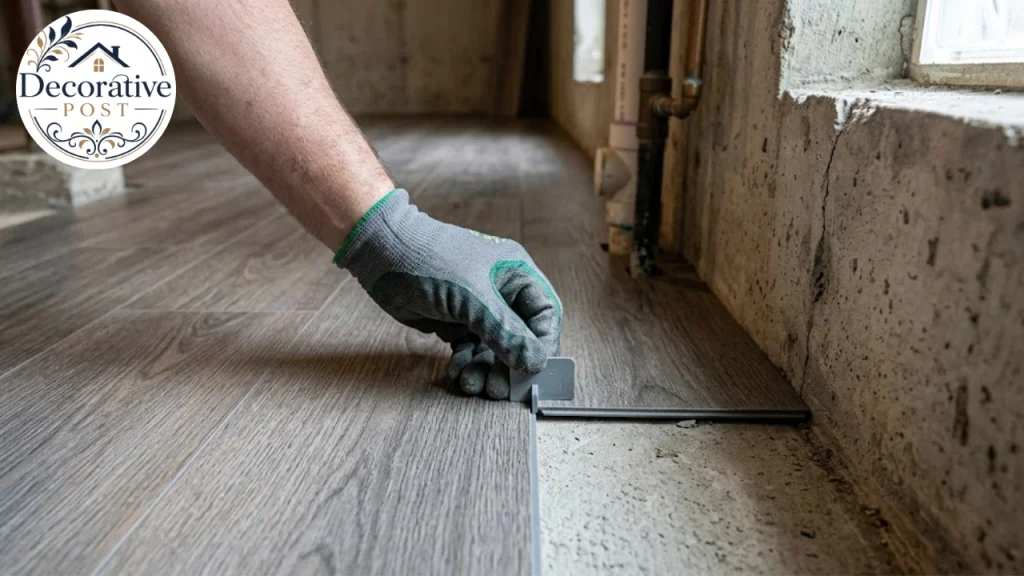
Leave the expansion gap. A quarter-inch at every wall and fixed object, covered by skirting or quarter-round. Floating floors move, and a floor pinned at the edges buckles in the middle.
Level the slab. Self-levelling compound for dips over about 3mm across a 6-foot span. Rigid core bridges small irregularities; it does not bridge genuine unevenness, and click joints fail over hollows.
Plan around anything permanent before you start. Flooring should run under built-in shelving and cabinetry only if you are confident it will never be lifted; otherwise, install the units first and floor up to them.
Start straight and check as you go. Basement walls are rarely square. Chalk a line off the longest wall rather than assuming, and measure your run every few rows.
Cut planks with a utility knife and a straightedge; score and snap. No saw needed for most cuts, which makes this a far quieter job than laminate.
What actually happens if the basement floods
An honest answer, because the marketing version is incomplete.
The planks themselves will survive standing water. They are PVC; they do not absorb, swell,l or delaminate.
The problem is underneath. Water that gets beneath a floating floor has no route out, and a sealed cavity full of standing water will grow mould within days.
So the correct response to a flood is to lift the floor, not to mop it. Click-lock LVP can be disassembled and relaid, which is a genuine advantage over glued flooring; plan the install knowing you may need to do this.
Dry the slab completely before relaying. Use a dehumidifier for several days, not an afternoon. Mould under a replaced floor is the same problem again, and the warning signs are the same ones covered in our guide to cleaning and preventing mould elsewhere in the house.
If your basement floods regularly rather than exceptionally, read the next section.
When LVP is the wrong answer
Writing against the obvious recommendation, because it matters.
If water enters your basement under hydrostatic pressure through cracks, up through the slab, or at the wall-floor joint, no floor covering fixes that. You need drainage, a sump system, or exterior waterproofing first. Flooring over an active water problem buries it.
If the slab tests very wet and you cannot mitigate, polished or sealed concrete is a legitimate finished floor and increasingly a design choice rather than a compromise.
If the basement floods more than occasionally, loose-lay carpet tiles are worth considering. They look less impressive, but they lift, dry, and replace individually.
If headroom is already tight and a subfloor system would take you below comfortable ceiling height, a direct-glue LVT over a sealed slab may serve better than a floating floor. Painting the ceiling a lighter shade buys back some perceived height too, as our ceiling colour guide explains.
Any flooring contractor who will not raise these options is selling you flooring rather than solving your problem.
Five mistakes that ruin basement LVP
Skipping the moisture test. The most expensive two days you will ever save.
Doubling the underlayment. Attached pad plus separate pad equals broken click joints.
No expansion gap. The floor buckles, and the fix is pulling it up.
Choosing WPC for an unheated basement. It will move seasonally, and the seams will show it.
Buying on thickness alone. A thick plank with a 6 mil wear layer will look worn before a thinner one with 20 mil.
How to decide, in order
:: Test the slab. Plastic sheet for three days, or a proper ASTM test. Everything downstream depends on this.
Choose the system. Dry slab means direct floating install with a vapour barrier. Damp slab means a subfloor panel system first.
Choose the core. SPC unless the basement is heated year-round; living space and comfort outweigh stability.
Choose the specs. 5mm or thicker, 20 mil wear layer, bevelled edge on an older slab.
Choose the brand to fit the budget, from the tiers above.
Get the first step right, and the rest is straightforward. The best LVP flooring for basement installations is rarely about finding a better plank; nearly every rigid-core product on the market will outlast the slab it sits on, provided someone checked what the slab was doing first.
That check is the whole job. Everything after it is just laying boards.
FAQs:
Is LVP good for basements?
Yes, rigid-core LVP is the most commonly recommended basement flooring because it is waterproof, comfortable underfoot, and tolerates temperature swings. The caveat is that the plank being waterproof does not protect the slab beneath it, so slab moisture should be tested and managed first.
Is SPC or WPC better for a basement?
SPC in most cases. Its dense stone-composite core is more dimensionally stable across the temperature swings basements experience, and it is harder-wearing. WPC is softer and warmer underfoot, which suits a heated, finished basement used as living space.
Do you need underlayment for vinyl plank flooring on concrete?
You need a vapour barrier over a basement slab: 6-mil polyethylene minimum, 10–15 mil below grade. Separate cushioned underlayment is optional and should never be added beneath a plank that already has an attached pad.
Can vinyl plank flooring get wet from underneath?
Yes, and this is the main basement risk. Floating LVP is impermeable, so moisture rising through concrete is trapped against the back of the planks. The plank is unaffected, but the sealed cavity can grow mould.
What thickness of LVP is best for a basement?
At least 5mm total thickness, with 6–8mm preferable over an older slab. The wear layer matters more than overall thickness; aim for 20 mil, and treat anything under 12 mil as unsuitable for a living space.
Will LVP mould in a basement?
The plank itself contains no organic material and cannot support mould. Mould forms in the space between an untested damp slab and the impermeable floor above it, which is why slab testing and a vapour barrier matter.
Can I install LVP directly on a basement concrete floor?
Yes, if the slab is dry, level, and clean, with a vapour barrier between. If moisture testing shows active vapour transmission, fit a dimpled subfloor panel system first.
What happens to LVP if the basement floods?
The planks survive submersion, but water trapped underneath will cause mould within days. Click-lock flooring should be lifted, the slab dried fully, and the planks relaid, which is a practical advantage over glued-down flooring.