

A laundry room doesn’t need to be enormous to work beautifully. What it needs is a place for everything. Dirty clothes need somewhere to wait. Detergent needs to be within reach. Clean clothes need a temporary landing spot.
Mops and ironing boards need homes of their own. And if you have ever opened a cupboard and had three bottles fall toward you, you already know that simply adding storage isn’t enough. The arrangement matters. Well-designed laundry room cabinets can turn an awkward utility area into one of the most organized rooms in the house.
They can conceal supplies, create a folding station, use vertical space, and make everyday chores feel less chaotic. The trick is knowing what to put where. Rather than beginning with cabinet colors or door styles, start with the room’s jobs. Once those are clear, the right cabinet layout becomes much easier to build.
Begin With a Storage Inventory
Before measuring for cabinets, empty the laundry room and make a list of what actually belongs there. Don’t rely on memory. Look at the items currently sitting on top of the washer, behind the door, on the floor, and in nearby closets. Your list might include:
- Laundry detergent
- Fabric-care products
- Stain removers
- Laundry bags
- Dryer accessories
- Towels
- Sheets
- Baskets
- Hangers
- Iron
- Ironing board
- Drying rack
- Mop
- Broom
- Vacuum attachments
- Cleaning cloths
- Buckets
- Household cleaners
Now divide everything into three groups: Use constantly: keep these close to the appliances. Use occasionally: put these in cabinets or drawers that are easy to reach but don’t need prime space. Use rarely: store these higher up or in less accessible areas.
This simple exercise prevents one common remodeling mistake: spending money on storage capacity that doesn’t match your real needs.
Design the Room in Zones
A laundry room becomes easier to use when different activities have defined areas. Think of the room as a series of small work zones.
The washing zone
This is where detergent, stain treatment, and laundry baskets should live.
The drying zone
This can include hanging space, a drying rack, or a rod for clothes that shouldn’t go into the dryer.
The folding zone
A countertop or table-height surface gives clean laundry somewhere to land.
The cleaning zone
Mops, vacuums, brushes, and household cleaners belong together.
The linen zone
If towels and bedding are stored here, give them dedicated shelves rather than squeezing them into random cabinets. You don’t necessarily need a separate cabinet for every zone. The point is to make the room’s storage logical.
When everything has a predictable location, putting things away takes seconds instead of becoming another chore.
Let the Washer and Dryer Determine the Cabinet Plan
Cabinetry should be fitted around the appliances rather than forcing the appliances into a predetermined cabinet design. Start by recording the exact model dimensions. Measure:
- Width
- Depth
- Height
- Door clearance
- Lid clearance
- Rear connection space
- Side clearance
- Required ventilation
Then check the manufacturer’s installation instructions. This matters because two machines that appear similar can have different clearance requirements. Dryers are particularly important because exhaust and ventilation requirements affect how the surrounding cabinetry can be designed.
Manufacturer documentation provides model-specific requirements rather than a universal clearance number. Don’t build the cabinet first and hope the appliance fits afterward.
Side by Side Appliances Give You the Most Flexibility
If your washer and dryer are next to each other, you have several options. A continuous countertop can run across the machines. Wall cabinets can occupy the space above. A tall storage unit can fill an unused end of the wall.
You can also combine closed cabinets with open shelving. One particularly practical arrangement is:
tall cabinet + washer + dryer + drawers or counter space
This creates distinct storage without making the entire room look like a wall of cupboards. If you have front-loading machines, the space above them is especially useful for a folding counter.
Top Load Washers Change Everything
A top-loading washer requires room for the lid. This sounds obvious, yet it is surprisingly easy to overlook when designing cabinets. Before installing a shelf or cabinet over a top-loader, measure the lid when completely open.
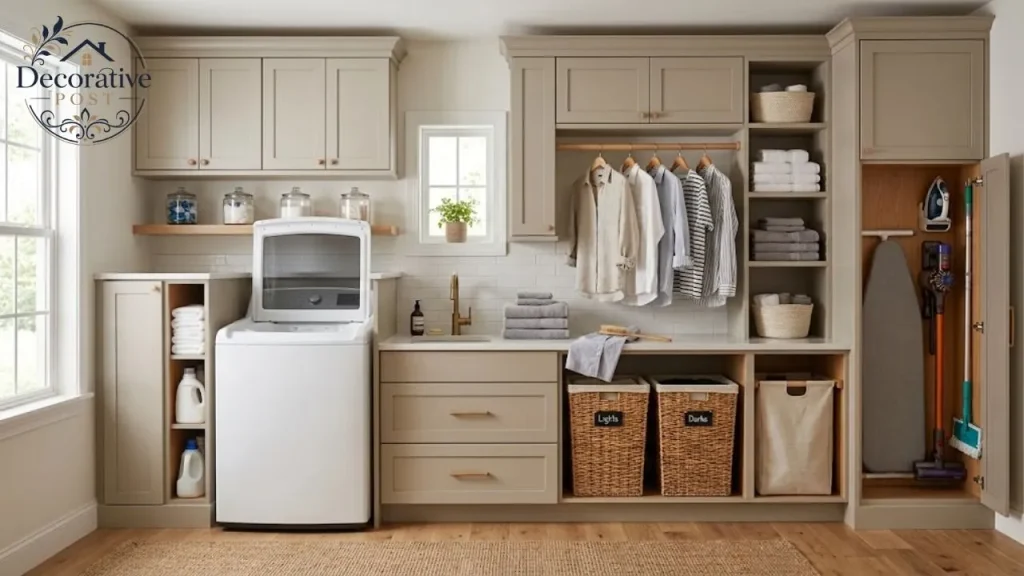
If the lid rises high, overhead cabinetry may need to be raised, shortened, or eliminated. You can use the surrounding walls instead. A narrow cabinet beside the machine may provide more practical storage than a cabinet that interferes with the lid. Function comes first.
Stacked Machines Need Vertical Thinking
Stacked washer-dryer combinations are excellent for compact spaces because they reduce the floor footprint. But the freed floor area doesn’t automatically mean you should fill every wall with cabinetry. Use the available height carefully. A narrow tall cabinet can store:
- Brooms
- Cleaning tools
- Ironing equipment
- Laundry baskets
- Bulk supplies
Shallow wall storage can hold smaller products. A hanging rail can provide a drying area without taking floor space. The uppermost cabinets are best reserved for things you don’t need every day. Nobody wants to climb onto a chair every Tuesday to reach the detergent.
Create a Folding Surface That Fits Your Routine
One of the most useful additions to a laundry room is a proper folding area. But bigger isn’t always better. If you usually fold a few shirts at a time, a compact counter may be enough. If your household washes large loads of bedding and towels, a wider uninterrupted surface is much more useful. The ideal folding area should be:
- Comfortable to stand at
- Easy to clean
- Well lit
- Close to the dryer
- Large enough for your typical load
For front-loading machines, a counter installed over the appliances can make excellent use of otherwise unused space. For top-loaders, a separate side counter is usually more practical.
Use Drawers Where Small Things Tend to Disappear
Cabinets are excellent for bottles and large supplies. Drawers are better for small objects. A shallow drawer can hold:
- Clothespins
- Mesh laundry bags
- Garment-care tools
- Small brushes
- Sewing supplies
- Spare buttons
- Measuring scoops
Dividers can keep everything separated. This is especially helpful when several small accessories have similar shapes. A drawer that opens fully also makes it easier to see what’s inside than a deep cupboard shelf.
Give Cleaning Tools a Full Height Home
The broom is often the forgotten object in a laundry-room renovation. So is the ironing board. They don’t fit naturally into ordinary cabinets. A dedicated tall cabinet solves the problem. Install internal hooks or brackets where appropriate, then create zones for:
- Long-handled tools
- Vacuum attachments
- Ironing equipment
- Cleaning cloths
- Buckets
If you have a cordless vacuum, include its charging location in the plan. That is a small detail with a big convenience payoff. Instead of carrying the vacuum to another room to charge, you can give it a permanent home.
Use the Back of Cabinet Doors
The inside of a cabinet door is valuable real estate. Depending on the cabinet and the products involved, door-mounted organizers can hold:
- Small brushes
- Clothespins
- Cleaning cloths
- Gloves
- Laundry bags
Keep heavier items away from lightweight hinges and make sure the organizer doesn’t interfere with shelves. The best storage accessories disappear into the routine. You shouldn’t have to think about them.
Add Pull-Out Storage to Deep Cabinets
Deep cabinets are useful for bulky objects but frustrating when everything gets pushed toward the back. A pull-out shelf can solve that problem. Instead of leaning into the cabinet to reach a bottle, you bring the shelf toward you. This works especially well for:
- Cleaning products
- Large detergent containers
- Paper goods
- Spare towels
- Household supplies
Not every cabinet needs a pull-out. Use them where depth genuinely creates an access problem.
Think Twice About Open Shelving
Open shelves are attractive and convenient. They can display:
- Woven baskets
- Folded towels
- Laundry supplies in containers
- Decorative pieces
- Frequently used items
But there is a trade-off. Laundry rooms generate lint. Open shelving therefore requires more frequent dusting than closed cabinetry. If your priority is a clean, low-maintenance appearance, use doors for the messier supplies. If your priority is quick access, open shelves can be excellent. A combination usually provides the best balance.
Choose Cabinet Depth Based on Access
Cabinet depth deserves more attention than it gets. Standard upper cabinets are often around 12 inches deep, while base cabinets are typically around 24 inches deep. These measurements are useful starting points rather than rules that apply to every laundry room.
Ask yourself what happens when the cabinet is full. Can you see the products at the back? Can you reach them without knocking over everything in front?
Does the cabinet make the walkway feel narrow? If the answer is no, reducing depth may improve the room even if it technically reduces storage volume. Accessible storage is better than theoretical storage.
Don’t Ignore the Space Beside the Appliances
The narrow gap beside a washer and dryer can look insignificant. It isn’t. A slim pull-out cabinet can hold bottles or brushes. A vertical cubby can store laundry baskets. A narrow open shelf can hold folded towels. A hanging rail can occupy an otherwise unused section of wall.
These small areas can be especially valuable in compact rooms. But don’t force a cabinet into a gap simply because the gap exists. Leave enough clearance for the appliance and for future maintenance.
Select Countertops for the Work, Not Just the Look
The countertop in a laundry room works harder than a decorative surface. It may encounter:
- Water
- Detergent
- Stain remover
- Heat from freshly dried laundry
- Dust
- Lint
Choose something easy to wipe down. Quartz, solid-surface materials, laminate, and other durable countertop products can all be appropriate depending on budget and design. The important part is matching the material to the room’s workload. A delicate finish that requires constant caution may become frustrating.
Cabinet Materials Matter Too
Laundry rooms don’t typically experience the same moisture levels as bathrooms, but water leaks and humidity can still occur. The construction of the cabinet matters more than simply choosing a material because it sounds premium.
Plywood cabinet boxes
Plywood is widely used for durable cabinet construction and generally holds hardware securely.
MDF
MDF provides an exceptionally smooth surface for painted cabinetry. Proper sealing and protection are important around moisture-prone areas.
Laminate
Laminate offers practical, easy-care surfaces and many finish options.
Thermofoil
Thermofoil can provide a smooth, seamless appearance, although the particular product’s heat and moisture limitations should be considered.
Wood
Wood can bring warmth and character to a laundry room. Because it responds to environmental humidity, proper finishing and construction remain important. There’s no universal winner. Choose based on the actual conditions in your room.
Don’t Design Cabinet Storage Around Hazardous Products
Laundry products require sensible storage. Detergent packets in particular can be dangerous if children get access to them. The American Academy of Pediatrics recommends keeping laundry products out of sight and out of reach of children and advises secure storage.
If children regularly use the laundry room, consider this when deciding where low drawers, open shelving, and countertop containers should go. A beautiful storage system isn’t successful if it creates an avoidable safety problem.
Make Room for Hanging Clothes
A drying rod is one of the easiest additions to overlook. Yet it can be incredibly useful. Use it for:
- Dress shirts
- Delicate garments
- Clothes fresh from the dryer
- Items waiting to be ironed
- Air-dry clothing
A rod can go:
- Beneath upper cabinets
- Between cabinets
- Beside stacked machines
- On a short unused wall
If space is tight, a retractable or folding solution can work. The key is to position it near the dryer so freshly dried clothing doesn’t have to travel across the house.
Use Vertical Storage Without Making the Room Top-Heavy
Floor-to-ceiling cabinetry creates impressive storage capacity. But too much tall cabinetry can visually shrink a small room. Balance closed tall storage with lighter elements. For example:
- Tall cabinet on one side
- Lower cabinets below a worktop
- Open shelf or hanging rail on the opposite side
This creates visual breathing room. If the room has a window, don’t automatically surround it with cabinetry. Natural light is also a form of value.
Lighting Should Follow Your Hands
Laundry rooms need more than general illumination. You need enough light to read care labels, inspect stains, and see inside cabinets.
Task lighting beneath upper cabinets can make a folding surface dramatically easier to use. If the room is enclosed or lacks windows, layered lighting becomes even more valuable. Don’t place the brightest light only in the center of the ceiling. Put light where the work happens.
Choose Hardware for Wet, Busy Hands
Laundry-room cabinet handles are used frequently. Pulls are often easier to grab than tiny decorative knobs, especially when your hands are wet or you’re carrying a basket. Choose hardware that:
- Feels comfortable
- Is easy to clean
- Doesn’t have unnecessarily sharp edges
- Complements nearby finishes
Small details matter when you interact with something dozens of times a week.
When Custom Cabinets Are Worth It
Custom cabinetry makes the most sense when the room has constraints that standard cabinets cannot solve efficiently. For example:
- An unusually narrow room
- An angled wall
- A very tall ceiling
- A combination laundry and mudroom
- Specialized hamper requirements
- Built-in utility equipment
- Unusual appliance dimensions
Custom cabinets can also eliminate awkward filler spaces. But customization isn’t automatically better. If stock cabinetry fits your room comfortably, paying for a fully custom solution may not provide enough practical benefit.
When Ready-Made Cabinets Make More Sense
Stock cabinetry can be a smart choice for straightforward rooms. It may be enough if:
- The walls are standard
- Appliance placement is uncomplicated
- You don’t need unusual storage
- Your budget is limited
- You are comfortable using organizers to improve the interiors
Good planning often matters more than cabinet price. An inexpensive cabinet in the right location can be more useful than an expensive cabinet in the wrong one.
Three Cabinet Setups to Consider
For a narrow laundry closet
Use a stacked washer and dryer, shallow upper storage, and one tall cabinet if space allows. Keep the floor open. Use a wall-mounted rod instead of a bulky drying rack.
For a medium-size laundry room
Try side-by-side front-load machines, a continuous folding counter, upper cabinets, and one tall utility cabinet. Add drawers for small accessories. This provides a good balance of storage and work surface.
For a large family laundry room
Separate storage into zones. Include:
- Multiple hampers
- Linen shelving
- Cleaning-tool storage
- Folding counter
- Hanging area
- Utility sink
- Upper cabinets
- Tall cabinets
The larger the room, the more useful zoning becomes. Otherwise, extra space simply turns into a larger place for clutter.
Cabinet Colors That Work in Laundry Rooms
Your cabinet color can either open up the room or make it feel heavier. For a bright, timeless look, white remains a dependable choice. Warm gray can create a softer appearance. Muted green adds color without overwhelming the room. Natural wood brings warmth.
Navy or charcoal can work beautifully in rooms with plenty of natural or artificial light. Don’t choose the color in isolation. Look at it beside the countertop, flooring, backsplash, appliances, and wall color.
Keep the Visual Noise Under Control
A laundry room contains many visually busy objects. Detergent bottles have labels. Laundry baskets have handles. Cleaning tools are tall. Clothing creates piles. Cabinetry can provide the visual backdrop that brings all of this together.
If everything is open, the room may feel busy even when it is technically organized. Closed cabinets provide a visual reset. That’s one of their biggest advantages.
The Cabinet Features You Probably Don’t Need Everywhere
It’s easy to get carried away with clever storage. But every mechanism costs money and eventually needs maintenance. You probably don’t need:

- Pull-outs in every cabinet
- Built-in organizers for objects that already have simple homes
- Decorative glass doors on every upper cabinet
- Extremely elaborate molding
- Deep storage for small bottles
- Specialized compartments for items you rarely use
Spend money on features that remove genuine friction. A pull-out hamper you use every day is valuable. A complicated organizer that solves a problem you don’t have isn’t.
Measure Before You Order Anything
Take measurements twice. Record:
- Wall width
- Wall height
- Appliance dimensions
- Door openings
- Window position
- Outlet locations
- Plumbing
- Drain
- Dryer vent
- Gas connection where applicable
- Baseboards
- Trim
- Ceiling height
- Walkway width
Then compare them against the appliance manufacturer’s instructions. If you’re hiring a cabinet installer, have the installer verify the final dimensions rather than relying only on a rough room sketch. That extra verification is cheap compared with replacing cabinetry.
A Better Way to Judge Your Finished Laundry Room
Don’t judge it while standing in the doorway. Pretend you’re doing laundry. Carry a full basket into the room. Open the washer. Reach for detergent. Move clothes to the dryer. Take something out that needs to hang. Fold a towel. Put away the detergent.
Now notice what gets in your way. That is the real test. A cabinet layout that looks perfect in a rendering can feel completely different when you’re carrying a heavy basket and trying to open an appliance door. Function reveals problems that photographs hide.
Final Thoughts
The smartest laundry room cabinets don’t try to turn a utility room into a showroom. They make the room easier to use. They give detergent a sensible home. They hide cleaning supplies. They create a place to fold clothes. They keep awkward tools upright. They make small rooms feel less chaotic and large rooms easier to organize.
Most importantly, they work with the appliances instead of fighting them. So measure first, think through your laundry routine, plan your storage zones, and check the manufacturer’s installation requirements before ordering cabinetry.
Once those practical decisions are right, choosing the color, countertop, and hardware becomes the enjoyable part. The result isn’t just a prettier laundry room. It’s a room that earns its place in your daily routine.
Frequently Asked Questions
What type of cabinet is best for a laundry room?
A combination usually works best: upper cabinets for everyday supplies, drawers for smaller items, and a tall cabinet for bulky cleaning equipment.
How can I add cabinets to a very small laundry room?
Use vertical space with narrow tall cabinets and shallow wall storage. Avoid unnecessarily deep cabinets that reduce the available walkway.
Should laundry cabinets match kitchen cabinets?
They can, especially when the laundry room is near the kitchen. Matching cabinetry creates continuity, but a different color or hardware finish can also give the room its own character.
What should go in a laundry room cabinet above the washer?
Use this space for detergent,stain-treatment products, laundry bags, dryer accessories, and other frequently used supplies. Keep products safely stored according to their labels.
Are drawers or cabinets better for laundry storage?
Neither is universally better. Cabinets work well for bottles, towels and bulky items, while drawers are particularly convenient for small accessories such as clothespins and laundry bags.
How do I hide a vacuum and mop in a laundry room?
A narrow floor-to-ceiling utility cabinet is one of the most practical solutions. Add internal hooks or organizers to keep long-handled tools upright and separated.
Can laundry room cabinets go around a dryer vent?
Cabinetry must be planned around the dryer’s specific venting and clearance requirements. Never enclose or obstruct a dryer vent simply to create additional storage.
Is open shelving better than closed laundry cabinets?
Open shelving provides quick access and can make a small room feel lighter, while closed cabinets hide clutter and reduce the visual impact of bottles and cleaning products.