

A BTU is a British thermal unit, the amount of energy needed to raise one pound of water by one degree Fahrenheit. On an air conditioner or heater, the number you see is almost always BTU per hour, which is a rate: how much heat the machine can move in sixty minutes.
For cooling, a bedroom of 100 to 150 square feet needs about 5,000 BTU per hour, and a room of 450 to 550 square feet needs about 12,000. A very sunny room adds 10 percent, a shaded room subtracts 10 percent, each person beyond two adds 600, and a kitchen adds 4,000.
For heating, a common rule of thumb is 30 BTU per square foot, which works out to roughly 10 watts. It is a starting point, not a verdict, and the rest of this article is about where it holds and where it fails.
Energy versus rate: the distinction that trips everyone
Strictly speaking, a BTU is a quantity of energy, like a kilowatt-hour. A BTU per hour is a rate of delivering it, like a kilowatt.
Retailers drop the “per hour” and write “12,000 BTU” on the box. That is shorthand, and it is the reason the unit confuses people. A 12,000 BTU air conditioner does not store or use 12,000 BTU. It can remove that much heat from a room every hour it runs.
The unit is small, which is why appliance ratings run into the thousands and tens of thousands.
The conversions worth keeping
These four conversions cover almost every question about the BTU, and they come from the University of Illinois’s energy reference.
1 kilowatt-hour equals 3,412 BTU. 1 watt equals 3.412 BTU per hour. 1 ton of cooling equals 12,000 BTU per hour. 1 therm, the unit gas utilities bill in, equals 100,000 BTU.
| Rating | In BTU per hour | In tons |
|---|---|---|
| 1,000 W electric heater | 3,412 | n/a |
| 1,500 W electric heater | 5,118 | n/a |
| 5,000 BTU air conditioner | 5,000 | 0.42 |
| 9,000 BTU air conditioner | 9,000 | 0.75 |
| 12,000 BTU air conditioner | 12,000 | 1.0 |
| 18,000 BTU air conditioner | 18,000 | 1.5 |
Notice what the 1,500-watt row tells you. Every 1,500-watt electric heater, whatever its shape or price, turns that wattage into 5,118 BTU per hour, because electric resistance heating converts essentially all the power it draws into heat.
Differences between heaters are about where the heat goes and how it feels, not how much of it there is.
Sizing a room for cooling
ENERGY STAR publishes a BTU sizing chart that most retailer guides copy. Match your room’s floor area to a capacity:
| Area to cool (sq ft) | Capacity (BTU per hour) |
|---|---|
| 100 to 150 | 5,000 |
| 150 to 250 | 6,000 |
| 250 to 300 | 7,000 |
| 300 to 350 | 8,000 |
| 350 to 400 | 9,000 |
| 400 to 450 | 10,000 |
| 450 to 550 | 12,000 |
| 500 to 700 | 14,000 |
| 700 to 1,000 | 18,000 |
The ranges overlap near the top of the chart, so a room on a boundary is a judgement call. If you are between two rows, the adjustments below usually settle it.
The adjustments are the part people skip.
A heavily shaded room reduces the capacity you need by 10 percent. A very sunny room increases it by 10 percent. For more than two regular occupants, add 600 BTU per hour for each additional person. If the unit will be used in a kitchen, add 4,000.
Those four lines do more work than the chart. Two rooms of identical floor area can need capacities one or two rows apart.
Two worked examples
These are arithmetic illustrations, not case studies, but they show how the adjustments stack.
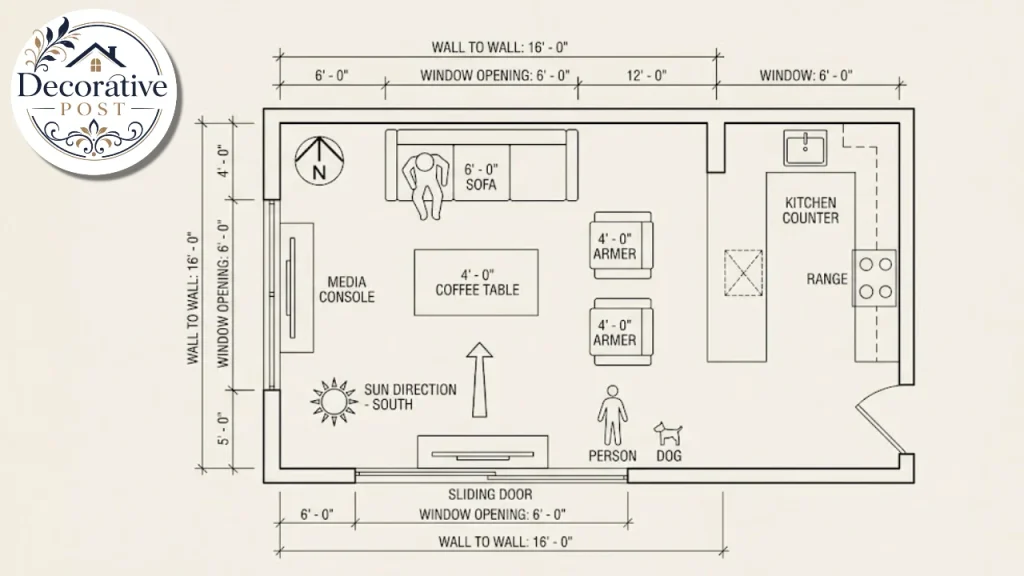
A 14 by 18 foot living room is 252 square feet, which lands in the 250 to 300 row at 7,000 BTU.
The room faces south and gets strong afternoon sun, so add 10 percent for 7,700. Four people regularly sit in it, so add 1,200 for the two beyond the first two. That gives 8,900, and the nearest unit is 9,000.
A 330 square foot open-plan room with a kitchen along one wall lands in the 300 to 350 row at 8,000. Add 4,000 for the kitchen, and the answer is 12,000. The base chart would have suggested a unit a third smaller.
If you only read one thing in this article, read that second example. Cooking heat is the most commonly forgotten load in a room that also has a sofa in it.
Doing the sum yourself
You do not need a calculator widget. Six steps cover it, and you can run them on the back of an envelope.
Measure the room’s length and width in feet and multiply them. Find that area in the sizing chart and write down the capacity. If the room is very sunny, add 10 percent, and if it is heavily shaded, subtract 10 percent.
Count the people who regularly use the room and add 600 for every one beyond two. If the unit will sit in or beside a kitchen, add 4,000. Then round to the nearest unit that is actually sold.
When the answer falls between two sizes, a bedroom or a damp-prone room is usually better served by the smaller one, for the humidity reasons covered below. A very sunny room with afternoon heat can justify the larger.
Write the adjusted figure down before you shop. It is the number every product page should be measured against.
Why bigger is not better
When a window unit seems to struggle, the instinct is to buy more capacity. For cooling, that instinct is often wrong.
An air conditioner does two jobs: cooling the air and removing moisture from it. Moisture condenses on the cold coil, and it only comes out when air passes across that coil repeatedly over a long run.
An oversized unit reaches the thermostat setting quickly and shuts off before it has dried the air. Green Building Advisor describes a system twice as large as needed running half the time while blasting the house with twice the airflow. The room gets cold but stays damp.
The result is that clammy, cool-but-sticky feeling that people often answer by lowering the thermostat further, which makes the room colder without making it drier.
Short cycling comes with the same problem. The unit starts and stops in bursts, with temperature swings between them and a bigger blower that is noisier in use.
A persistently damp room is also a mould risk. The same conditions that make a bathroom grow mould — warm, wet, and still are what an oversized unit produces in a bedroom, and the guide to cleaning shower mould explains what that growth looks like and why ventilation is the long-term fix.
So size to the adjusted number, not to the largest unit the circuit will support.
The rating on the box is not what the room receives
This is where a BTU figure gets inflated, and it affects portable air conditioners most.
There are two ratings. ASHRAE is the raw cooling capacity of the machine in laboratory conditions that favour the unit. DOE SACC, the Seasonally Adjusted Cooling Capacity, weights performance across more realistic conditions and subtracts the losses the unit creates for itself.
On single-hose portables, the SACC figure is commonly 55 to 75 percent of the ASHRAE figure. A unit marketed as 14,000 BTU often delivers roughly 8,000 to 10,000 BTU on the SACC basis.
The reason is mechanical. A single-hose unit pulls room air in to cool its own condenser, then exhausts it outside, which draws warm air back in through gaps. Dual-hose units lose less, so they keep more of their rating.
The practical rule is to size from the SACC number. A listing that shows only ASHRAE, with no SACC figure, is withholding the number that matters. Evaporative coolers sit outside both systems and are compared on airflow and temperature drop instead.
A portable with a big headline and a small SACC can end up delivering less than a window unit with a modest label. Compare like with like.
Window unit or portable
Capacity labels get confusing when you compare formats, because the two main types lose heat in different ways.
A window unit sits in the opening with its hot side outside, so what it removes stays removed. A single-hose portable sits inside the room and pulls room air across its own condenser, then blows that air outside, which draws warm air back in through gaps elsewhere.
A dual-hose portable keeps separate intake and exhaust paths and loses less. That is why dual-hose units hold more of their rating on the SACC basis than single-hose ones do.
So the same adjusted number can call for different labels. A single-hose portable may need a much higher headline figure than a window unit to deliver the same cooling, while still costing more to run.
If you rent and cannot fit a window unit, a dual-hose portable is usually the better compromise. If you can use a window, use it.

Heating is a different calculation
Heating a room uses the same BTU but a different logic. You are replacing the heat the room loses through its walls, windows, and air leaks, and that depends on climate and construction.
A widely quoted rule of thumb is 30 BTU per square foot of living space. Converting it, 30 divided by 3.412 is about 8.79 watts per square foot, which is usually rounded to 10 watts.
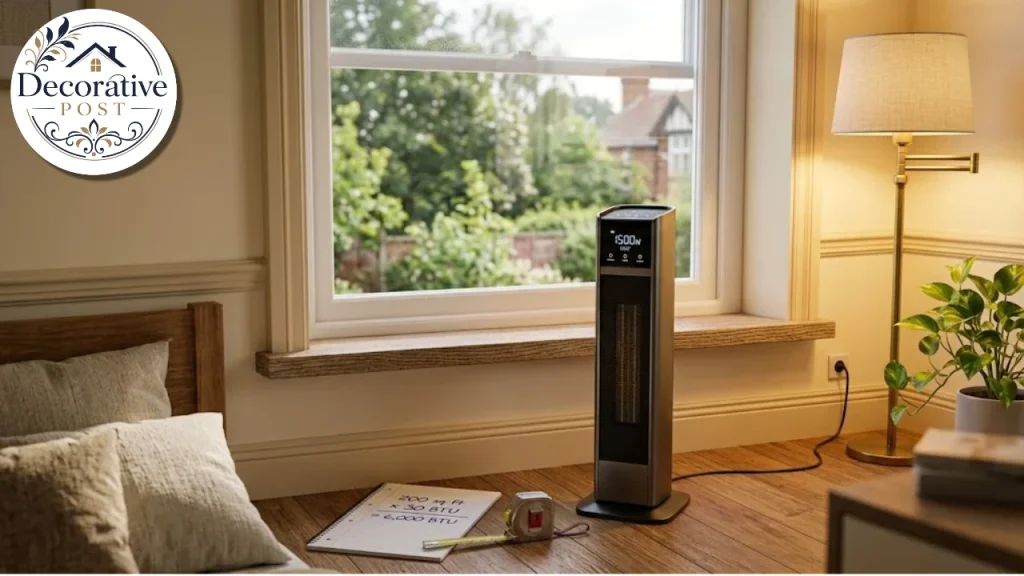
Applying it: a 1,500-watt heater delivers 5,118 BTU per hour, which at 30 BTU per square foot covers about 171 square feet. A 2,000-watt unit covers about 227, and a 5,000-watt unit about 568.
A 200 square foot bedroom is therefore 6,000 BTU, or about 1,760 watts, and a single 1,500 watt heater will fall a little short on the coldest nights.
Where a furnace is already running, and the heater is only a supplement, the rule drops to about 10 BTU per square foot. A 1,500-watt heater could then top up roughly 512 square feet.
What a heater costs to run, in arithmetic
The conversions make cost simple to estimate, even without a bill in front of you.
A 1,500-watt heater draws 1.5 kilowatts. Run at full output for one hour, it uses 1.5 kilowatt-hours, and for eight hours it uses 12. Multiply that by your local rate per kilowatt-hou,r and you have the maximum cost of a night.
It will rarely run flat out for the whole night, because a thermostat cycles it once the room reaches temperature. The figure is a ceiling, not a forecast.
The same arithmetic shows why bigger heaters are not free comfort. A 3,000-watt unit makes twice the heat, and also draws twice the power whenever it is on.
Where the rule of thumb breaks
The 30 BTU rule makes no allowance for insulation, ceiling height, window area, or local winters, and the sources that publish it are open about that.
A well-insulated room in a mild climate loses far less than a leaky one in a cold climate, and the formula treats them the same. A room with a high ceiling holds more air than its floor area suggests.
Treat the output as a baseline, then adjust by judgment. If the room has single-pane windows, an exposed floor or a north-facing exterior wall, move up. If it is a small interior room with good insulation, move down.
The other limit is the circuit. A 11,500-watt heater draws 1.5 kilowatts, which is about 12.5 amps on a 120 volt supply, and it is the reason most portable heaters stop at that figure on a standard household outlet.
Fixed electric heat, and what to do with the wall
Permanent electric baseboards work on the same arithmetic. A baseboard rated at 1,500 watts delivers the same 5,118 BTU per hour as a portable one, and it does so quietly along the exterior wall where heat loss is greatest.
They need almost no upkeep, but they do need dusting. Lint and pet hair on the fins reduce output and can bake into a smell, and the guide to cleaning baseboard heaters covers the safe order, including switching the breaker off first and letting the unit cool.
Leave clearance in front of any heater, and do not box one in. When you plan built-ins along a wall, keep them clear of the heat source and its airflow, a point worth remembering alongside the approach to custom built-ins.
Curtains, sofas and shelving placed against a heater cut its output, trap heat and create a fire risk. Allow breathing space on every side.
Gas, therms and the same unit
Not every home heats with electricity, and the unit shows up on gas bills too. Gas utilities bill in therms, and one therm is 100,000 BTU.
Convert it to electrical terms: one therm equals about 29.3 kilowatt-hours, because 100,000 divided by 3,412 is 29.3. That gives you a way to compare a gas bill and an electricity bill on the same footing.
A furnace or boiler is also rated in BTU per hour, but the rating is its input or output capacity, not the amount a given room needs. A large rating on the nameplate says what the equipment can deliver, not what your house requires.
If you are replacing equipment, a heat-loss calculation for the whole house is the proper basis, and the room-by-room rule of thumb is only a sanity check against it.
Room by room
The right capacity depends on what the room is for, so here is how the adjustments play out in the spaces readers ask about most.
Living rooms
Living rooms usually carry the most people and the most glass. The adjustments for occupants and sun matter more than the base chart.
Furniture layout changes how air moves, too. A sofa pushed against a supply or a heater blocks it, and the way furniture organises a living room is as much a comfort decision as a styling one.
Basements
Basements are naturally cool in summer and cold in winter, so they rarely need much cooling and sometimes need dehumidifying more than air conditioning.
Do the moisture work first. Heating or cooling a damp basement wastes energy, and the sequence for finishing a basement puts water, air quality, and insulation ahead of any equipment choice. Rigid foam on masonry changes the heat loss, and with it the number you need.
Bedrooms
Bedrooms are small and occupied at night, so a modest unit is usually right. Resist the pull to size up, because an oversized unit that cycles on and off is noisier and leaves the air damp.
Kitchens and open-plan spaces
The kitchen adjustment of 4,000 BTU exists because cooking, ovens,s and dishwashers all release heat into the room. If your kitchen opens onto a living area, size for the whole volume plus that allowance.
Rooms with high ceilings
The chart is built on floor area, which assumes a standard ceiling height.
A room with a tall ceiling holds more air, and a pale ceiling colour changes how much light bounces around the room, which the ceiling colour guide explains in detail. Treat both as reasons to lean toward the larger capacity in the range.

The heat sources you forget to count
The adjustments above include people and kitchens, but a room fills up with other heat sources the chart ignores.
Electronics, lighting, and appliances release heat into the room as they run. A ventless laundry machine releases its drying heat indoors rather than through a duct, which is one more reason to think about where it sits, and the guide to ventless washer-dryer combos covers the placement trade-offs.
Windows are the largest variable. A large south- or west-facing window can add more heat in an afternoon than several people, which is exactly why the sunny-room adjustment exists.
Blinds, shades, or reflective film reduce that load before the air conditioner ever sees it. Often the cheapest BTU is the one you never have to remove.
Cut the load before you size the machine
The cheapest BTU is the one you never have to remove or add. Reducing the load first can drop a room into a smaller row of the chart.
For cooling, block the sun at the glass rather than inside it, since heat that has already entered the room has to be pumped out. Shades, blinds, and reflective film all work, and a closed door keeps a conditioned room from sharing its cool air with the hall.
For heating, stop the leaks. Gaps under doors, around windows, and along baseboards let heated air escape faster than any heater can replace it, and sealing them is usually cheaper than a bigger unit.
Both directions respond to the same principle. Fix the envelope, then size the equipment to what is left.
Reading a label and a bill
Three habits help when you are comparing real products.
Look for the capacity in BTU per hour, and for portables look for the SACC figure. Look for the electrical requirement, since a larger unit may need a dedicated circuit. And compare the efficiency rating, because two units with the same capacity can draw very different amounts of power.
On the electricity side, the conversion does the work. A 1,500-watt heater running for an hour uses 1.5 kilowatt-hours, and multiplying that by your local rate gives the cost per hour.
For air conditioners, the efficiency rating tells you how much cooling you get per unit of power, which is why a smaller, more efficient unit can cost less to run than a larger, cheaper one.
The mistakes that cost the most
Sizing by floor area alone and ignoring sun, occupants, and the kitchen.
Buying the biggest unit available, then living with a cold, damp room.
Trusting a portable’s ASHRAE rating instead of its SACC rating.
Applying the 30 BTU heating rule to a leaky, uninsulated room without adjusting.
Expecting a 1,500-watt heater to warm a large open space on its own.
Boxing in a heater with furniture or built-ins.
Heating or cooling a damp basement before fixing the moisture.
Forgetting that a window unit and a heater share the same circuit limits as everything else on the outlet.

What to take from it
A BTU number is only meaningful once you know the room it has to serve. The sizing chart gives a base, the adjustments move it, and the rating on the box may overstate what a portable unit delivers.
Size to the adjusted figure rather than the largest available, because an oversized cooler leaves a room cold and clammy, while an undersized heater runs flat out and still loses.
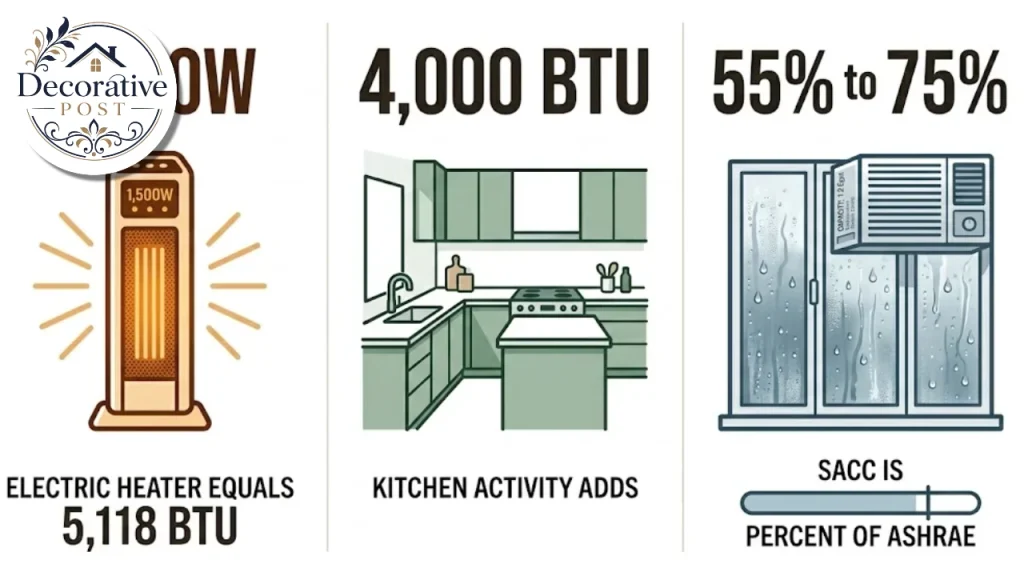
If you remember three things, make them these: a 1,500-watt heater is 5,118 BTU whatever it looks like, a kitchen adds 4,000, and portable ratings should be read as SACC.
FAQs:
What does BTU stand for?
British thermal unit. It is the energy needed to raise one pound of water by one degree Fahrenheit, and appliance ratings usually mean BTU per hour.
How many BTU do I need to cool a room?
The ENERGY STAR chart gives about 5,000 BTU per hour for 100 to 150 square feet, 7,000 for 250 to 300, 9,000 for 350 to 400, and 12,000 for 450 to 550. Adjust 10 percent for sun or shade, add 600 per extra person beyond two, and add 4,000 for a kitchen.
How many BTU is a 1,500-watt heater?
5,118 BTU per hour, because 1 watt equals 3.412 BTU per hour. At the common 30 BTU per square foot rule, that heats about 171 square feet.
How many BTU do I need to heat a room?
A common rule of thumb is 30 BTU per square foot, which is about 10 watts. It ignores insulation, ceiling height, and climate, so adjust up for a leaky or cold room.
How many BTU is one ton of air conditioning?
12,000 BTU per hour. A 9,000 BTU unit is three-quarters of a ton and an 18,000 BTU unit is a ton and a half.
Is a bigger BTU air conditioner better?
No. An oversized unit cools the room quickly and shuts off before it removes enough moisture, so the room stays cold and clammy and the unit short-cycles.
What is the difference between ASHRAE and SACC?
ASHRAE is the raw laboratory capacity, while DOE SACC is adjusted for realistic conditions and the unit’s own losses. On single-hose portables, SACC is commonly 55 to 75 percent of ASHRAE, so size from the SACC figure.
How do I convert kilowatts to BTU?
Multiply by 3,412. One kilowatt equals 3,412 BTU per hour, and one kilowatt-hour equals 3,412 BTU.
Do all 1,500-watt heaters produce the same heat?
Yes, in total output, since resistance heaters turn essentially all the power they draw into heat. They differ in how the heat is delivered and how it feels.