

Neither is a mistake. That is the first thing to settle about grey vs gray, because a surprising number of people believe one is a misspelling and spend time correcting the other.
They are the same word, with the same meaning, describing the same colour. The split is regional, not right and wrong.
What is genuinely useful to know is the handful of cases where the choice is taken out of your hands: words where only one spelling works regardless of where you are writing, and names you cannot change at all. Those are the ones that catch people out.
The short answer
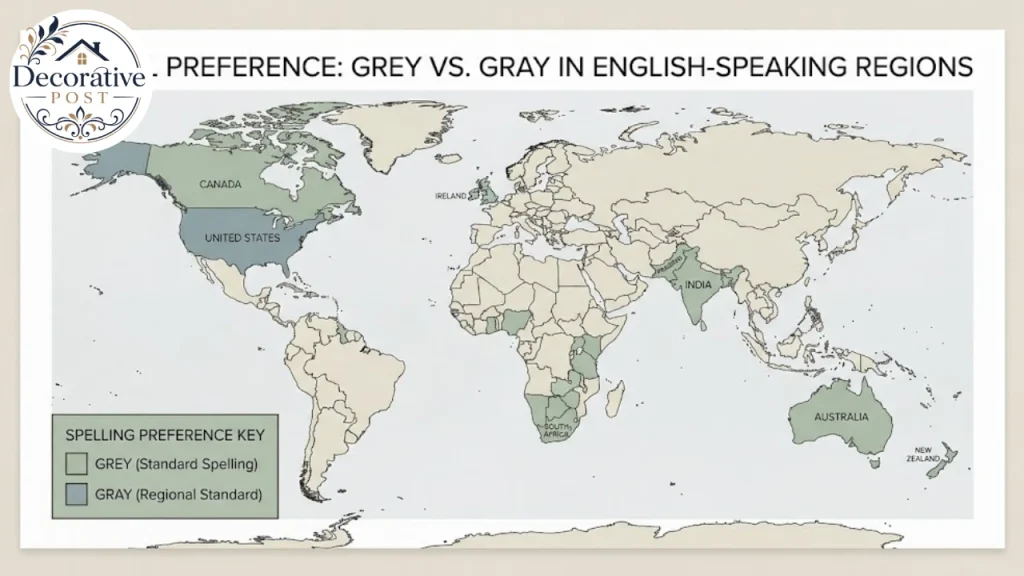
Grey is standard in British English, and in Australian, New Zealand, Irish, South African, and notably Canadian usage.
Gray is the more common spelling in American English.
Both derive from the same Old English root, grǣg, and neither carries a different meaning. Merriam-Webster treats both as common variants and declines to call either one wrong.
Pick the one that matches your audience, apply it consistently, and memorise the five or six exceptions below.
The memory trick that actually works
There is a mnemonic for grey vs gray, and it is unusually good, because it is built into the words themselves.
gr<u>e</u>y has an e, for England. gr<u>a</u>y has an a, for America.
That is it. It covers the general case completely, and once you have it, you will not need to look this up again.
The only thing it does not cover is Canada, which uses grey despite sitting next to the United States. Canadian spelling leans British on a number of these: colour, centre, cheque, and grey follows that pattern.
Where each spelling is standard
A fuller picture, because “British versus American” undersells how the grey vs gray split actually falls.
| Region | Standard spelling |
|---|---|
| United Kingdom | grey |
| Ireland | grey |
| Australia | grey |
| New Zealand | grey |
| South Africa | grey |
| Canada | grey |
| United States | gray |
Put that way, gray is the outlier rather than the norm. The United States is the one major English-speaking country that favours it, which is worth knowing if you write for an international audience; grey is the safer default outside North America.
The practical consequence for anyone publishing online: your traffic determines your spelling. A site with mostly American readers should use gray; one with mixed or Commonwealth readership is better off with grey.
Where the spellings come from
Brief, because the history explains why there is no correct answer.
Both spellings descend from Old English grǣg. Neither is a later corruption of the other; they are parallel developments of the same word, and both have been in continuous use for centuries.
English spelling was not standardised until well after printing arrived, and for a long period both forms circulated freely in both countries. The regional preference we now treat as a rule is a relatively recent settlement rather than an ancient distinction.

Dictionaries reflect that. Merriam-Webster’s own examples show an American novel from 1868–69 using gray and a British novel from 1919 using grey, which is about as clean an illustration of the split as you could want, but it is a pattern of usage rather than a law.
This matters practically. When someone tells you one of these is wrong, they are describing a house style, not a rule of English.
The exceptions, which are the useful part
Here is where the regional rule stops applying. These are the grey vs gray cases worth committing to memory, because the choice is not yours.
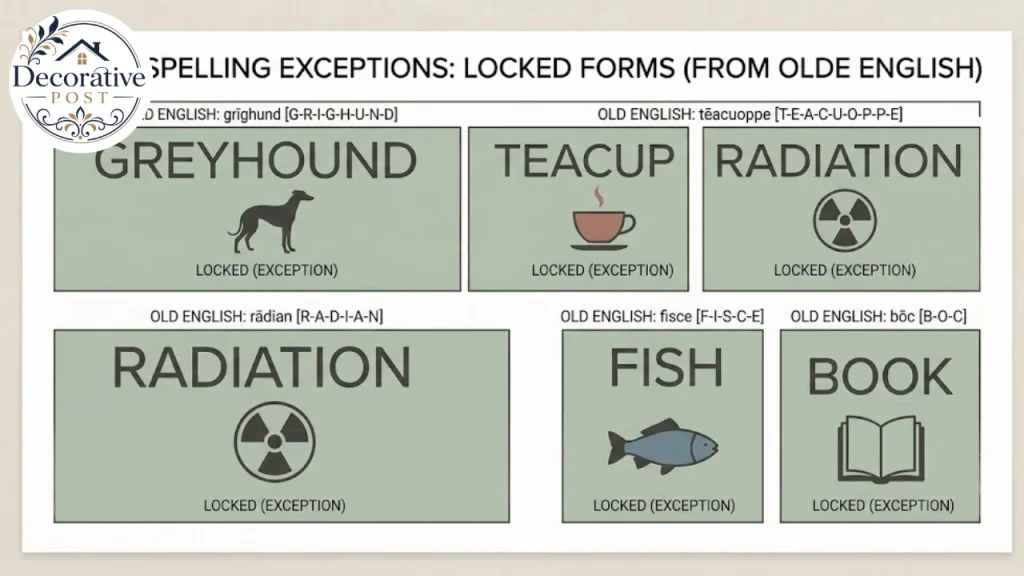
Greyhound is always grey
Even in American English. The dog is a greyhound, never a grayhound, and the brand follows the same spelling.
The reason is genuinely interesting: the word has nothing to do with the colour. Greyhound comes from Old English grīghund, which has a different root entirely from grǣg. The resemblance to “grey” is a coincidence of sound, not a shared origin.
So the spelling is fixed because it was never a colour word to begin with. Most greyhounds are not grey.
The Gray unit is always gray
In scientific writing, the gray symbol Gy is the SI unit of absorbed radiation dose, and it takes the gray spelling in British English too.
That is because it is named after a person: Louis Harold Gray, the British physicist. Units named after people take the person’s name, and his was spelled with an a.
Grayling is always gray
The fish keeps gray in British English as well. One of the few cases where British writing uses the a-spelling by default.
Proper nouns never change
This is the category people get wrong most often, and the rule is absolute: you do not respell a name.
The Picture of Dorian Gray is Gray, because Wilde wrote it that way. Grey’s Anatomy is Grey. Fifty Shades of Grey is Grey. Earl Grey tea is Grey, after Charles Grey, the 2nd Earl Grey.
Brand names likewise. Grey Poupon and Grey Goose both keep the e, and both originated in France rather than Britain.
Surnames come in both forms; Gray and Grey are separate family names, and a person’s own spelling is the only correct one. Changing someone’s name to match your style guide is an error, not a correction.
Everything else follows the region
Grey/gray matter, grey/gray squirrel, grey/gray whale, grey/gray area. All of these take whichever spelling your audience uses, and none is fixed.
A quick reference table
| Term | Spelling | Why |
|---|---|---|
| greyhound | always grey | Different etymology, unrelated to colour |
| Earl Grey | always Grey | Named after a person |
| Grey Poupon, Grey Goose | always Grey | Brand names |
| Dorian Gray, Grey’s Anatomy | as written | Titles and proper nouns |
| gray (the unit, Gy) | always gray | Named after Louis Harold Gray |
| grayling (the fish) | always gray | Established convention |
| grey/gray area | regional | Ordinary usage |
| grey/gray matter | regional | Ordinary usage |
| grey/gray squirrel | regional | Ordinary usage |
How each spelling behaves in a sentence
A small practical matter that trips people up more than the regional question does.
As a noun. “The walls were painted in a soft grey.” Both spellings work identically as nouns, and the article form “a grey” is standard when describing a specific shade.
As an adjective. “A grey sofa.” Again identical. No hyphen when it stands alone before a noun.
As a verb. “His hair is greying.” This is where spelling choice produces a visible difference, because the inflected forms follow the base spelling: greying and greyed in British usage, graying and grayed in American.
Note that American usage sometimes drops to a single consonant pattern that looks unfamiliar to British eyes, and vice versa. Neither needs doubling; it is greying, not greyying.
In compounds. Grey-haired, grey-green, blue-grey. Hyphenate when two colour words modify a noun together, and follow your house spelling throughout the compound.
Greige is the exception already noted. One spelling only, derived from grey plus beige, and it does not have an American variant.
Comparatives. Greyer and greyest, or grayer and grayest. Both regular, both following the base spelling.
The one rule that matters more than which you pick
Consistency.
Choosing grey or gray is a coin toss against your audience. Switching between them inside one document is the thing readers actually notice, and it reads as carelessness rather than as a stylistic choice.
Set it once. Decide at the start of a project, record it, and apply it everywhere: body text, headings, image alt text, captions, metadata, file names.
Check your spell checker’s locale. This is the practical cause of most inconsistency. A document set to US English will quietly flag every grey, and a writer clicking through suggestions will end up with a mixture without ever deciding anything.
Watch quoted material. If you quote a source that uses the other spelling, leave the quotation alone. The spelling inside quotation marks belongs to whoever wrote it.
Watch imported content. Pasted text, supplier descriptions,s and syndicated material arrive with their own spelling, and this is where mixed usage most often creeps into otherwise careful writing.
A find-and-replace pass at the end catches most of it, but run it carefully, because it will happily convert greyhound to grayhound and Dorian Gray to Dorian Grey.
Why paint and interiors make this harder
A specific wrinkle for anyone writing about colour, decorating or design, and the reason this question comes up so often in that context.
Paint colour names are proper nouns. A manufacturer’s colour name is fixed, and it does not change to suit your house style.
American brands overwhelmingly use gray in their colour names, because they write for an American market. British and European brands use grey.
So an article about neutral paint colours will legitimately contain both spellings in the same paragraph: the manufacturer’s spelling inside each colour name, and your own house spelling in the surrounding prose.
That looks like an error and is not one. It is the same principle as leaving a quotation alone.
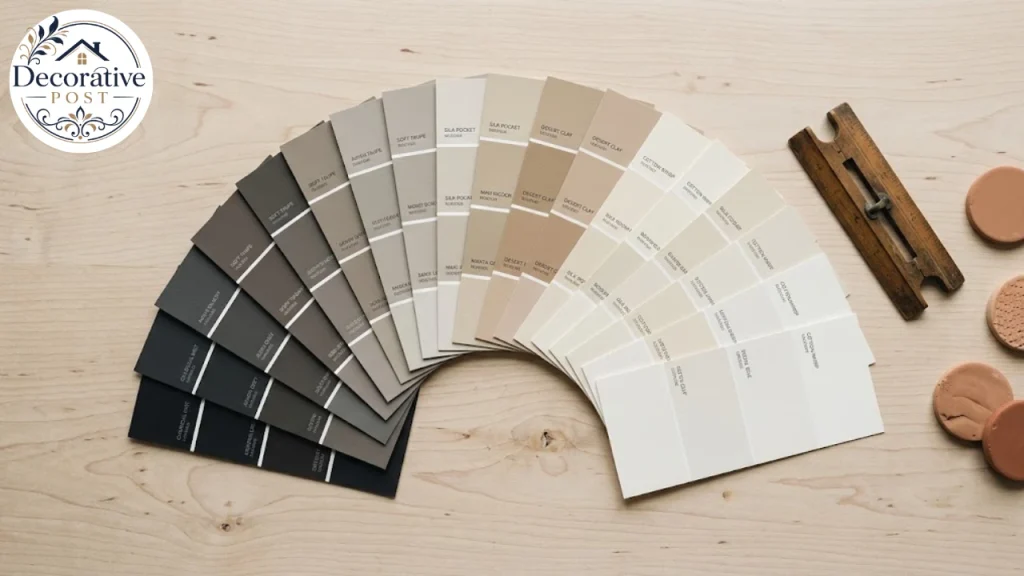
The practical rule for writing about paint: use your audience’s spelling in your own sentences, and reproduce every colour name exactly as the manufacturer spells it. If you are describing a warm neutral in general terms, that is your spelling. If you are naming a specific product, that is theirs.
The same applies to flooring, tile, fabric and furniture finishes. Product names are names.
If you are choosing a neutral rather than writing about one, the spelling is the least of it; what matters is how the colour behaves in your light, which our guide to White Dove paint covers in detail, and which undertone it carries, as our gray green paint guide sets out.
Searching and shopping across both spellings
A practical consequence most style guides ignore.
Search engines mostly handle it. Google treats grey and gray as the same query for general searches, so you will usually see results containing both.
Product catalogues frequently do not. A retailer’s internal site search often treats them as different strings, which means searching “grey sofa” on an American site may return nothing while “gray sofa” returns hundreds of results.
If a product search comes back empty, try the other spelling before concluding the item does not exist. This is a routine cause of fruitless shopping, particularly when buying from a site based in another country.
The same applies to filters and tags. A colour filter labelled “Gray” will not match items tagged “Grey” in a poorly built catalogue, and you may be missing most of the range. This is worth knowing when shopping for anything specified by colour, from home furnishings to basement flooring.
For anyone running a site: index both. Tag products with both spellings, or set up synonym handling in your search. It costs nothing, and it recovers searches you are currently losing.
Which spelling is more common overall
A fair question, and the answer to grey vs gray by volume depends entirely on what you are counting.
By number of countries, grey wins comfortably; it is standard everywhere except the United States.
By volume of published English, gray is competitive, because the United States produces an enormous share of English-language text and because American publishing has long been more centrally standardised.
By search volume, it varies by region in exactly the way you would predict, and the global split is close enough that neither dominates.
The honest conclusion: there is no global winner, which is why both remain in every major dictionary. Anyone telling you one is objectively more correct is expressing a preference.
Does the meaning ever differ?
No, and this is worth stating plainly because the internet contains a persistent myth to the contrary.
You will find claims that grey describes a cooler or bluer shade and gray a warmer one, or that one refers to hair and the other to weather. There is no basis for this in any dictionary or style guide.
The spellings are interchangeable in meaning. If you want to distinguish a cool neutral from a warm one, you need actual descriptive language: charcoal, slate, dove, taupe, greige, not a spelling change.
Where the myth probably comes from is paint marketing, where the two spellings appear across different brands with different palettes. If the American brands you see use gray and happen to have warmer collections, a pattern appears that is entirely coincidental.
There is one genuine near-exception. Because greyhound and the gray unit have fixed spellings for etymological reasons, you could argue those words carry meaning tied to a spelling, but they are separate words, not shades of the same one.
Writing for a mixed audience
Practical advice for anyone publishing to an international readership, which online means most people.
Pick by majority. Check your analytics. If more than half your readers are American, use gray. Otherwise grey is the safer choice.
Do not try to use both. Alternating to please everyone pleases nobody and looks like an error.
Mention both once, early, if the distinction matters. On a page about the colour specifically, a single parenthetical “grey (or gray)” acknowledges the variant without disrupting the text.
Use both in metadata. This is the one place where covering both spellings is legitimate and useful. Alt text, image file names, and tags can reasonably include the variant your body copy does not use.
Never let a translation or localisation tool decide. Automated locale switching will convert proper nouns, and you will end up publishing Dorian Grey.
Grey and gray in design writing specifically
Grey vs gray carries slightly more weight in design writing than elsewhere, for two reasons.
Interior and design writing uses this word constantly, far more than general prose, because grey is one of the dominant neutrals in contemporary decorating. This means an inconsistency shows up repeatedly rather than once.
It also means the word appears in high-visibility positions: headings, product names, image captions, URL slugs. Anything from a grey-green wall colour to a sofa description carries it. A URL containing one spelling and a heading containing the other is a small but real credibility problem.
Set the spelling before you write the first article in a series. Retrofitting it across a site is tedious, and URL slugs in particular are awkward to change once indexed.
Decide how you will handle product names as a standing rule, and write it down. “Manufacturer spelling inside colour names, house spelling everywhere else” is the clean version.
Be careful with greige, which is one spelling only and derived from grey plus beige regardless of your house style. Nobody writes graige.
The word also turns up constantly in furniture and finish descriptions: a reclining sofa listing, a kitchen backsplash tile name, a flooring shade, and each of those is a place where house style and manufacturer spelling can collide.
The underlying colour decisions matter far more than the orthography. Whether a neutral reads warm or cool in a given room depends on light and undertone, and the same reasoning that governs choosing a ceiling colour applies to choosing a wall neutral, which is why sampling beats any amount of reading.
A note on style guides
If you work to a published style guide, it has already decided this for you and the decision is not negotiable.
American guides, the Chicago Manual of Style and AP, follow American spelling conventions throughout, which means gray.
British guides follow Oxford style conventions; the Guardian and Observer style guide and the Economist style guide use grey.
Academic publishing follows the journal, not the author. A British researcher publishing in an American journal writes gray, and the copy editor will change it if they do not.
Corporate style guides often specify this explicitly, and if yours does not, it is worth adding. A one-line entry prevents a recurring argument.
The useful principle: when a style guide exists, it outranks your preference, and it outranks this article. When one does not exist, your audience decides.
For anyone writing to no guide at all— most bloggers and small business owners — the practical answer is to write down your own choice somewhere you will find it again. A single line in a notes file beats trying to remember what you decided eighteen months ago.
Common mistakes
Treating one spelling as an error. Both are correct. Correcting someone else’s regional spelling is the actual mistake.
Respelling proper nouns. Dorian Gray, Earl Grey, Grey’s Anatomy. Names are fixed.
Converting greyhound. Always grey, in every variety of English, because it was never a colour word.
Converting the gray unit. Always gray, including in British scientific writing, because it is named after a person.
Running an unchecked find-and-replace. It will break every exception above.
Changing spelling inside a quotation. Leave quoted text as the source wrote it.
Mixing both in one document. The only genuine error available on this topic.
Believing the warm-versus-cool myth. There is no meaning difference. Use real descriptive words instead.
Teaching it, or settling an argument
Three framings that work when you need to explain this to somebody else.
For children or language learners, the E-for-England and A-for-America mnemonic is enough. It is memorable, it is accurate for the general case, and the exceptions can wait.
For a colleague who insists one is wrong, the dictionary settles it fastest. Merriam-Webster, an American dictionary, lists both as common variants and does not mark either as incorrect. That is difficult to argue with.
For an editor applying a style guide, there is nothing to argue about. The guide decides,s and the writer complies, the same way they comply on serial commas.
The conversation that genuinely matters is not which spelling but whether the document is consistent. Redirecting the argument there turns a preference dispute into a solvable problem.
One last practical note. If you are publishing on the web and genuinely unsure, look at your three most-read pages and see what you used. Matching your existing content costs nothing and avoids the inconsistency that is the only real error here.
A decision in four steps
One: identify your audience. American readers: use gray. Anyone else, including Canadian readers, use grey.
Two: set your spell checker to match before you start writing rather than after.
Three: learn the six exceptions. Greyhound, Earl Grey, the gray unit, grayling, brand names, and all proper nouns.
Four: be consistent everywhere, including headings, captions, alt text, slugs, and file names.
The whole of grey vs gray reduces to that. It is a regional preference with a short list of fixed cases, and the only real error is inconsistency within a single piece of writing.
Which is a relief, because the actual difficulty with this colour has never been the spelling. It is that there are several hundred of them and most look identical on a screen.
FAQs:
Is it grey or gray?
Both are correct. Grey is standard in British, Irish, Australian, New Zealand, South African, and Canadian English. Gray is the more common spelling in American English. They mean exactly the same thing.
Which spelling is used in America?
Gray. The United States is the main English-speaking country that prefers the a-spelling, which is why the mnemonic works: gray for America, grey for England.
Do grey and gray mean different things?
No. The claim that one describes a cooler shade and the other a warmer one appears online but has no basis in any dictionary. Both spellings come from the same Old English root, grǣg, and are interchangeable in meaning.
Why is greyhound always spelled with an e?
Because the word has nothing to do with the colour. Greyhound derives from Old English grīghund, a different root from grǣg, so the spelling is fixed in American English too. Most greyhounds are not grey.
Which spelling does Canada use?
Grey. Canadian spelling follows British convention on this, as it does with colour, centre and cheque, despite the proximity to the United States.
Should I change the spelling in a brand or product name?
No. Proper nouns and product names keep their original spelling: Earl Grey, Grey Poupon, Grey Goose, The Picture of Dorian Gray. This includes paint colour names, which is why an article about neutrals may legitimately contain both spellings.
Why do some paint colours use gray and others grey?
Because colour names are proper nouns reflecting the manufacturer’s market. American brands use gray in their names; British and European brands use grey. Reproduce each name exactly and use your own house spelling in the surrounding text.
Which spelling is more common worldwide?
Grey is standard in more countries, but the United States produces a large share of published English, so neither dominates globally. Both appear in every major dictionary as acceptable variants.