

The showroom is the worst place to judge one of these. Open floor, no walls, nothing behind it, nothing in front. Every model feels spacious because the space is borrowed.
Then it arrives in a room with a wall behind it and a coffee table in front, and the thing that seemed generous turns out to need nearly four feet of floor it does not have.
That is the first half of this. The second half is what breaks, when, and what it costs because a reclining sofa has moving parts, and moving parts have a service life nobody mentions at the point of sale.
The short answer
A standard reclining sofa needs 12 to 18 inches of clearance behind it to recline fully. A wall-hugger needs only 4 to 6 inches, because the seat slides forward as the back goes down.
The footrest extends roughly 18 to 24 inches forward from the seat base, so you need that much clear floor before a table or anything else.
Manual is cheaper, simpler, and easier to repair. Power costs more, needs an outlet, and gives infinite positions plus optional powered headrests.
A good one lasts 10 to 15 years or more. The cable goes first, at around 5 to 8 years.
The clearance arithmetic
A reclining sofa has three measurements that matter, and most people take only the first.
Behind. A standard reclining mechanism pivots the back rearward, which is why it needs 12 to 18 inches of wall clearance. A sofa pushed flat against a wall will not recline fully, and forcing it damages the mechanism and the wall.
In front. The footrest travels 18 to 24 inches forward. Add that to the sofa’s closed depth, and you get the real floor footprint, which is frequently over five feet.
Around. Walkway space, which is the one that determines whether the room still functions. A reclined sofa that blocks the route between the door and the kitchen makes the room worse even though the sofa is comfortable.
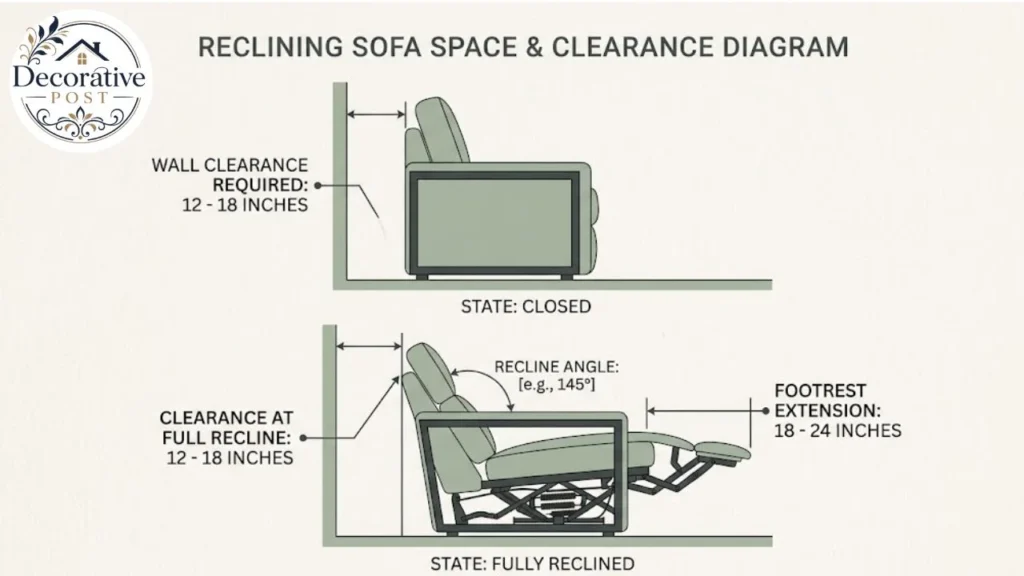
The method. Mark the full reclined footprint on the floor with painter’s tape, the depth plus 24 inches forward, and the clearance line behind. Live with that outline for a day. Walk the room. Open the door.
It takes ten minutes, and it is the single most reliable way to avoid an expensive mistake, because furniture retailers will not refuse a sale on dimensional grounds and delivery crews will not carry it back for free.
Wall-huggers, and when they are the answer
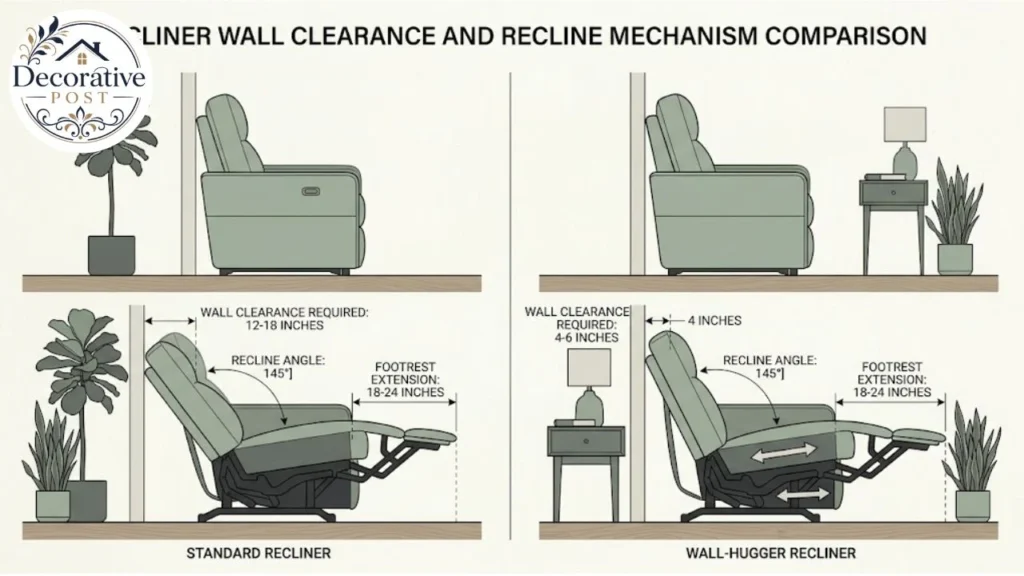
If the clearance maths does not work, this is the solution, and it is underused.
A wall-hugger reclines by sliding the seat forward rather than tipping the back rearward. The result is the same seating position with 4 to 6 inches of wall clearance instead of 12 to 18.
That difference decides whether a reclining sofa fits a small living room at all. It also means the sofa can sit where a conventional one cannot:t against a window wall, in front of a radiator run, or in a room where the only viable wall is the shortest one.
The trade-offs are real but modest. Wall-huggers generally cost more for equivalent quality, the recline angle is sometimes slightly shallower, and the forward slide means the floor space in front still needs to be clear.
If your room is tight, price a wall-hugger before concluding a reclining sofa is impossible. It usually is not; it is just a different product.
Power or manual
The decision that affects price, repairability, and how the sofa will suit you in a decade.
Manual. A lever, a handle, or body weight against the back. Cheaper, mechanically simpler, no cord, and significantly easier to repair; a failed cable is an $8 to $20 part.
The cost is effort and granularity. You get two or three positions rather than a continuous range, and operating it requires reasonable core strength. That last point matters more over time than most buyers expect.
Power. A button or a handset drives a motor. Infinite positions, which is genuinely more comfortable on a long sit, and it requires no physical effort at all.
Premium power models separate the back and legrest into independent controls, add USB charging, and often include a powered headrest that tilts forward without changing the recline angle. For anyone who reads or watches television on the sofa, that headrest is the feature most likely to justify its cost.
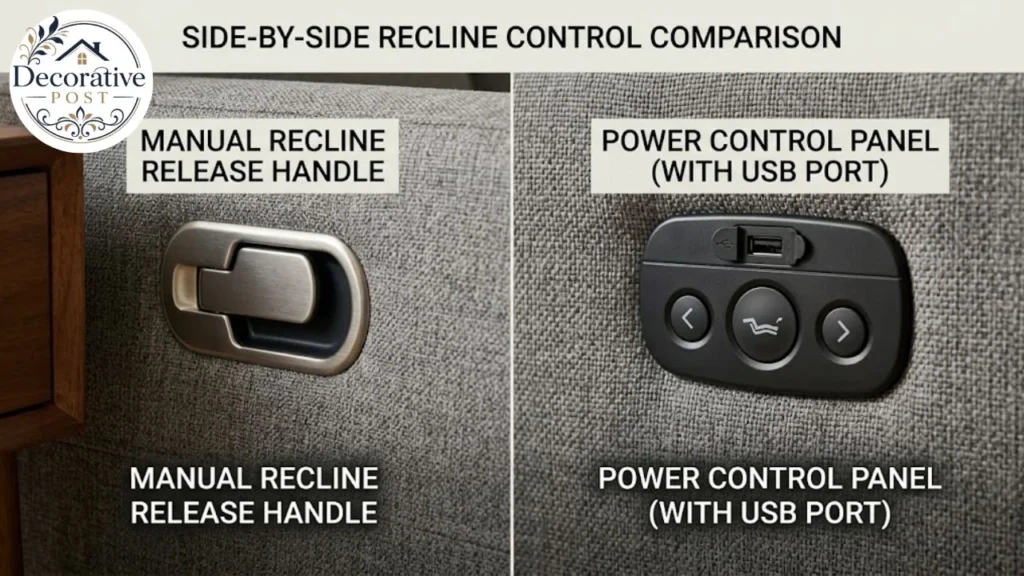
The costs are a cord, a higher price, and more components that can fail. A motor is $80 to $200 against a cable’s $8 to $20.
The honest split. Manual for a guest room, a secondary sofa, or a household on a budget who values simplicity. Power for a primary sofa that gets hours of daily use, and for anyone with limited mobility or strength, where it stops being a luxury and becomes the reason the furniture works.
Cord routing, before delivery, not after
A small thing that causes disproportionate annoyance.
Power models need a socket, and the cords are short. Plan the route before the sofa arrives, because moving a 300-pound reclining sofa to reach a socket is a two-person job you will do once and resent.
Extension cords are not a permanent solution. Beyond the trip hazard, continuous draw through a light-duty extension lead is poor practice. If there is no socket within reach, that is an electrician’s job.
Some models offer an optional battery pack, which removes the cord entirely and is worth asking about if the sofa needs to float in a room rather than sit against a wall.
For a sofa positioned in the middle of an open-plan space, cord management becomes a visible design problem rather than a practical one. Worth thinking about alongside the rest of the room layout, which the ideas in our cozy living room guide cover in more detail.
What actually determines how long it lasts
Not the upholstery. This is the part retail displays get backwards.
Frame and mechanism quality matter more than the leather. A well-built reclining sofa with a good frame and mechanism lasts 10 to 15 years or more, and the covering is the part you can repair or replace. A failed frame is terminal.
What to ask about the frame. Kiln-dried hardwood is the benchmark. Particleboard and low-grade engineered panels in a reclining frame are a problem specifically because the mechanism loads the frame in ways a static sofa never experiences;s every recline cycle is a stress event.
The mechanism is the other half. Reclining hardware is heavy steel linkage, and the difference between a good mechanism and a cheap one shows up at year six rather than on the showroom floor.
Weight is a crude proxy. Reclining sofas are considerably heavier than static ones because of the hardware, and within a price bracket the heavier unit usually has more steel and more timber in it.
Ask how the mechanism is warranted, separately from the frame and separately from the upholstery. Those three are routinely covered for different periods, and on power models the electronics are often a fourth category with the shortest term of all.
Upholstery, ranked honestly
Leather dominates the reclining sofa market, and the grades matter more than the marketing suggests.
Top grain. The practical choice for most reclining sofas. A protective finish, easy to wipe clean, and it handles the friction of a moving mechanism well.
Full grain. The most durable, with a natural surface that develops patina over years. It also shows contact marks more readily, which some people read as character and others as wear.
Italian Nappa. Soft, fine-grain, premium. Best deployed on the seating panels and headrests where you actually touch it.
Bonded leather: avoid. It peels and flakes in high-contact areas, which on a reclining sofa means exactly where your head, elbows, and hands go. This is the single most common regret in budget reclining furniture.
“PU leather” and “leather match” avoid on primary seating. Leather match puts real leather on the contact surfaces and vinyl elsewhere, which is a reasonable compromise on sides and backs but not on the parts you use.
Performance fabric is a legitimate alternative, particularly with children or pets. Modern performance weaves resist spills well and avoid the cold-in-winter problem leather has.
A detail specific to reclining furniture: the moving panels flex thousands of times over the sofa’s life, and cheap coverings fail at those flex points first. Check what covers the reclining sections specifically, not just the seat.
What breaks, when, and what it costs

The section no retailer publishes, and the most useful information in this article.
| Part | Typical service life | Replacement cost |
|---|---|---|
| Pull cable | 5–8 years | $8 – $20 |
| Power motor | 5–10 years | $80 – $200 |
| Handset / remote | Varies | $15 – $40 |
| Springs | 8–15 years | Part cost modest, labour varies |
| Mechanism overall | 10–20 years with maintenance |
The cable is the first thing to go on a manual recliner, and it is a cheap part. A sofa that will not open is usually a frayed or detached cable rather than a dead mechanism, which is worth knowing before anyone talks you into a replacement.
On a power model, replace the handset before the motor. A handset is $15 to $40; a motor is $80 to $200. Non-responsive power is often the handset, the transformer, or a loose connector rather than the motor itself.
Check the warranty before any motor work. Opening the unit yourself can void coverage on exactly the component you are trying to fix.
Diagnosing the common faults
Will not open. Check for a cushion or debris blocking the mechanism first, then the pull cable; reattach it to its bracket hook or replace it. A bent release lever can sometimes be realigned.
Footrest will not fully close. Usually a linkage rod that has popped out of its clip. Snap it back, lubricate the pivots, and cycle the footrest about ten times. If it still will not close, the return spring is weak and needs replacing.
Footrest drops on its own. Weak return spring. Replace it.
Squeaking or grinding. Dry metal-on-metal pivots. Lubricate every pivot point, hinge pin, and cable guide, then wipe off the excess.
Leans to one side. A broken torsion spring, loose frame bolts, or an uneven leg. Tighten the bolts on both sides, level the feet, and replace the spring if it has gone.
Power dead. Reset the outlet and breaker, check the transformer’s indicator light, reseat the connectors, then try a new handset before considering the motor.
A safety note on torsion springs: they are under high tension. Wear eye and hand protection if you handle them, or leave that one to a technician.
Maintenance, which almost nobody does
Fifteen minutes twice a year roughly doubles the usable life of the mechanism.
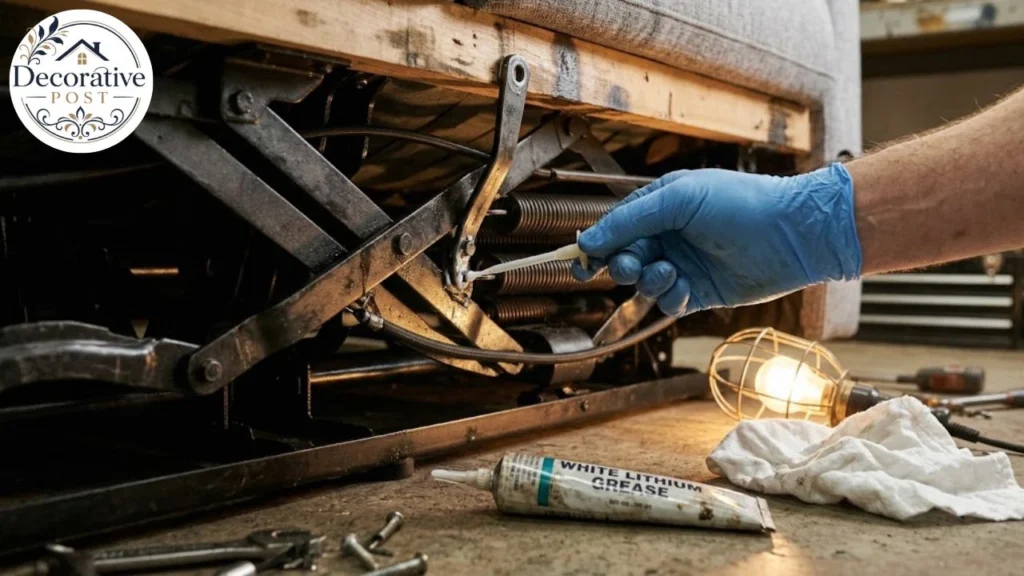
Every six months. Lubricate the pivots and the pull cable, tighten the accessible bolts on the base frame and mechanism, and inspect the cables and springs for fraying or distortion.
Use white lithium grease on metal pivots. It lasts considerably longer than a spray penetrant. Avoid cooking oils and petroleum jelly, which attract dust and degrade. Paste wax works on any rubbing wooden parts.
Every twelve months. Clean the upholstery, replace worn feet or glides, and check power connections and cords on electric models.
The bolts are the item people skip and the one that matters most. A reclining mechanism works loose over hundreds of cycles, and a sofa that develops a wobble or a lean is usually telling you about fasteners rather than failure.
When to repair and when to replace
Three conditions where replacement is the better call.
The frame is cracked. Terminal. Frame repair on upholstered furniture is rarely economical.
Repair costs exceed about half the price of a new sofa. At that point, you are funding someone else’s labour on a product already past its midpoint.
Parts are no longer available. Mechanism hardware is model-specific, and manufacturers discontinue it. It’s worth asking about parts availability before buying from a brand you have never heard of.
Everything short of those is usually worth fixing, and often by you. A cable, a spring, a handset, and a set of bolts cover the large majority of faults on a sofa that is otherwise sound.
Configurations, and the trade-offs in each
Two-seat reclining sofa. Both seats recline, usually with a shared or separate console. The most space-efficient option and the easiest to fit.
Three-seat with reclining ends. The common arrangement, and the compromise is the middle seat. It typically does not recline and often sits over the mechanism housing, which makes it the least comfortable seat in the house. Fine for a household of two; worth considering if three people regularly sit together.
Reclining sectional. Maximum seating and maximum footprint. The corner unit rarely reclines, and clearance has to work on two walls rather than one,e a real constraint in a bi-level or split-level home where the living area is often the narrower room.
Power sofa with drop-down table. Increasingly common, and it suits a media room or a finished basement better than a formal living room.
A practical note on the middle seat: sit in it in the showroom for several minutes. It is the seat that gets used by guests and children, and it is the one nobody tests.
Testing one properly in a showroom
Thirty seconds on a sofa tells you nothing. These are the things to actually do before buying.
Sit for ten minutes, reclined. Recliner comfort reveals itself slowly, and the model that feels best in the first moment is frequently not the one that feels best at minute eight. Lumbar support in particular only declares itself after a few minutes.
Operate the mechanism five or six times. Listen for grinding, watch for hesitation, and check whether the footrest returns fully and smoothly each time. A mechanism that is already rough on the showroom floor will not improve.
Check the recline at the angle you will actually use. Most people recline partially rather than fully. Try the intermediate positions, which is where manual models are weakest.
Sit in the middle seat. The one nobody tests, and often the worst seat in the house on a three-seater with reclining ends.
Get up from it. Standing out of a reclined sofa is harder than sitting into one, and seat height determines how hard. If anyone in the household has knee or hip trouble, this test matters more than any other.
Look at the back. It will face the room in some positions. Showrooms place sofas against partitions precisely so you do not see this.
Take a tape measure with you and check the manufacturer’s stated dimensions against the actual piece. Published figures are occasionally the closed depth rather than the reclined one, and the discrepancy is always in the retailer’s favour.
Measuring for delivery
Separate from the clearance question, it catches people out independently.
Measure the tightest point on the route, not the front door. Hallway turns, stair landings and interior doorways are where furniture gets stuck.
Ask whether the sofa is modular or can be delivered in sections. Many reclining sofas separate, and some do not. This single question determines whether difficult access is a problem.
Measure the diagonal of your doorways. A sofa that will not fit through square often passes at an angle, and delivery crews know this, but it helps to know in advance whether it is marginal.
Reclining sofas are heavier than their static equivalents because of the steel hardware, so stairs are a genuine consideration rather than an inconvenience.
Confirm what the delivery includes: threshold, room of choice, assembly, packaging removal. “Delivery” sometimes means your driveway.
Living with one
The honest differences between a reclining sofa and a static one, after the novelty passes.
You lose the clean back line. Reclining sofas are designed to sit against a wall, and the backs are often plainer than the fronts. In an open-plan room where the back is visible, that matters, and it is the thing people notice from the doorway.
Throws and cushions interfere. Anything draped over the back can foul the mechanism, and loose cushions end up in the footrest gap. Reclining sofas resist the styling that makes a static sofa look finished.
Vacuuming underneath is awkward. The mechanism housing sits low,w and the frame is heavy. Expect a permanent dust zone unless you recline the sofa to clean under it.
The gaps are real. When reclined, there are open gaps between the seat and the back where remote controls, phones,es and food go to die.
It is heavy. Rearranging the room becomes a project rather than an afternoon whim.
None of these is a reason not to buy one. They are the reasons to buy one deliberately, for a room where comfort is the brief, rather than by default.
Making it look intentional
Reclining furniture has a reputation for ruining living rooms, and it is partly earned. These things help.
Choose a lighter or more interesting colour than instinct suggests. The default dark brown is what makes reclining furniture read as functional rather than designed. Greys, creams and the deeper blues all look like furniture first.
Mind the visual weight. A large reclining sofa needs something substantial opposite it: a bookcase, a fireplace, or art scaled to match, as covered in our guide to decorating walls.
Ground it with a rug. A rug large enough to sit under the sofa’s full reclined footprint anchors it and stops the piece from looking marooned. A DIY area rug is a cheap way to test the proportion before committing.
Keep the side tables clear of the footrest arc. A table that works when the sofa is closed and gets kicked when it opens is a daily irritation.
Think about the sightline from the door. In a combined entryway and living space, the back of the sofa is often the first thing you see.
Protect the floor. Reclining sofas are heavy, and the feet carry concentrated load, particularly as the mechanism shifts weight rearward. Felt pads are essential on wood; our guide to cleaning hardwood floors covers what heavy furniture does to a finish over years.
What it costs
Planning ranges rather than quotes, since this category spans a lot of ground.
| Configuration | Typical range |
|---|---|
| Manual two-seat | $700 – $1,500 |
| Manual three-seat | $900 – $2,000 |
| Power two-seat | $1,200 – $2,400 |
| Power three-seat | $1,500 – $3,200 |
| Power with headrest and console | $2,000 – $4,000 |
| Reclining sectional | $2,500 – $6,000+ |
| Premium leather, full grain | $3,000 – $7,000+ |
Where to spend if the budget is finite: the frame and the mechanism. Those are the parts that cannot be fixed cheaply or replaced selectively.
Where to save: upholstery grade on the non-contact surfaces, and features you will not use. A drop-down table on a sofa in a formal living room is costly with no return.
If you are furnishing a room from scratch rather than replacing one piece, the sequencing in our guide to home furnishings is worth reading before committing the budget to the largest item.
Floor models are worth asking about. A reclining sofa that has been sat in by strangers for six months is still a sofa with a full warranty, often at a substantial discount, and the mechanism has effectively been stress-tested.
Who should buy one
Buy one if the room’s purpose is comfort: a den, a media room, a basement living space,e and you have the clearance for it in both directions.
Buy one if anyone in the household has mobility limitations or spends long periods seated. Power recline in that situation is not an indulgence.
Buy a wall-hugger if the clearance maths fails on a standard model. Price it before giving up on the category.
Think twice if the sofa has to be the centrepiece of a formal room with its back on display, or if the walkway is already tight.
If only one person in the household reclines, a single armchair is often the better bet. Our guide to the BarcaLounger covers what to look for in a standalone recliner and how the mechanisms compare.
Choose a static sofa and a separate recliner if only one person actually reclines. That combination usually costs less, fits better, and gives you a sofa that looks like a sofa.
The thing to settle before anything else is the tape on the floor. A reclining sofa that fits is a genuinely good piece of furniture; one that does not is an expensive object you resent every time you walk around it.
Measure first, then shop.
FAQs:
How much space do you need behind a reclining sofa?
A standard model needs 12 to 18 inches of clearance between its back and the wall to recline fully. A wall-hugger needs only 4 to 6 inches because the seat slides forward rather than the back tipping rearward.
How far does a reclining sofa extend when open?
The footrest travels roughly 18 to 24 inches forward from the seat base. Add that to the sofa’s closed depth to get the real floor footprint, which often exceeds five feet.
Is power or manual recline better?
Manual is cheaper, mechanically simpler, and easier to repair, with a failed cable costing $8 to $20. Power gives infinite positions, requires no physical effort, and suits daily use or limited mobility, but a motor costs $80 to $200 to replace.
How long does a reclining sofa last?
A well-built sofa with a quality frame and mechanism lasts 10 to 15 years or more. The mechanism itself can run 10 to 20 years with maintenance. Pull cables typically fail at 5 to 8 years and power motors at 5 to 10.
Why won’t my reclining sofa open?
Most often, it’s a frayed or detached pull cable, which is an inexpensive part. Check first for a cushion or debris blocking the mechanism, then inspect the cable and its bracket hook. A bent release lever can sometimes be realigned.
How do you stop a reclining sofa squeaking?
Dry metal pivots cause it. Lubricate every pivot point, hinge pin, and cable guide with white lithium grease, then wipe off the excess. Avoid cooking oils and petroleum jelly, which attract dust and degrade.
What leather should you choose for a reclining sofa?
Top grain is the practical choice for most people, durable with a protective finish and easy to clean. Avoid bonded leather, which peels at high-contact points, and avoid “leather match” or PU on the primary seating surfaces.
Can a reclining sofa go against the wall?
Only a wall-hugger can sit close to a wall, at 4 to 6 inches. A standard reclining sofa pushed flat against a wall will not recline fully, and forcing it damages both the mechanism and the wall.