

Nobody searches for how to potty train a puppy in week one. Week one is fine; you are running on adrenaline, and the puppy is small enough that the accidents are small.
Week two is when people start searching for this at two in the morning, having just cleaned urine out of a rug for the third time that day, quietly wondering what they have done.
That is the normal part. Here is the plan that gets you out of it, including the half nobody else writes about what to do with your actual house while it is happening.
The short answer
How to potty train a puppy: take them out on a schedule based on their age, use the same spot and the same cue every time, reward within three seconds of them finishing, supervise or confine them indoors at all times, and clean every accident with an enzymatic cleaner.
Most puppies are not reliably house-trained until four to six months old. Anyone promising seven days is describing early progress, not a finished dog.
The bladder clock, properly explained
Every guide on how to potty train a puppy repeats the same rule: a puppy can hold their bladder for roughly one hour per month of age. Some sources say one hour per month plus one.
Both versions circulate widely, and the difference is less important than the thing neither version says clearly: this only applies to a calm, resting puppy.
The moment a puppy wakes up, eats, drinks, or plays, that window collapses to somewhere between five and fifteen minutes. A two-month-old mid-play session may need to go every fifteen to twenty minutes.
So the rule is a floor, not a schedule. Use it to set your maximum interval, then override it completely after every meal, nap, drink, and play session.
Full voluntary bladder control usually arrives around seven months. Before that, you are not training a puppy to hold it you are managing a body that physically cannot.
That reframe matters. Most frustration in potty training comes from treating a developmental limit as disobedience.
Smaller breeds often need more frequent trips than the table suggests, because bladder capacity scales with body size.
Set the house up before you set the schedule
This is the part of how to potty train a puppy that the training guides skip, and it is where most of the damage actually happens.
Reduce the territory. A puppy with access to five rooms will use five rooms. Baby gates or an exercise pen confining them to one or two hard-floored rooms makes supervision possible and accidents survivable.
Roll up the good rugs. Not forever just for the training phase. If you are buying for this period, a cheap washable or DIY area rug is the sensible stopgap. Urine that soaks into a rug pad is far harder to eliminate than urine on a sealed floor, and a rug that still smells faintly of it to a dog becomes a designated toilet.
It is also worth thinking about what you bring into the room during this period. Our notes on choosing home furnishings are a useful filter: anything with an absorbent base is a liability for a few months.
Know what your floors can take. Sealed hardwood tolerates a prompt wipe-up. Standing urine left for hours will penetrate the finish and stain the wood beneath, and that damage is permanent. Our guide to cleaning hardwood floors covers what is safe to use and what will dull a finish.
Put the supplies where the accidents are. Enzymatic cleaner, paper towels, and a bin in the room the puppy lives in, not under the kitchen sink, two rooms away. If you are short on storage, the thinking behind good laundry room cabinets applies keep what you use daily at hand height, not in a cupboard. Speed matters enormously with urine on wood.
Sort out the route to the door. You will walk it fifteen times a day. Shoes, lead, and treats by the door, nothing to trip over, no closed doors in the way. If your entry doubles as living space, the layout ideas in our entryway and living room combo guide are worth a look before the puppy arrives.
Keep a towel by the door. Wet paws plus a sprint to the kitchen is how a clean floor stops being clean.
Build them a proper potty spot
Puppies learn location by surface and smell. A designated spot speeds everything up, and it is easy to make.
Pick somewhere close to the door you want ten seconds of walking, not two minutes. Sheltered from the worst weather helps, because a puppy that refuses to go out in rain will hold it and then go inside.
A small gravel or pea-shingle area works better than grass for this. It drains, it does not die from urine burn, and it gives a distinct underfoot texture that the puppy will learn to associate with the job. The construction is the same as a pea gravel patio or fire pit area excavate, membrane, edging, and gravel.
Keep it small. A two-meter square is plenty, and a small spot concentrates the scent, which is the whole point.
Leave one soiled patch unclean for the first week or two. The smell marks the spot as correct. After that, clear solids daily, or the puppy will start avoiding it.
If the rest of your garden is the problem bare patches, drainage, lawn burn our garden tips cover the recovery side.
The routine that actually does the work
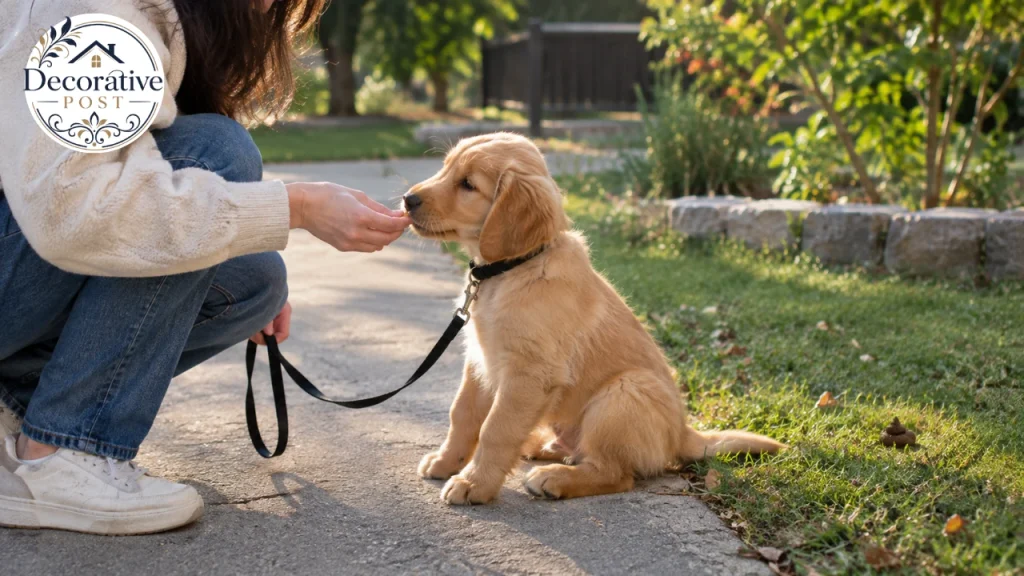
The scheduling half of how to potty train a puppy comes down to this. Take them out at every one of these moments, without exception: first thing in the morning, after every meal, after every nap, after every play session, after every drink, when they come out of the crate, and last thing at night.
Use a lead, even in your own garden. It stops the trip becoming a play session and keeps them in the designated spot.
Go to the same place every time. Stand still and be boring. A puppy investigating an exciting human will forget why they came out.
Say your cue “go potty,” “be quick,” or whatever you pick calmly, as they begin, not before. Saying it repeatedly beforehand teaches them nothing.
Reward within three seconds of them finishing. Not when you get back inside. Three seconds is roughly the window in which a dog connects a reward to a behavior.
Then stay out for a few minutes and play. If going to the toilet always means being taken straight back indoors, a smart puppy learns to delay as long as possible.
Indoors, they are either actively supervised, tethered to you, or confined. “Loose and unwatched” is where accidents come from, and every accident sets you back.
Crate training, done right
The crate works because dogs have a strong instinct not to soil where they sleep. That instinct only functions if the crate is the correct size.
It should allow the puppy to stand, turn around, and lie down comfortably. Any larger, and they will toilet in one end and sleep in the other, which teaches exactly the wrong lesson.
Most crates come with a divider panel for this reason. Move it out as the puppy grows rather than buying three crates.
Never put pee pads in the crate. It directly contradicts the instinct you are relying on.
Always toilet them immediately before going in and immediately after coming out. Every single time.
The crate is a management tool, not a storage solution. A puppy should not be in it longer than their age-appropriate hold time and never as punishment.
Pee pads: the honest trade-off
You will find contradictory advice on this, so here is the actual position.
Pads help if you live in a flat several floors up, the puppy is not yet fully vaccinated, you are out for stretches longer than the bladder clock allows, or the dog is a toy breed who may use indoor toileting permanently.
Pads hurt if your goal is a dog that toilets outdoors. You are teaching that going indoors on an absorbent surface is acceptable, and then later asking the puppy to unlearn it. Rugs, bath mats, and towels are all absorbent surfaces too, and puppies generalize.
If you use them, place them by the door you will eventually use, not in the middle of the room, and move them progressively closer to and then outside it.
If you can avoid them, avoid them. The transition back off pads costs more time than the convenience saves for most households with outdoor access.
Accidents, and why the cleaner matters more than you think
This is the most commonly botched part of potty training, and it is pure chemistry.
Ordinary household cleaners remove what you can smell. They do not remove what the dog can smell. Residual scent marks the spot as a toilet, and the puppy returns to it.
Use an enzymatic cleaner made for pet urine. The enzymes break down the proteins, producing the odor rather than masking them.
Never use ammonia-based cleaners. Urine contains ammonia, so you are effectively signposting the spot. Vinegar is also a poor choice here for the same reason.
Saturate the area rather than wiping it. Urine spreads further under the surface than the visible mark suggests, particularly on carpet and underlay.
If you catch them mid-accident, interrupt calmly with a soft sound, not a shout scoop them up, take them to the spot, and reward if they finish there. Startling a puppy badly teaches them that toileting near you is dangerous.
If you find an accident after the fact, clean it and say nothing. The puppy cannot connect your reaction to something they did twenty minutes ago.
What not to do
Never punish for an accident. It does not teach the lesson you think. A puppy scolded for a puddle learns that you are unpredictable, not that indoors is wrong.
The two common outcomes are both worse than the original problem. Some puppies begin hiding to toilet — behind sofas, in spare rooms which makes training dramatically harder. Others develop submissive urination, leaking when approached or greeted.
Rubbing their nose in it does nothing except damage your relationship with the animal.
Do not free-feed. Meals at set times produce predictable toileting. Food available all day produces the opposite.
Do not skip the reward because it feels silly. The three-second reward is doing most of the actual teaching.
If you have already lost your temper at some point most people have it is recoverable. Consistency from today forward matters more than a bad week behind you.
Overnight
Expect to get up in the night for the first few weeks. An eight-week-old puppy cannot physically last eight hours.
Stop food roughly three hours before bed and lift the water bowl about two hours before, unless your vet has advised otherwise for a particular dog.
Toilet them immediately before bed, and keep the crate close enough that you hear them stir. Catching the wake-up is far better than waking to an accident.
Night trips should be boring. Lead on, outside, cue, reward, straight back to the crate. No play, no lights on, no conversation.
Most puppies drop the night waking somewhere between twelve and sixteen weeks as the bladder catches up.
Flats and homes without a garden
Learning how to potty train a puppy in a flat is harder, but the principles are identical with one change: your journey to the toilet spot is three minutes, not ten seconds.
That means going earlier. Watch for pre-potty signals sniffing, circling, suddenly stopping mid-activity, heading for a corner and move immediately rather than waiting for certainty.
Carry the puppy to the lift or stairs in the early weeks. A puppy walking themselves down three flights frequently does not make it.
A balcony can serve as an interim spot using a real-grass or artificial-turf tray, provided drainage is handled and your building allows it. Check the safety of your balcony railing before leaving a puppy out there for even a moment gaps that a cat would ignore are a genuine hazard for a small dog.
A covered front porch or shared entrance area, where available, is usually a better interim option than indoor pads.
When it goes wrong
Pees inside immediately after coming in from outside. Almost always means the trip was too short or too interesting. The puppy was distracted, came in, relaxed, and then remembered. Fix it by staying out longer and standing still.
Keeps going in the same spot. Scent. Clean it again, properly, with enzymatic cleaner, and block access to that spot for a fortnight.
Was doing well, now regressed. Common around four to five months, and usually one of three things: a change in routine, a stressor in the household, or a medical issue.
Regression plus frequent small amounts, straining, or blood warrants a vet appointment rather than more training. Urinary tract infections are common in puppies and no amount of consistency will fix one.
Pees when excited or when greeted. This is not a house-training failure. Excitement and submissive urination are involuntary responses to arousal or deference, and the fix is calmer greetings and building confidence, not more training. Most puppies outgrow it.
Going outside fine, still going in one specific room. That room is not being supervised. Gate it.
Learning to read your own puppy
Every guide lists the standard signals: sniffing, circling, whining, heading for a door. Those are real, but they arrive late.
The more useful tell is specific to your individual dog, and you will spot it in the first fortnight if you watch for it.
A puppy who is busy with something and then abruptly stops usually needs to urinate. A puppy who is busy and suddenly gets up to cross the room usually needs to defecate.
Some puppies go quiet. Some start a half-hearted chew and abandon it. Some drift toward a particular corner they have used before.
Write yours down. It sounds excessive, but the owners who get through this quickly are the ones who learned their dog’s tell by day ten rather than day forty.
Once you know it, you stop relying on the clock. The schedule becomes a safety net rather than the primary system, and that is the point at which the whole thing stops feeling relentless.
Pay attention to timing too. Most puppies toilet within a fairly consistent window after eating often five to thirty minutes and knowing your dog’s number turns a guess into a plan.
What progress actually looks like
Owners tend to measure success by accidents, which is a noisy signal. A single bad day feels like collapse.
Better markers, roughly in order of appearance:
They begin toileting promptly on arrival at the spot rather than wandering. They start responding to the cue. They pause at the door rather than going straight past it.
Then comes signalling a look, a sit by the door, a bark, scratching. Not all dogs signal, and a dog who does not is not failing.
Then stretches. Three accident-free days, then a week, then a fortnight. The fortnight is the one that matters.
Accidents reducing in volume is also a signal worth noticing. A puppy who is trying to hold it and partly failing is further along than one who empties completely without hesitation.
Track it loosely on a calendar. Seeing the gaps widen is worth more for your morale than any single clean day.
So how long does this actually take?
Most puppies are reliably house-trained between four and six months. Some take longer, and small breeds often sit at the later end.
That is the real answer to how to potty train a puppy quickly: you cannot, because the limit is physical rather than educational.
You should see meaningful progress within one to two weeks understanding the cue, fewer accidents, signalling at the door. That is what the “seven days” articles are describing, and it is real progress, just not a finished job.
Reliability is different from progress. A dog is house-trained when they have gone several consecutive weeks with no accidents and will actively hold it and ask.
Only then is it worth putting the good rugs and the softer furniture back, and returning the room to the cozy living room you actually wanted.
Do not extend their freedom too early. The single most common cause of a four-month regression is an owner relaxing supervision at three months because things were going well.
Your first two weeks
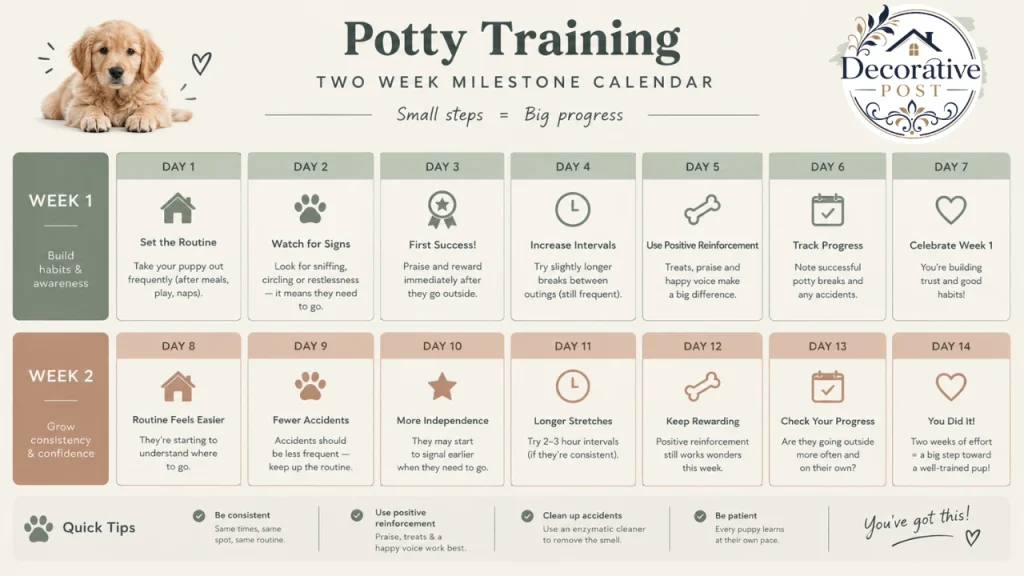
set the house up, build or choose the potty spot, start the schedule at the shortest interval for their age. Expect accidents. Supervise constantly.
keep the schedule rigid. Start using the cue as they begin. Reward within three seconds, every time. Clean every accident enzymatically.
begin spacing trips slightly further apart if accidents have reduced. Start noticing their individual pre-potty signals every puppy has a tell.
extend gradually, and roll the good rugs back out only when you have gone a solid fortnight without an accident.
The whole thing is less about training technique than about management, and management is mostly about your house. Get the gates, the floors and the route to the door right, and the puppy does most of the rest on their own schedule.
FAQs
How long does it take to potty train a puppy?
Most puppies are reliably house-trained between four and six months of age. Meaningful progress understanding the cue and fewer accidents usually appears within one to two weeks.
How often should a puppy go outside to pee?
Roughly once per hour for every month of age as a maximum interval, plus immediately after every meal, nap, drink and play session. An eight-week-old puppy needs ten to twelve trips a day.
What is the fastest way to potty train a puppy?
Rigid scheduling, constant supervision or confinement indoors, the same spot and cue every time, a reward within three seconds of finishing, and enzymatic cleanup of every accident.
Should I use puppy pads?
Only if you lack practical outdoor access, the puppy is not yet fully vaccinated, or you are away longer than their bladder allows. If your goal is an outdoor-toileting dog, pads add a step you will later have to undo.
Why does my puppy pee inside right after coming in from outside?
The trip was usually too short or too distracting. Stay outside longer, use a lead, stand still, and wait rather than assuming they are finished.
Why does my puppy keep peeing in the same spot?
Residual scent. Ordinary cleaners do not remove what a dog can smell, and ammonia-based ones make it worse. Use an enzymatic cleaner and block access to the spot for a couple of weeks.
Is it normal for a puppy to regress after doing well?
Yes, commonly around four to five months. Usual causes are routine changes, household stress, or a medical issue such as a urinary tract infection — worth a vet check if it comes with straining or frequent small amounts.
At what age do puppies get full bladder control?
Full voluntary control typically develops around seven months, though many puppies are reliable in practice before then.