

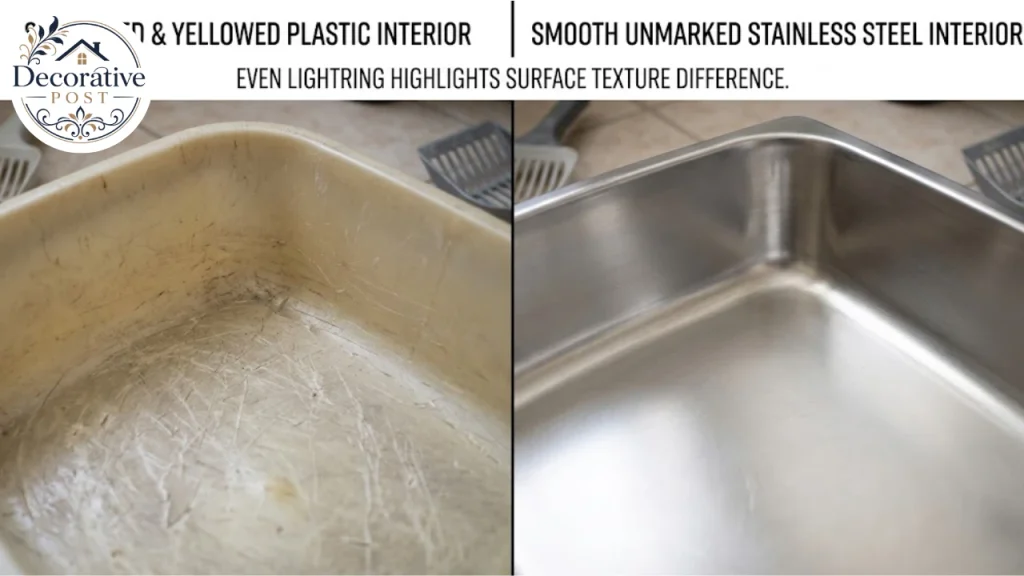
The case for steel is straightforward and genuinely sound. Plastic is porous; it scratches, and scratched plastic holds waste in a way no amount of scrubbing can reach. That is why a two-year-old plastic box smells faintly of ammonia the moment it dries, however thoroughly you clean it.
Steel does not have that problem. Non-porous, no claw marks, no absorbed odour.
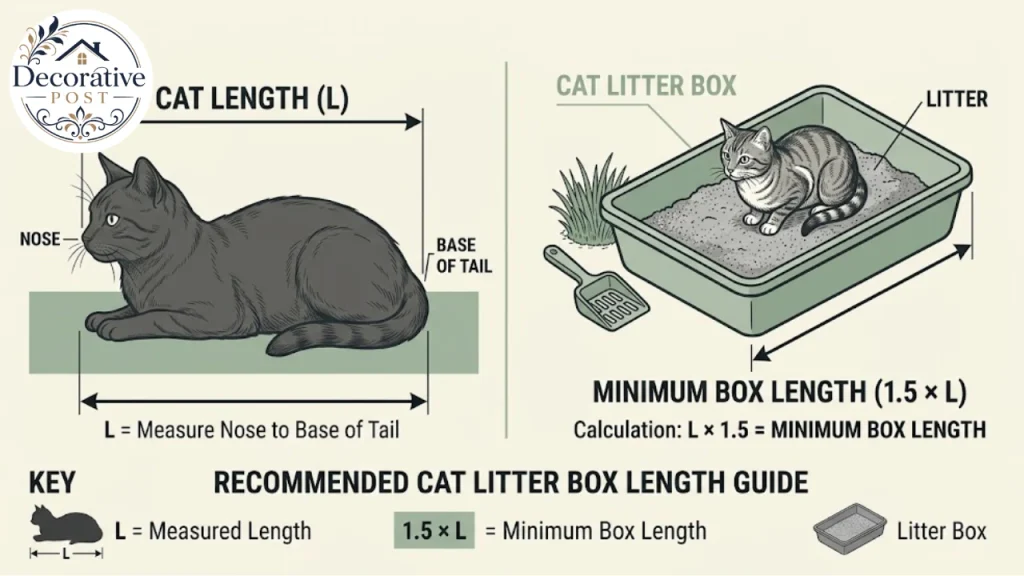
But there is a spec most steel boxes on the market fail, and it matters more than the material. Veterinary guidance says a litter box should be at least 1.5 times your cat’s length from nose to tail base. A great many stainless boxes are sold at sizes that do not meet it, and a box a cat finds too small is a box a cat eventually stops using.
The short answer
A stainless steel litter box solves odour retention, staining, warping, and claw-scratch bacteria harbouring the four failure modes of plastic. It costs more upfront and lasts years rather than months.
Measure your cat nose to tail base and multiply by 1.5. For an average adult,lt that means a box around 22 by 17 inches; for a large breed, 26 by 20 inches or more.
Keep the entry low, 2 to 4 inches for an older or arthritic cat, even if the other sides are high.
And follow the n+1 rule: one more box than you have cats.
Why plastic fails, specifically
Worth understanding properly, because it explains what a stainless steel litter box is actually buying you.
Plastic is porous. Urine penetrates the surface at a microscopic level, which means the odour source is inside the material rather than on it. Deep cleaning removes what is on top and leaves what has soaked in.
Claws scratch it. Cats dig, and digging scores the surface. Those scratches trap waste and bacteria, and they are impossible to clean out properly. This is why box odour gets worse over time rather than staying constant.
It warps and stains. Repeated washing, hot water, and ammonia exposure all degrade plastic. Yellowing is cosmetic; warping is structural and causes leaks at the corners.
It absorbs cleaning products too, which is a less-discussed problem. Residual scent from a strong cleaner lingers in plastic, and some cats object to that more than they object to the smell they were covering.
Steel addresses all four at once. A smooth, non-porous surface gives odour nothing to cling to, holds no claw marks, does not warp or stain, and rinses genuinely clean.
The practical result is a box that smells neutral between scoops after months of use, rather than one that smells like a litter box the moment it is empty.
The size rule nobody sells against
This is the most important section on the page, and it works against most of the products in this category.
The rule. Veterinary guidance from AAFP and ISFM, the professional bodies for feline medicine, sets the minimum at 1.5 times the cat’s body length, measured nose to tail base.
How to measure. Nose to where the tail joins the body, not the tip of the tail. An average adult cat measures roughly 15 to 18 inches by that method, which puts the minimum box length at around 22 to 27 inches.
| Cat size | Recommended box (L × W) |
|---|---|
| Small, under 4 kg | 20 × 15 in |
| Average, 4–6 kg | 22 × 17 in |
| Large, over 6 kg — Maine Coon, Ragdoll | 26 × 20 in or larger |
Why it matters more than material. A cat needs room to turn, dig, position, and cover. A box that is too small produces a cat that stands with its hindquarters over the edge, or stops using the box entirely.
Inappropriate elimination is one of the most common behavioural complaints in cats, and box size is among the easiest contributing factors to fix. It is also the one most often overlooked, because a box looks adequate to a human eye at a size the cat finds cramped.
The commercial problem. A great many stainless steel boxes are manufactured at sizes convenient to ship rather than sizes derived from this rule. Check the stated internal dimensions against your own cat’s measurements before buying, and treat a vague “large” or “XL” as meaningless.
If your cat is currently using a plastic box happily, measure that box too. There is no point upgrading the material and downgrading the footprint.
Entry height, which is a separate number
The detail that decides whether an older cat keeps using the box, and it is routinely confused with wall height.
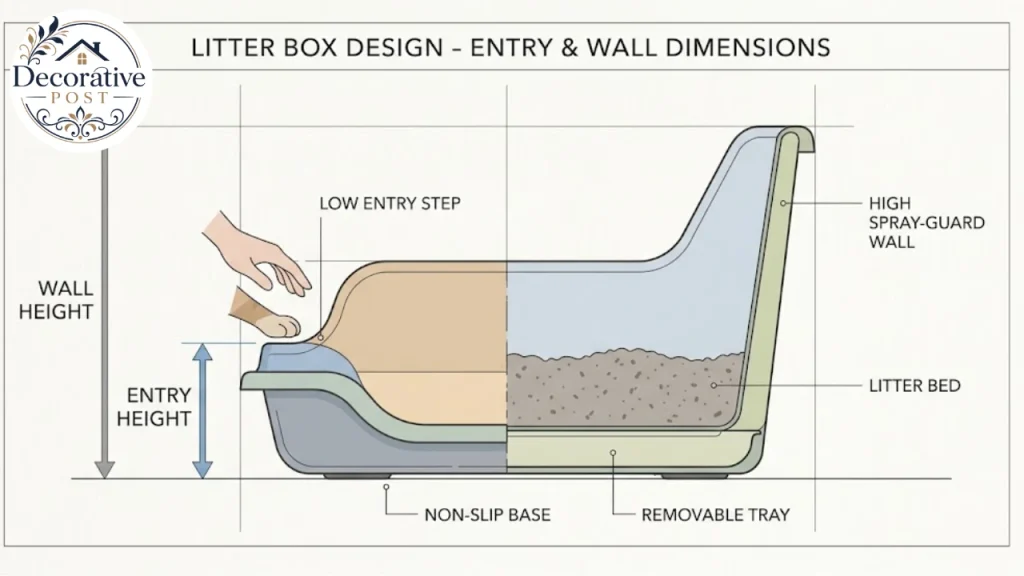
Wall height keeps litter in. Entry height is what the cat has to step over. They are different measurements,s and a good box treats them separately.
For a healthy adult cat, a standard entry of around 5 to 6 inches is fine.
For an arthritic or senior cat, the recommended entry is 2 to 4 inches, and some cats, particularly post-surgery, do better at around 1.5 inches. Start at the lowest practical height and raise it only if litter spills badly.
The design that solves both is a low front with higher sides and back. That contains scatter while leaving an easy step-in, and it is worth looking for specifically rather than accepting a box with uniform walls.
Signs your cat is struggling to get in
These are easy to miss and easy to misread as behavioural.
Accidents near the box rather than in it are the clearest signal, and it is physical rather than spiteful.
Hesitating before stepping in, or lowering themselves slowly rather than stepping over cleanly.
Reduced grooming around the hindquarters, which suggests difficulty reaching rather than disinterest.
Limping, or any visible change in how they move generally.
Using the box only when the litter has just been freshly cleaned, which can indicate pain or low confidence rather than fussiness.
A practical point on placement. An arthritic cat should not have to climb stairs to reach a box. Put one on the main living level, whatever else you have elsewhere.
A thin rubber mat outside the box helps with traction on smooth floors, which matters considerably on tile or sealed timber. Our guide to cleaning hardwood floors covers what repeated accidents do to a finish, and a mat is cheaper than a refinish.
How many boxes you actually need
The rule is simple and widely ignored.
N+1. One more box than the number of cats. Two cats need three boxes; three cats need four.
The reasoning is resource competition. Cats guard territory, and a single box in a multi-cat household becomes a contested resource that one cat may control, and another may avoid.
Spread them out. Two boxes side by side read as one box to a cat. Different rooms, different floors where practical.
This is where the cost argument against steel weakens. If you need three boxes, three steel boxes are a real outlay,y but it is a one-time outlay against replacing nine plastic boxes over the same period.
A reasonable compromise for a tight budget is steel for the primary box in the main location, plastic for the secondary ones, replaced as they degrade.
The downsides, stated honestly
A stainless steel litter box has three genuine drawbacks and two that get overstated.
Price. Genuinely higher upfront. A good steel box costs several times a plastic equivalent, and the payback is over years rather than months.
Weight. Heavier than plastic, which is an advantage for stability and a disadvantage when you lift it to empty. A large steel box full of clumping litter is a substantial object.
Noise. Rarely mentioned and worth knowing. Litter scattering against a metal wall, and a scoop hitting the base, are louder than the same actions in plastic. Most cats ignore it; a timid cat may not.
Cold is the overstated one. Steel feels cool to the touch, but it reaches room temperature,re and litter insulates the base anyway. In practice, this is not a problem.
Acceptance is the other overstated concern. Most cats take to steel without any issue, though some need a few days to adjust to the different surface underfoot. Transition by placing the new box beside the old one rather than swapping it outright.
What to look for when buying
The specifications that matter when choosing a stainless steel litter box, in order.
Internal dimensions, not external. This is the number the cat experiences, and manufacturers quote external measurements when it flatters the product.
Stated steel grade. Food-grade 304 stainless is the benchmark, the same specification used in kitchen equipment. Many listings say only “stainless steel,” which covers a range of qualities including grades that will eventually show surface corrosion.
Rounded internal corners. Square internal corners trap waste and are genuinely difficult to scoop clean. Rounded or radiused corners are the single most useful construction detail.
Welded seams, properly finished. A seam that is spot-welded and left rough collects residue. Smooth continuous welds are what you are paying for.
Rolled or folded edges. Raw sheet steel edges are sharp. Any decent box rolls or folds the rim, which is both safer and stronger.
A low entry section, as covered above.
Non-slip feet. A steel box on a smooth floor slides when a cat digs vigorously. Rubber feet solve it; without them you need a mat.
Weight. Within a size bracket, heavier usually means thicker gauge steel, which means less flex and a longer life.
What to disregard: claims about odour-eliminating coatings, antimicrobial treatments and proprietary finishes. The non-porous surface is doing the work, and a coating on steel is a thing that can wear off.
Lids, hoods and enclosed designs
A decision that divides cat owners, and the honest position is that it depends on the cat rather than the owner.
The case for a lid. It contains scatter, holds odour in, stops a dog helping itself, and looks tidier in a visible location. High-sided steel boxes with lids are increasingly common.
The case against. An enclosed box concentrates odour inside, which is pleasant for you and unpleasant for the animal using it. Some cats refuse enclosed boxes outright, and a covered box in a multi-cat household can create an ambush point that a nervous cat will avoid.
The compromise most people land on is a high-sided open box rather than a fully hooded one. Steel suits this well, because the walls can be tall without the box feeling like a tunnel.
If you use a lid, ventilate it and scoop more often rather than less. The reason a hooded box smells worse when you open it is that nothing has been leaving.
Watch for the entry flap. Some enclosed designs include a swinging plastic door, and a surprising number of cats dislike pushing through one. If a cat has stopped using a covered box, removing the flap is the first thing to try.
A practical test: take the lid off for a fortnight and watch whether usage changes. Cats vote with their behaviour, and that experiment costs nothing.
Cleaning it properly
Cleaning a stainless steel litter box is simpler than cleaning plastic, with one important warning.
Daily. Scoop. This is the whole odour strategy, and no material substitutes for it.
Weekly. Empty completely and wash with mild soap and warm water. Steel rinses genuinely clean, which is the point: a wash actually resets the box rather than reducing the smell temporarily.
Dry it before refilling. Litter clumps against damp steel and forms a layer stuck to the base. A quick wipe prevents it.
Never mix cleaning products. Specifically, never use bleach anywhere near ammonia, and cat urine contains ammonia. The combination produces chloramine gas, which is dangerous in an enclosed space like a bathroom or utility room where litter boxes often live.
If you want to disinfect, use one product, rinse thoroughly, and let the box dry fully before the next goes near it. The same product-mixing warning appears in our guide to cleaning shower mould, and it is the most underrated household hazard there is.
Avoid strongly scented cleaners. Steel does not absorb them the way plastic does, but residue on the surface can still deter a sensitive cat. Mild and unscented is the safer default.
Do not use abrasive pads. Steel wool and harsh scourers scratch the finish, which reintroduces exactly the texture problem you bought steel to avoid. A soft brush or cloth is sufficient because nothing is bonded to the surface.
Litter depth and type
Both interact with the box choice.
Two to three inches of litter is the usual recommendation. Less and the cat cannot dig or cover properly; more and the top layer stays dry while the bottom sits wet, which wastes litter and encourages digging to the base.
Clumping litter works well with steel, because clumps lift cleanly off a non-porous base rather than adhering to it. This is a genuine practical advantage over plastic.
Avoid overfilling a high-sided steel box. The depth is tempting because the walls allow it, but deeper is not better, and the extra weight makes emptying harder. Store the surplus bag somewhere dry and sealed. Damp litter clumps in the bag, and the storage thinking in our guide to home organisation upgrades applies to keeping pet supplies contained.
The litter you use matters more to the cat than the box material does. Most cats prefer a fine-grained, unscented clumping litter, and a cat that is avoiding a box is far more likely to be objecting to the litter or the cleanliness than to the steel.
Placement, which does more than product choice
A good box in a bad location gets avoided.
Quiet and low-traffic, but not isolated. A cat wants to feel unexposed while using it, and also wants an escape route. A cupboard with one entrance can feel like a trap.
Away from food and water. Cats do not eliminate near where they eat, and a box beside the feeding station is a common cause of avoidance.
Not beside noisy appliances. A washing machine starting its spin cycle while a cat is in the box can create an aversion that persists long after. This is a genuine consideration if the box lives in a utility space; our guide to laundry room cabinets covers planning that room, and a litter box belongs in the quietest corner of it.
On the main living level for any older cat, as covered above.
Away from the main living sightlines for your sake rather than the cat’s. A bathroom, utility room, or a dedicated cabinet all work.
Accessible at all times. A box behind a door that gets closed is a box that will be used somewhere else.
Making it look like furniture
The aesthetic objection is legitimate, and a stainless steel litter box is actually easier to integrate than plastic.
Brushed steel reads as appliance rather than pet accessory, which suits a utility room, a laundry space or a modern bathroom far better than moulded plastic does. It also sits comfortably alongside the finishes in a kitchen or utility run; the same logic covered in our guide to modern kitchen cabinets.
Cabinet enclosures work well, provided the internal space genuinely fits the box plus room for the cat to turn. A built-in unit designed around the box is the tidiest version of this. Measure the box, then add clearance; a cabinet that fits the box exactly does not fit a cat using it.
Ventilation matters in an enclosure. A sealed cabinet concentrates odour, and some cats refuse to enter one. Cut or specify vents.
A bathroom placement pairs naturally with steel, and the fixtures tend to match. If you are planning that space, the storage approach in our guide to bathroom cabinet organisation applies to keeping litter, scoop, and bags contained nearby rather than visible.
Keep the surround easy to clean. Litter scatter is inevitable regardless of wall height, and a hard floor around the box beats carpet every time. If the box sits in a finished basement, the flooring choices in our basement LVP guide handle this well.
A mat with a textured surface catches tracked litter and is worth having, whatever the box is made of. On carpet, a hard mat underneath protects the pile, and a DIY area rug is not the right surface to put one on.
What it costs, and whether it pays back
The honest arithmetic.
| Item | Typical range |
|---|---|
| Plastic box, basic | $10 – $25 |
| Plastic box, high-sided or covered | $25 – $60 |
| Stainless steel box, small or medium | $50 – $100 |
| Stainless steel box, large or XL | $90 – $200 |
| Stainless steel with lid or enclosure | $120 – $250 |
The payback case. Plastic boxes are commonly replaced every one to two years, because that is when scratching and absorbed odour make them unpleasant. A steel box lasts years without degrading.
Over a cat’s lifetime, twelve to eighteen years, that is a meaningful difference even before you count the inconvenience of repeated replacement.
Where the case weakens. If you need three boxes under n+1, the upfront cost multiplies and the payback period extends. And if your current plastic box is working fine and your cat is happy, there is no urgent reason to change.
Where the case is strongest. Multi-cat households, where odour load is highest. Homes where the box is in a living space rather than hidden away. And any situation where you have replaced plastic boxes repeatedly and are tired of it.
Signs it is time to change the box, whatever it is made of
Four indicators that the box, rather than the litter,r is the problem.
Odour immediately after a full clean. That is absorbed smell in the material, and it means the box is past its useful life.
Visible scratching inside. Scored plastic holds bacteria regardless of cleaning.
Staining that does not shift, particularly on the base.
The cat is using it less, or going beside it. Check size and entry height before assuming behaviour.
If any of those apply, a replacement is overdue, and that is the moment the steel calculation makes the most sense, since you are buying a box anyway.
When to involve a vet rather than buy a box
Worth stating clearly, because litter box avoidance is sometimes medical.
Straining, frequent small urinations, or crying in the box can indicate a urinary tract problem or a blockage. In male cats, a urinary blockage is a genuine emergency.
Blood in the urine warrants a prompt appointment.
A sudden change in habits in an otherwise settled cat is more likely medical than behavioural, particularly in an older animal.
Going outside the box repeatedly despite a clean, correctly sized, well-placed box needs investigating rather than managing.
No box purchase substitutes for that. If the behaviour is new, see a vet first and buy equipment second.
The buying sequence

Measure your cat, nose to tail base, and multiply by 1.5. That number is your minimum box length.
Count your boxes. N+1, and spread across locations.
Check internal dimensions on any product you consider, and disregard “large” as a descriptor.
Confirm the steel grade is food-grade 304 if stated.
Check the entry height against your cat’s age and mobility, and look for a low-front design if that is a concern.
Look for rounded internal corners, smooth welds, and rolled edges.
Transition gradually. New box beside the old one for a week, same litter, same depth.
A stainless steel litter box is one of the few pet purchases where the premium product is genuinely better rather than just more expensive. Non-porous beats porous, permanently.
But it only works if the box is big enough for the animal using it. Get the tape measure out before you open the shopping bag; the material question is the easy one.
FAQs:
Are stainless steel litter boxes better than plastic?
Yes, in the ways that matter. Steel is non-porous, so odour cannot soak in; it does not hold claw scratches that trap waste and bacteria; and it will not warp, stain, or absorb cleaning products. The trade-offs are higher upfront cost and more weight.
What size litter box does my cat need?
At least 1.5 times your cat’s length from nose to tail base, per AAFP and ISFM guidance. That works out to roughly 22 by 17 inches for an average adult cat, 26 by 20 inches or larger for a big breed, and 20 by 15 inches for a small cat.
How many litter boxes should I have?
One more than the number of cats: the n+1 rule. Two cats need three boxes, placed in different locations rather than side by side, since two boxes together read as one resource to a cat.
Will my cat use a stainless steel litter box?
Most cats accept one without difficulty, though some need a few days to adjust to the smooth surface. Transition by placing the new box beside the old one with the same litter rather than swapping it outright.
Are stainless steel litter boxes cold for cats?
Not in practice. Steel feels cool to the touch but equalises to room temperature, and two to three inches of litter insulates the base. It is the most overstated objection to these boxes.
How do you clean a stainless steel litter box?
Scoop daily, then empty and wash weekly with mild soap and warm water, drying it before refilling. Avoid abrasive pads, which scratch the finish, and never mix cleaning products with bleach near the ammonia in cat urine,e as it produces chloramine gas.
What entry height is best for an older cat?
Two to four inches, and around 1.5 inches for a cat recovering from surgery. Entry height is separate from wall height, so a box with a low front and higher sides gives easy access while still containing litter scatter.
What grade of stainless steel should a litter box be?
Food-grade 304 stainless is the benchmark, the same specification used in kitchen equipment. Listings that say only “stainless steel” may use lower grades that eventually show surface corrosion.