

The phrase does a specific job in English. You walk into the lion’s den when you deliberately enter a place where the people are hostile, and the power is not yours: a board meeting that wants your resignation, a hearing where everyone has already decided, a dinner with in-laws who disapprove.
It carries courage rather than recklessness. That distinction is what makes it useful.
What it does not carry is any zoological accuracy. Adult lions do not live in dens. There is also no archaeological evidence that the thing in the story it comes from ever existed. Both facts are more interesting than the idiom.
The short answer
A lion’s den means a situation or place full of hostile, powerful people that you must enter and face anyway. The emphasis is on willing confrontation rather than accidental danger.
The phrase comes from the Book of Daniel, chapter 6, in which Daniel is thrown into a den of lions as punishment and survives the night unharmed.
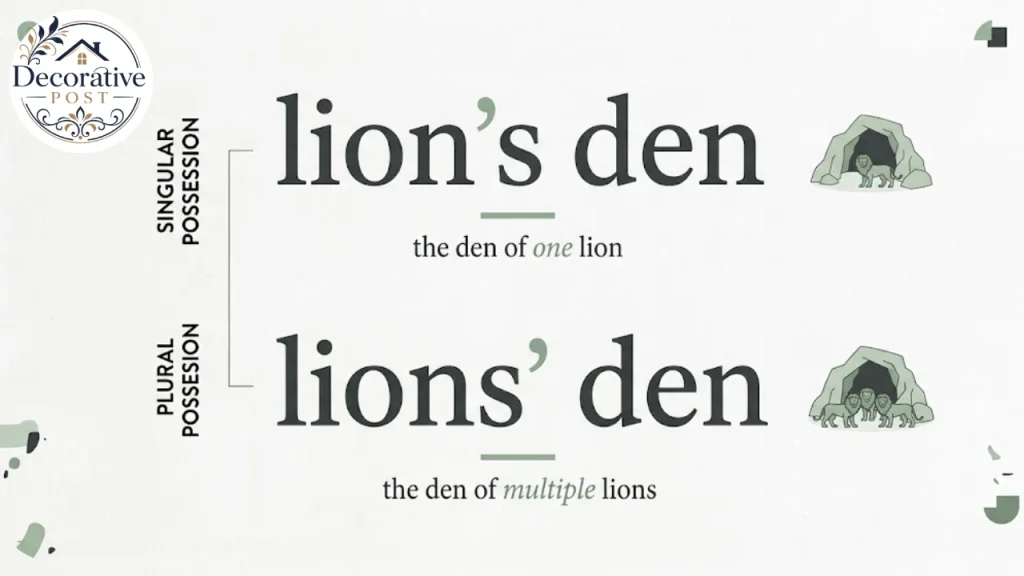
Both spellings of the possessive circulate: lion’s den for one lion, lions’ den for several. The biblical story has multiple lions, so lions’ den is technically the more faithful rendering, though lion’s den is now the dominant idiomatic form.
What the idiom actually means
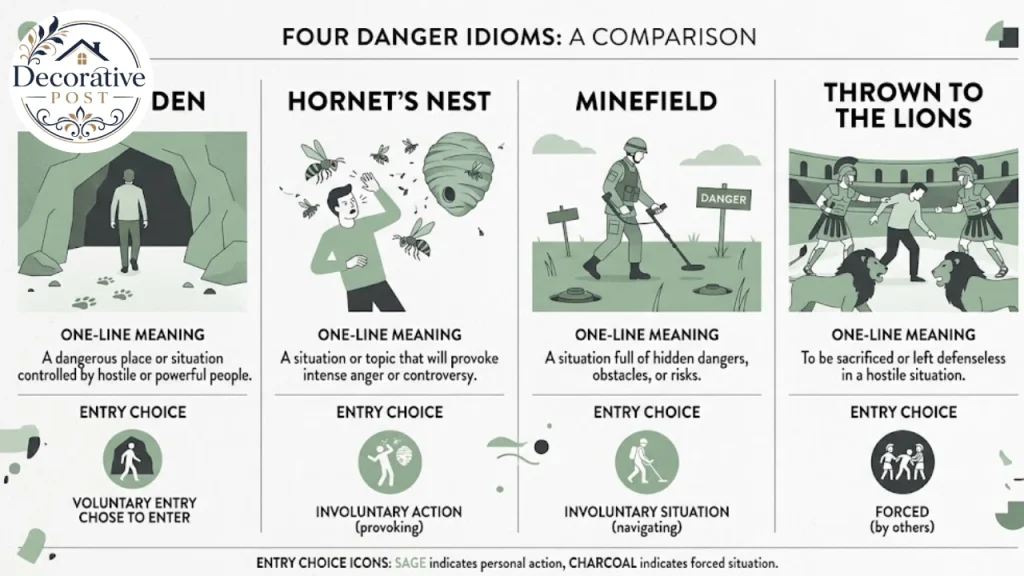
A lion’s den is worth separating from its near neighbours, because English has several phrases for danger and they are not interchangeable.
A lion’s den is hostile,e and you enter it deliberately. The danger is social and political rather than physical, and the people in it hold the power. You go in because you have to, or because you have decided to.
A hornet’s nest is trouble you stir up, often carelessly. The emphasis is on provocation rather than courage.
A minefield is danger you must cross carefully. The threat is diffuse,e and the skill required is caution, not nerve.
A wolf’s lair or snake pit are closer, but both suggest treachery and concealment. A lion’s den is openly adversarial; l everyone knows where they stand.
Thrown to the lions is the passive version, and it means something different. You had no choice and no agency. Entering the lion’s den is active; being thrown to the lions is being sacrificed.
That last distinction is the one people blur most often, and it reverses the meaning. “He walked into the lion’s den” is admiring. “He was thrown to the lions” is sympathetic.
Using it correctly
A few notes on register and construction, because lion’s den is a phrase that can land badly.
It is informal to neutral, not formal. Appropriate in journalism, conversation and business writing; out of place in legal or academic prose.
It is a compliment when applied to someone else. Saying a colleague walked into the lion’s den acknowledges their courage.
It can sound self-aggrandising when applied to yourself. “I went into the lion’s den” implies you were brave, which is a claim better left for others to make.
Common constructions: walk into, step into, enter, go into, face. “Beard the lion in his den” is an older and more literary variant, meaning to confront someone on their own territory.
Avoid it where the danger is genuinely physical. Using the idiom about a real dangerous situation reads as flippant, because the phrase has drifted entirely into the metaphorical.
How the phrase behaves in practice
Where you actually encounter it, which tells you something about its register.
Business journalism uses it constantly. An executive appearing before shareholders, a founder pitching to hostile investors, a politician on an unfriendly broadcast. The phrase has become almost standard shorthand for these.
Sports writing uses it for away fixtures. A team travelling to a hostile stadium enters the lion’s den, and in that usage the hostility is the crowd rather than any individual. This is the most literal surviving sense: an actual place you go into.
Political reporting uses it for hearings and committees. The adversarial structure fits the phrase exactly: you are summoned, the questioners hold the power, and you have to answer anyway.
It rarely appears in fiction dialogue because characters who describe their own situation in idiom sound writerly. Narration carries it better than speech.
It has largely replaced “beard the lion in his den” in everyday use, which is a loss of nuance; the older phrase specified confronting a particular person, whereas the modern one usually describes a group or an institution.
One tonal note. The phrase has a faint whiff of self-drama about it, which is why it works better in third person and better in reporting than in a first-person account. “She walked into the lion’s den” is reportage. “I walked into the lion’s den” is a memoir sentence, and it needs the rest of the paragraph to earn it.
The story behind it
The phrase enters English through one narrative, and the details matter because they explain the shape of the idiom.
In the Book of Daniel, chapter 6, Daniel serves as a senior administrator under a foreign king. His rivals, resenting his position, engineer a law forbidding prayer to anyone but the king, knowing Daniel prays to his own God.
Daniel prays anyway. He is reported, and the king, who likes Daniel and is trapped by his own decree, reluctantly has him thrown into the den of lions. The entrance is sealed with a stone.
The king returns at dawn and finds Daniel alive. The narrative attributes his survival to divine protection, and Daniel’s accusers are then thrown in themselves.

Why this produced a durable idiom. The story has three elements the phrase inherited: hostile parties who engineered the situation, a protagonist who did not back down, and an outcome in which integrity rather than force prevailed.
That is why “lion’s den” carries a note of vindication as well as danger. You are not expected to be eaten.
The scholarly problem with the den
Here is the part most explainers of the lion’s den story skip, and it is genuinely interesting.
There is no archaeological evidence for lion dens in the ancient world. Biblical scholarship notes this directly: we have found no zoo-like dens or lion pits from the period, anywhere in the ancient Near East.
The practical objection is stronger than the absence of evidence. A lion would be unlikely to survive long in a subterranean cavern or a bottle-shaped dungeon of the kind the story seems to describe. Lions need space, air and shade. A pit is not a viable enclosure for one.
Scholars have therefore asked whether the den was literal. The suggestion is not that the narrative is careless but that the lion imagery may be doing symbolic work. Lions appear throughout ancient Near Eastern literature as a figure for royal power, chaos and hostile forces.
Karel van der Toorn has examined the Babylonian background of the motif, and Brent Strawn has studied leonine imagery across the Hebrew Bible and the wider ancient Near East. The reading that emerges is of a literary image with deep regional roots rather than a documented penal practice.
What this does not mean. It does not mean the story is “false” in any sense that would interest a reader of the idiom. Idioms do not require their source narratives to be archaeologically verified; “crossing the Rubicon” survives regardless of the river’s current silt levels.
It does mean that anyone presenting the lion’s den as an established historical punishment is overstating the evidence.
Lions in the ancient imagination
Context that explains why this image, rather than some other predator, became the standard figure for hostile power.
Lions were real and present. They ranged across the Near East in the ancient period, not merely in Africa, which meant the audience for these texts knew the animal firsthand rather than as an exotic report.
They were a royal symbol throughout the region. Lion imagery appears on palace reliefs, gates and seals across Mesopotamia, Assyria, Persia and Egypt, almost always attached to kingship. Royal lion hunts were depicted as demonstrations of a ruler’s fitness to rule.
That is what makes the narrative image work. A den of lions controlled by a king is not a random danger. It is the king’s own power, in its most concentrated form, turned on a subject, which is exactly the situation the idiom now describes.
Scholarship has traced the motif rather than the institution. Karel van der Toorn has examined its Babylonian background and Brent Strawn has surveyed leonine imagery across the Hebrew Bible and the wider region. What the work establishes is a deep literary tradition rather than a documented penal practice.
The useful conclusion for a reader of the idiom: the phrase inherited its force from centuries of lions standing for royal power, which is why it means hostile authority rather than mere hostility. A lion’s den is never just a dangerous room. It is somebody else’s territory.
Lions do not have dens
The zoological fact, and the one that makes lion’s den quietly inaccurate as a description of anything.
Adult lions do not live in dens. They are not denning animals in the way wolves, bears,s or foxes are. A pride rests in the open under a tree, in long grass, on a rock, and moves with its territory and its prey.
If you went looking for a lion’s den in the wild, you would not find one. There is no permanent home address.
There is one genuine exception, and it is temporary. A lioness close to giving birth leaves the pride to find a secluded denning site, usually thick vegetation and sometimes a cave.

She gives birth there after a gestation of roughly 110 days, about three and a half months, to a litter of one to six cubs.
She keeps the cubs hidden at that site until they are around two months old, then rejoins the pride with them. After that, the den is abandoned.
So a den exists in a lion’s life for about eight weeks, once per litter, and it is a nursery rather than a home. The idiom’s image of a permanent lair full of resident lions is wrong in almost every particular.
Why she hides them. Cubs are vulnerable to other predators and to unrelated male lions. The seclusion is protection, and moving them between sites is common behaviour if she senses the location is compromised.
That reframing is worth having. The real lion’s den is one of the most defensive places in nature rather than one of the most aggressive: a mother hiding newborns, not a chamber of waiting threats.
Lion’s den or lions’ den
The apostrophe question, which comes up constantly and has a clean answer.
Lion’s den ,one lion, possessive singular. This is the dominant form of the idiom today.
Lions’ den: several lions, possessive plural. This is the more accurate rendering of the biblical story, which has multiple lions, and many Bible translations use it.
Lions den, with no apostrophe, is simply an error in prose, though it appears in business names where the apostrophe has been dropped stylistically.
Which should you use? For the idiom, lion’s den. It is the established form, and nobody will query it. For a reference to the biblical episode specifically, lions’ den is defensible and arguably better.
Be consistent within a document, which is the same rule that governs every other variant spelling decision. The reasoning we set out in our guide to grey vs gray applies exactly: pick one, record it, and apply it everywhere,e including headings and metadata.
Where else the phrase turns up
The phrase lion’s den is attached to a surprising number of unrelated things, and knowing them helps if you are searching for one.
Film and television. Several films share the title, including American productions from 1919 and 1936, a 1988 short by Bryan Singer, and a 2008 Argentine film by Pablo Trapero. Episodes of various series use it, and The Lion’s Den was a short-lived American drama with the spelling altered for the surname.
Books. Steven Duffy’s 2009 novella The Lion’s Den was nominated for a World Fantasy Award. Susie Linfield published The Lions’ Den in 2019.
Places. A nightclub in Greenwich Village, a village in Mashonaland West in Zimbabwe, and a rugby stadium in Pallekele, Sri Lanka, are known by the nickname.
Sport. A mixed martial arts fighting team carries the name, and professional wrestling has a match type called the Lion’s Den match.
Current affairs. A Palestinian militia operating in the West Bank adopted the name, which is why a search for the phrase may return news results rather than language or wildlife content.
That last one is worth knowing if you are searching. The phrase is a live news term as well as an idiom, and results shift with events.
The other kind of den
Here is the connection that makes this phrase relevant well beyond zoology and scripture, and it is a genuine etymological relationship rather than a coincidence.
The word “den” means both an animal’s shelter and a room in a house. The domestic sense grew out of the animal one: a small, enclosed, private space where you retreat.
That is why a den in a home is characteristically the snug room rather than the formal one. Lower ceilings, darker colours, heavier furniture, a door that closes. The vocabulary carried the connotation across intact.
It is also why “man cave” works as a phrase, and why “den” in estate-agent language signals something different from “study” or “second reception.” A study implies work; a den implies retreat.
The design logic follows from the word. A den should feel enclosed, which is the opposite of the advice given for most rooms. Where a living room wants light and openness, a den earns its character from the opposite — and the layering approach in our guide to a cozy living room applies in concentrated form.
Colour does most of the work. Dens are the one room where a deep, saturated or dark colour reads as intentional rather than oppressive. The reasoning in our ceiling colour guide matters more here than anywhere, because a dark ceiling in a small room is either the best decision in the house or the worst.
Basements make natural dens, because they already have the enclosure the room wants: limited daylight, a sense of being below the main floor, acoustic separation. Our basement guide covers the sequence for converting one, and the moisture work that has to come first.
Furniture should be comfort-led rather than display-led. This is the room where a reclining sofa or a proper armchair recliner stops being a compromise and becomes the correct choice, because nobody is judging the sightlines.
A bar or games element suits the room’s purpose. The ideas in our home bar guide sit naturally in a den in a way they do not in a formal living space, and built-in shelving along one wall does more for the enclosed feeling than any amount of furniture.
The linguistic point is the useful one. A room called a den is being promised seclusion by its own name, and the design decisions that deliver that are mostly the inverse of the standard advice.
Variants and related expressions
Phrases in the same family, with their distinct uses.
Beard the lion in his den. Older and more literary. Means to confront a formidable person on their own ground. “Beard” here is a verb meaning to face boldly.
Thrown to the lions. Passive, sacrificial, no agency. Often used about someone abandoned by their own side.
The lion’s share. Unrelated in meaning despite the shared animal; it means the largest portion, from an Aesop fable in which the lion takes most of the kill.
Put your head in the lion’s mouth. Recklessness rather than courage. The emphasis is on the stupidity of the risk.
In the belly of the beast. Overlapping but broader, and usually about being inside a hostile system rather than facing hostile people.
Walk into the fire. Similar courage, different source imagery, and no implication that the opposition is powerful rather than merely dangerous.
Keeping these distinct is worth the effort, because they carry different judgements about the person involved. One says brave, one says foolish, one says victim.
Translating and localising it
Brief, but relevant for anyone writing for an international audience.
The phrase does not translate literally into most languages with its idiomatic force intact. Many languages have an equivalent built on a different animal or image entirely.
Where the biblical reference is widely known, a literal translation often carries. Where it is not, the phrase lands as a confusing animal reference rather than an idiom.
For international web writing, the safer approach is to use it and let context carry it, rather than explain it. Readers who do not know it will infer hostility from the sentence around it.
Avoid it in material intended for translation. Idioms are the first thing machine translation mangles, and a localisation team will have to replace it anyway.
Common mistakes
Confusing it with “thrown to the lions.” Opposite agency, opposite sympathy.
Using it about physical danger. The phrase has drifted entirely metaphorical, and literal use reads as flippant.
Applying it to yourself. It is a compliment, and compliments are better received than issued.
Treating the den as historical fact. There is no archaeological evidence for lion dens in the ancient world, and scholars question whether the one in the story was literal.
Assuming lions live in dens. They do not. Only a lioness with newborn cubs uses one, for about eight weeks.
Dropping the apostrophe in prose. Lion’s den or lions’ den; lions den is an error outside brand names.
Over-explaining it. Idioms work by recognition. A sentence that defines the phrase it just used deflates both.
What to take from it
The idiom is clean and useful: a hostile place, entered on purpose, by someone who could have stayed out.
The source story is Daniel 6, and it supplies both the danger and the implied vindication, which is why the phrase has never meant certain defeat.
The scholarship is more uncertain than popular retellings suggest, and there is no evidence that lion dens existed as a penal institution in the ancient Near East.
The zoology is simply wrong, and interestingly so. A real lion’s den is a lioness hiding one to six cubs in thick vegetation for eight weeks, which is the most protective behaviour in her life rather than the most threatening.
And the word itself survives in English domestically, which is the part most people never connect. The den in your house and the den in the phrase are the same word doing the same job: a small enclosed place where something retreats and is not easily reached.
FAQs:
What does “lion’s den” mean?
A situation or place full of hostile, powerful people that you enter deliberately and must face. It implies courage rather than recklessness, and unlike “thrown to the lions,” it suggests you had a choice.
Where does the phrase “lion’s den” come from?
From the Book of Daniel, chapter 6, in which Daniel is thrown into a den of lions for praying to his own God in defiance of a royal decree, and survives the night unharmed.
Is it lion’s den or lions’ den?
Both appear. Lion’s den is the dominant idiomatic form today; lions’ den is the more faithful rendering of the biblical story, which features multiple lions, and many Bible translations use it. “Lions den” without an apostrophe is an error in prose.
Did lion dens actually exist?
There is no archaeological evidence for zoo-like lion dens or pits anywhere in the ancient Near East, and a lion would be unlikely to survive in a subterranean pit. Scholars have questioned whether the den in the story was literal or symbolic.
Do lions live in dens?
No. Adult lions rest in the open and move with their territory. Only a lioness uses a den, a secluded site in thick vegetation or occasionally a cave, to give birth and hide her cubs until they are about two months old.
How long do lion cubs stay in the den?
Around two months. After a gestation of roughly 110 days, the lioness gives birth to one to six cubs at a secluded site, keeps them hidden there, and then rejoins the pride with them.
What is the difference between “lion’s den” and “thrown to the lions”?
Agency. Walking into the lion’s den is active and admirable;g you chose to face hostility. Being thrown to the lions is passive and sympathetic; you were sacrificed, often by your own side.
Why is a room in a house called a den?
The domestic sense grew out of the animal one. A den is a small, enclosed, private space you retreat into, which is why the household version is characteristically the snug room rather than the formal one.