

A recliner sofa is judged on four specifications, and almost none of them appear in the showroom tag: seat foam density in pounds per cubic foot, upholstery abrasion rating, the actual leather grade, and how the frame is joined.
Get those four right and the sofa is comfortable in year ten. Get them wrong, and it sags by year three, the headrest peels, and the mechanism develops a wobble nobody can tighten out.
The frustrating part is that price does not reliably signal any of it. Two sofas at the same price can differ by a decade of service life, and the difference is invisible from the outside.
Why this is a harder purchase than a normal sofa
A standard sofa is a frame, a suspension system, and some cushions. A recliner sofa adds a steel mechanism per seat, which changes the engineering problem in three ways.
The first is cyclic loading. Every recline puts the frame through a flex cycle, and a joint that would sit still for twenty years in a static sofa is now being worked several times a day.
The second is weight distribution. When the footrest extends, the load moves forward, and the rear of the frame is lifted, so the back legs and rear rail take stress a normal sofa never sees.
The third is that the mechanism hides the frame. On a conventional sofa, you can lift a cushion and see the deck. On a reclining seat,t the steel box is in the way, which is exactly why cheap reclining furniture gets away with cheap frames.
So the usual sofa advice only half applies. The parts of it that matter most here are the frame and the joinery, and the part that matters least is the spring system, because on a reclining seat the mechanism carries the seat rather than a coil deck.
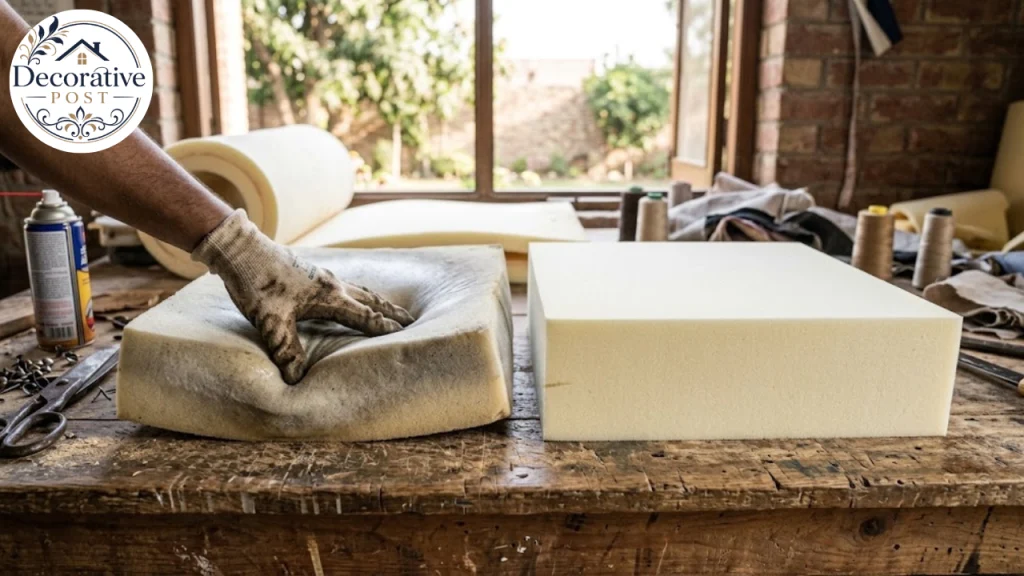
Number one: foam density, and why your sofa went flat
This is the single most predictive specification and the one retailers are least likely to volunteer.
Density is the weight of the foam per cubic foot, written as lbs/ft³. It is not the same as firmness, which is measured as ILD and describes how hard the cushion feels rather than how much material is in it.
The distinction matters because they move independently. A medium-firm 2.5 lb foam can feel softer than an extra-firm 1.8 lb foam, and the softer one will outlast the firmer one by a decade.
Density is what predicts longevity. Firmness is what predicts how it feels on day one, and firmness is the thing that fades.
Here is the figure that reframes the whole purchase. For a typical seat cushion, estimated service life runs roughly like this:
| Foam density | 160 lb sitter | 250 lb sitter |
|---|---|---|
| 1.8 lbs/ft³ | 4–5 years | 1–3 years |
| 2.0 lbs/ft³ | 6–7 years | 2–4 years |
| 2.2 lbs/ft³ | 8–10 years | 4–6 years |
| 2.5 lbs/ft³ | 15+ years | 10–15 years |
Note what the second column does. The same cushion that gives five years under a lighter sitter gives one to three under a heavier one, which is why two households buying the identical recliner sofa report wildly different experiences and each assumes the other is wrong.
1.8 lbs/ft³ is the most common density in mass-market upholstery. It is not a defect;t, it is a price point, and it is why so many sofas feel visibly tired in their third or fourth year.
Moving up to 2.2 or 2.5 roughly doubles or triples the life of the seat. Ask for the figure in writing before you compare any two sofas on price.
One more term to decode. HR, or high resilience, describes how well foam springs back rather than how much of it there is. Adding HR properties is inexpensive, so nearly everything claims it, and “high resiliency” on a tag tells you almost nothing without a density number beside it.
Number two: the abrasion rating, and the two tests that do not convert
Fabric durability is reported as a rub count, and there are two different tests producing two incompatible numbers.
Wyzenbeek is the American method and reports double rubs, with the machine moving back and forth in a straight line. One double rub approximates one sit-and-stand cycle.
Martindale is the European method and reports cycles, with the abrasion following a figure-eight path in multiple directions.
They use different machines, different motions, and different abrasives, so the numbers do not convert. Comparing a Wyzenbeek figure to a Martindale figure tells you nothing, and you should only ever rank fabrics tested the same way.
For Wyzenbeek, the useful thresholds are these. Nine to fifteen thousand double rubs suits a formal chair that is rarely used. Fifteen thousand and above is the everyday residential standard for a family sofa. Thirty thousand and above is heavy residential or light commercial.
Martindale runs on different ground: roughly twenty to twenty-five thousand cycles for heavy-duty residential, and around forty thousand for commercial.
The honest caveat is that past about thirty thousand double rubs, higher numbers stop making a practical difference in a home. Weave structure, fibre type, and whether the fabric can actually be cleaned matter more at that point.
Which is worth remembering when a salesperson leads with a six-figure rub count. It is a real number, but above a certain point it is being used as a trophy rather than as information.
Number three: the leather problem
This is where the most money gets lost, and a recliner sofa is hit harder than any other category.
Bonded leather is made from tannery scraps ground into a pulp, mixed with binders including polyurethane, and bonded onto a fabric backing. It is then embossed and dyed to look like hide.
By volume,e it is typically around 5 to 20% real leather. The remainder is plastic and adhesive.
It fails by cracking first, then shedding the cracked top coat in flakes. Reports of peeling within about two years of ordinary household use are common, and the failure is structural to the material, so it cannot be reconditioned or repaired.
Now consider where it fails first. The seat, then the armrests, then the headrest, where hair products make contact. On a reclining sofa, those are precisely the three surfaces your hands and head are on constantly, and the headrest is the one you touch every single time you adjust the thing.
The labelling is the trap. “Leather match”, “blended leather” and “reconstituted leather” all describe the same product, and some retailers simply drop the qualifier and call it leather.
“Leather match” deserves particular attention because it is not always dishonest. It can mean genuine top-grain hide on the seating surfaces with a matched synthetic on the sides and back, which is a legitimate cost-saving choice. The spec on a Barcalounger is written in exactly those terms, and the construction is sound.
So the question to ask is specific: which panels are hide, and which are not? A supplier who answers panel by panel is selling you the first thing. One who repeats the phrase is probably selling you the second.
Real leather comes in grades. Full grain is the complete top layer, unsanded, with the natural markings intact, and it is the most durable upholstery leather there is. Top grain is the same layer, lightly sanded and finished, more uniform in appearance, slightly better at resisting stains, and still genuinely durable.
Either will take cleaning and conditioning and can be restored years later, which is the actual difference. Condition it every six to twelve months, and keep medications, lotions, sunscreen, hair products, and insect repellent off it, because those strip the finish faster than wear does.

Number four: frame and joinery
The frame should be kiln-dried hardwood, or an engineered hardwood built from at least seven layers of solid wood pressed together. Not MDF, not particleboard, and not standard plywood.
The joints matter as much as the wood. Mortise and tenon, double dowel, or corner-block reinforcement are what you want to hear.
What you do not want is a frame held together mainly by screws and glue, or by a metal plate bridging two pieces of wood. Those hold fine under static load and loosen under a flex cycle, which is the exact load a recliner applies.
A lifetime frame warranty is a reasonable proxy if you cannot get a straight answer on construction. Manufacturers do not offer it on frames they expect to fail.
On springs, adjust the standard advice. Eight-way hand-tied coil decks are the premium answer in a static sofa, where you can lift the cushion and feel the individual springs through the deck fabric.
On a reclining seat, there usually is no coil deck, because the mechanism carries the seat. Which means the spring question largely applies to the stationary middle seat on a console model, and to the back cushions, and the frame question absorbs the rest of your attention.
If the sofa does use sinuous springs anywhere, they can perform perfectly well provided the wire is at least 8-gauge with two or more tie wires crossing each spring. Avoid wire grid systems, which are noisy and have a reputation for breaking.
Power or manual, decided honestly
Manual mechanisms are purely mechanical, operated by a lever or a push back against the seat, and they give you two or three set positions. Power mechanisms are motorised and stop at any angle you like.
Each fails in its own way, and the distinction is about character rather than reliability.
A manual mechanism has more sloppy joints and loose brackets available to it, so what goes wrong over the years is a jerky, rattling action that gradually gets worse. It is also noisier in use, and closing the footrest takes real leg strength.
A power mechanism has fewer loose joints and a smoother action, and it is quiet. What it has instead is a motor, a transformer and a handset, any of which can simply stop working.
The practical trade-offs sit elsewhere. Power needs an outlet, which constrains where the sofa can go, though battery packs exist for floating layouts. Power is heavier because of the motors, which matters on delivery day and on stairs.
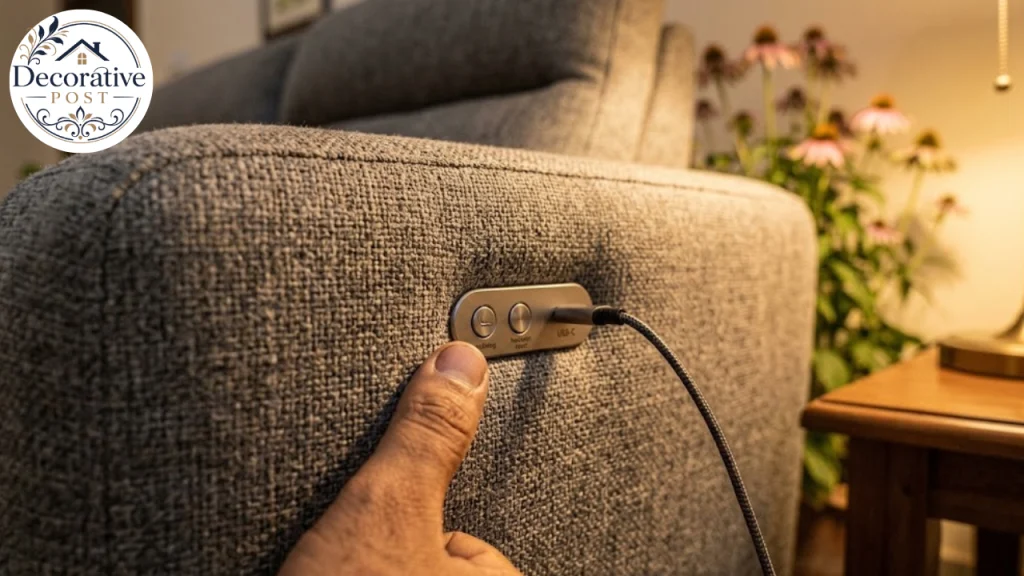
Power is where the features live: adjustable headrest, powered lumbar, independent footrest, heat, massage, lift assist, USB or USB-C in the arm, and memory presets. If anyone in the household has limited mobility or strength, power is not a luxury and the lift function is the reason to buy it.
Expect to pay a couple of hundred dollars more per seat for entry-level power over entry-level manual.
Configurations, and the middle-seat question
A reclining loveseat gives two reclining seats and the smallest footprint. A three-seat reclining sofa gives two or three.
That ambiguity is the thing to pin down. Many three-seat models recline only at the ends, with a fixed middle seat, and some of those middle seats are noticeably firmer and shallower than the outer two because there is no mechanism underneath.
Console models replace the middle seat entirely with a drop-down storage box, cup holder,s and often the USB ports. You lose a seat and gain the storage, and the sofa gets no shorter, which is worth understanding before you order.
True three-across reclining models exist and are the right answer if three people genuinely recline. They are wider, heavier, and the mechanisms sit closer together, so check that two adjacent seats can be reclined at once without the arms fouling.
Reclining sectionals solve the layout problem and create a delivery one, which the measuring section below deals with. Their redeeming feature is that they come apart, so they go through doors a one-piece sofa cannot.
Clearance, briefly
A standard recliner sofa needs meaningful space behind it. Published figures vary by manufacturer across roughly ten to eighteen inches, so take the number from the spec sheet for your specific model rather than from a general guide.
Wall-hugger designs move the seat forward as the back goes down, cutting that to somewhere in the three- to six-inch range depending on the maker.
Forward, allow for the footrest. Most reclining sofas reach around thirty-six to forty inches of overall depth when fully open, and you want twelve to eighteen inches of clear floor beyond the extended footrest before a coffee table or media unit.
The cheapest way to test all of this is painter’s tape on the floor at full reclined depth, lived with for a few days. There is a fuller treatment of clearances and long-term mechanism care in the companion piece on reclining sofas, which covers the maintenance side this article does not.
Getting it into the house
More of these are returned for not fitting than for not being comfortable, and a recliner sofa is bulkier than the room it came from suggests. All of it is avoidable with a tape measure.
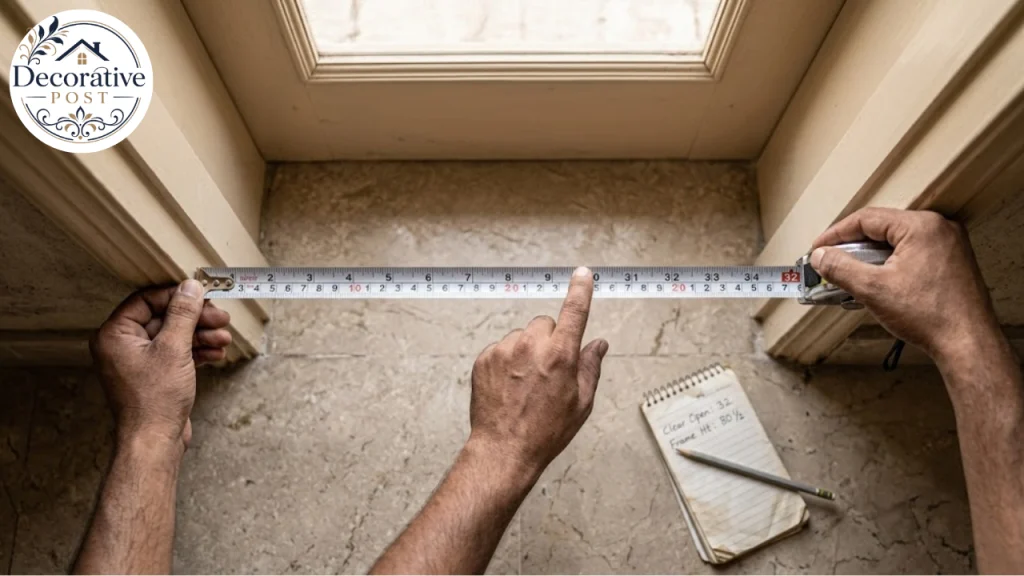
Measure the sofa at its widest point arm to arm, including any flared arm panels. Measure depth from the front of the seat cushion to the back of the frame, ignoring an extended headrest. Measure height from the floor to the top of the back.
Then measure the door the way the sofa experiences it. You want the clear opening, edge to edge between the stops with the door open past ninety degrees, not the nominal size. A door sold as 32 inches typically gives about 30 to 31 inches clear.
Compare depth against that clear opening. If depth is smaller, it goes through flat and you are finished.
If it is not, you tilt the sofa and rotate it through, and the relevant dimension changes as it turns. Ignore guides that tell you diagonal depth is always smaller than depth, because geometrically it is not. Measure the actual profile rather than trusting a formula.
Two things buy you room. Removing the legs typically gains four to six inches, which is often the whole problem solved. Taking the door off its hinges gains somewhere between one and three and a half inches depending on the stop and hinge.
Then walk the route. The narrowest point of the hallway, the turning room at each corner, stair landings and switchbacks, and the interior of any elevator, which is usually smaller inside than the opening suggests.
Check for a header, transom, or light fitting above the doorway too, because height stops as many deliveries as width.
If it still will not go, the options are a patio door, a ground-floor window, a balcony, or a sectional that comes apart. For a heavy single piece on switchback stairs, pay movers rather than discovering the limit yourself.

The ten-minute showroom test
Do these in order and you will learn more than an hour of browsing.
Recline every seat fully, including the one you are not sitting in. Listen for grinding, clicking,g or a catch partway through the travel. A new mechanism that is already noisy will not improve.
Close the footrest with your legs only, from a seated position. On a manual model, this is the action you will perform thousands of times, and if it is hard in the showroom, it will be harder on carpet.
Recline two adjacent seats at once and check that the arms and the mechanism housings do not interfere.
Sit in the middle seat of a three-seater and compare it honestly to the ends. Then sit in it reclined if it reclines, and check whether your feet actually reach the footrest.
Press down on the front rail of the seat frame with the footrest extended. There should be no give and no creak.
Rock the sofa gently from the back while someone is reclined in it. Any wobble now is a frame or joinery issue, not a bedding-in issue.
Ask for the four numbers. Foam density, rub count and test method, which panels are hidden, and how the frame is joined. Get them in writing on the order.
Reading the warranty
Reclining furniture warranties are usually tiered, and the tiers reveal what the maker expects to fail.
A lifetime frame warranty alongside five years on the mechanism and one year on foam and upholstery is a common and reasonable shape. A one-year blanket warranty on everything is a statement about the product.
Check who pays for labour and transport, because a parts-only warranty on a motor means you are paying a technician to fit a free part. Check whether the mechanism cover is pro-rated after a point. And check whether the warranty survives a move, since some are void once the original purchaser relocates.
Ask one specific question: are replacement mechanisms and handsets available separately, and for how many years? Handsets are a common failure and a cheap part, and a maker who stocks them is a maker who expects the sofa to outlive them.
Where the sofa is going
Worth settling before ordering, because the room decides the configuration more than the catalogue does.
The furniture arrangement determines whether you need a sectional at all. A pair of reclining loveseats facing each other often works better than one large piece, and the way furniture organises a room is the right starting point rather than the seat count.
Basement media rooms are the natural home for this furniture, and also the hardest delivery. Measure the stair turn before you order anything one-piece, and if the space is still being finished, the sequence for getting a basement right puts moisture and ceiling height ahead of furniture for good reason.
Built-in cabinetry along the back wall solves the console-versus-middle-seat dilemma, since storage behind the sofa frees you to buy three reclining seats. The approach to built-ins carries over directly.
If the room doubles as an entertaining space, the circulation logic behind a home bar is what keeps an extended footrest out of the traffic route.
On colour, this category skews grey, and the range names are inconsistent between manufacturers. That raises the grey and gray spelling question in almost every catalogue.
Mid-tones hide wear better than either extreme. The surrounding surfaces matter too, since a ceiling colour changes how a large upholstered mass reads in a room with low light.

The mistakes that cost the most
Buying on comfort alone. Showroom comfort is a firmness impression, and firmness is the property that fades.
Accepting “high density” or “high resilience” without a number. Ask for lbs/ft³.
Treating bonded, blended, reconstituted, or unqualified “leather” as leather. Ask which panels are hide.
Comparing a Wyzenbeek figure to a Martindale figure. They do not convert.
Measuring the nominal door size instead of the clear opening between the stops.
Forgetting to check height at the doorway, or the turn at the top of the stairs.
Assuming a three-seat reclining sofa reclines in three places.
Not testing the middle seat, which on many models is the worst seat in the house.
Putting a standard model against a wall without checking that model’s own clearance figure.
Ignoring whether handsets and mechanisms are available as spares.
What it costs to keep
Leather needs conditioning every six to twelve months, which is a ten-minute job and the difference between restoring the sofa in year eight and replacing it.
Fabric needs the cleaning code honoured. W means water-based cleaners, S means solvent only, WS means either, and X means vacuum only and nothing wet at all. Using water on an S-code fabric sets a ring you will not remove.
Mechanisms want their fixings checked periodically, and the moving parts kept lubricated, which is covered in detail in the companion article. Motors and handsets are consumables on a long enough timeline, and they are cheap if the maker still stocks them.
What this comes down to
A recliner sofa is a mechanism, a frame,e and a set of consumable surfaces, and the showroom only lets you evaluate the last of those.
Ask for the four numbers and the rest follows. 2.2 lbs/ft³ or better on the foam, 15,000 double rubs or better if it is fabric, hide on every panel you touch, and hardwood joined with mortise and tenon, dowels,ls or corner blocks.
A sofa meeting those, in a plain style with a manual mechanism, will serve you far better than a feature-loaded model at the same price built to 1.8 lb foam and bonded leather. The features are what get sold. The numbers are what you live with.
FAQs:
How long should a recliner sofa last?
A well-built one with a hardwood or metal frame, durable upholstery, and high-density foam gives seven to ten years or more in regular use. The seat foam is usually the first thing to go, and at the common 1.8 lbs/ft³ density it can soften noticeably in three to five years, or sooner under a heavier sitter.
Is bonded leather worth it on a recliner sofa?
It is the weakest choice for this specific furniture. Bonded leather is roughly 5 to 20% real leather with the rest plastic and adhesive; it commonly starts peeling within about two years, and it cannot be repaired. Reclining sofas concentrate hand and head contact exactly where it fails first.
Is power or manual better?
Power if anyone needs lift assistance or has limited strength, or if you want infinite positions and a quiet action. Manual if you want fewer electronic parts and a lower price. Manual mechanisms degrade into a jerky action over time, while power mechanisms stay smooth until a component simply stops.
What foam density should I look for?
2.2 lbs/ft³ as a sensible minimum and 2.5 if you can get it. At 2.5, a cushion can give fifteen years or more for a lighter sitter and ten to fifteen for a heavier one, against four to five and one to three,e respectively, at the common 1.8.
What does “leather match” mean?
Genuine leather on the main seating surfaces with a matched synthetic on the sides and back. It can be a legitimate construction, but the same phrase is also used loosely for bonded leather, so ask which specific panels are hide.
How much space does a reclining sofa need behind it?
Standard models need roughly ten to eighteen inches depending on the manufacturer, and wall-hugger designs cut that to about three to six. Take the figure from your model’s own spec sheet, and allow twelve to eighteen inches of clear floor in front of the extended footrest.
Will a recliner sofa fit through a 30-inch door?
Often, but check properly. Compare the sofa’s depth against the clear opening between the door stops, not the nominal door size. Removing the legs typically gains four to six inches, and taking the door off gains one to three and a half inches, which solves most cases.
Do reclining sofas with three reclining seats exist?
Yes, but many three-seat models recline only at the ends with a fixed middle seat, and console models replace the middle seat with storage. Confirm the reclining seat count on the order rather than assuming it from the width.