

General information, not professional advice. Prices and licensing rules vary by region, so confirm them locally before you book or spend money.
The short answer
An air tech is a heating, ventilation, and air conditioning technician, usually shortened to HVAC tech, who installs, maintains,s and repairs cooling systems. When your air conditioner stops cooling, an air tech finds out why.
Most calls come down to a short list of causes: a dirty filter, a failed capacitor, dirty coils, a refrigerant leak,ak or an electrical fault. A good tech separates the symptom from the cause, then fixes the cause.
This guide covers what happens on a call, what the common repairs cost, which credentials matter, and what you can safely check yourself first.
What “air tech” actually means
The phrase is used loosely. Job boards use “air tech” and “A/C tech” as titles for air conditioning technicians, and some companies use it as part of a business name. In everyday speech, it just means the person who works on your cooling.
Some air techs specialise in residential work. Others handle commercial rooftop units, refrigeration,n or large chillers. The skills overlap, but the equipment doesn’t, so ask what kind of work a company does most.
The job covers more than air conditioning. HVAC stands for heating, ventilation, and air conditioning, and the same technician often services furnaces and heat pumps too.
If you are researching the career rather than hiring one, a later section covers training and pay.
How an air conditioner works, in plain terms
Understanding the basics makes every conversation with a technician easier. An air conditioner does not create cold. It moves heat from inside your home to the outside.
Refrigerant circulates in a sealed loop. In the indoor coil, it absorbs heat from the air; in the outdoor coil, it releases heat. A compressor drives the loop, and fans move air across each coil.
That is why airflow matters so much. If the filter, the indoor coil, or the outdoor coil is clogged, heat cannot move properly, and the system runs longer for less cooling.
It is also why refrigerant problems are serious. The loop is sealed, so low refrigerant means a leak, and the air tech you hire should find and fix it rather than simply adding more.
Moisture is removed along the way. Warm humid air condenses on the cold indoor coil, and the water drains away through a condensate line, which can clog and cause leaks or shutoffs.
What an air tech does on a service call
A typical visit follows a pattern. Knowing it helps you judge whether someone is working properly or guessing.
First comes a conversation. The tech asks what you have noticed: warm air, odd noises, ice on the lines, a breaker that keeps tripping, a higher power bill. Specific answers speed up the diagnosis.
Next is inspection. According to one service company’s description of the work, techs clean coils, replace filters, lubricate motors, check electrical connections, measure refrigerant levels,s and verify airflow.
Then comes diagnosis. The aim is the root cause, not only the symptom. “Not cooling” can mean low refrigerant, a bad compressor, dirty coils,ls or leaking ductwork, and each needs a different fix.
After diagnosis, you should get options and a price before any work starts. A good tech explains what is wrong, what each fix costs, and what happens if you wait.
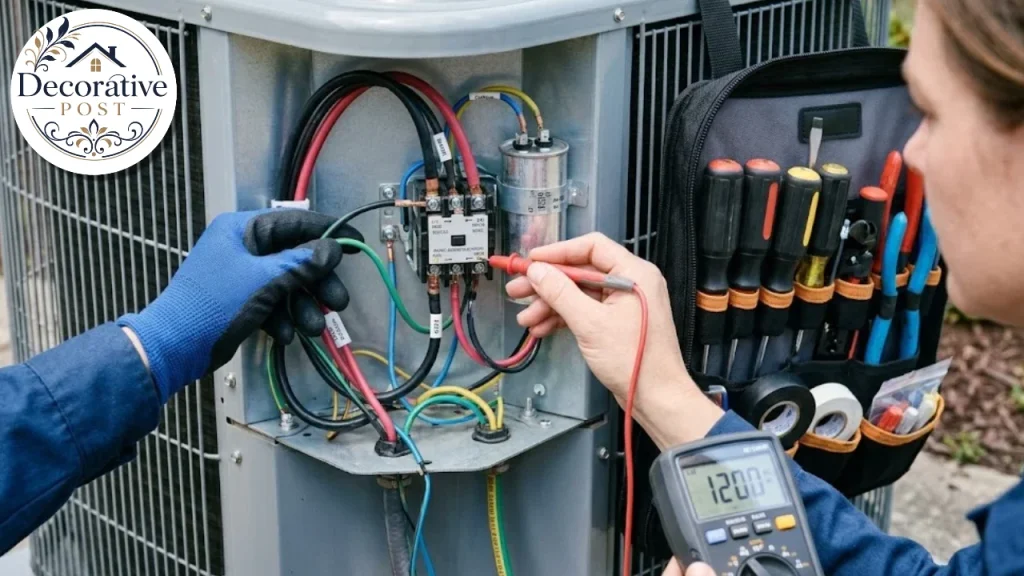
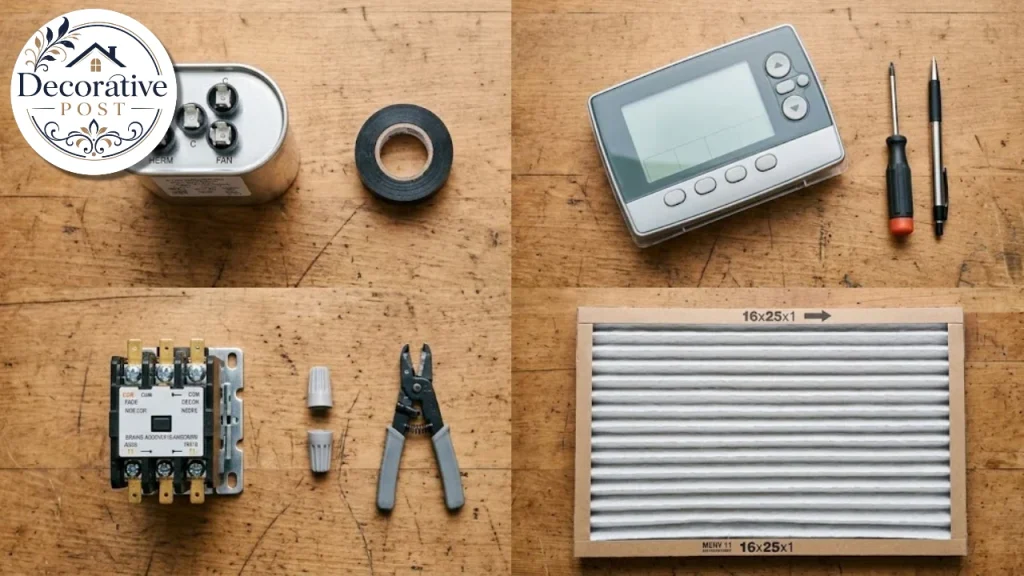
Finally, the repair itself and a recalibration. Failed parts such as thermostats, capacitors, contactors, blower motors, or compressors are replaced, and settings are checked so the system runs properly.
One franchise describes a typical residential service call as lasting one to two hours. Complicated faults take longer.
What to prepare before the tech arrives
A few minutes of preparation saves time on the clock and gets a better diagnosis.
Know the age of your equipment and gather any receipts or earlier service records. Techs use history to spot patterns, such as a part that keeps failing.
Have recent electricity bills handy. A sudden jump can help show when the problem began.
Clear a path to the indoor and outdoor units. Move furniture, trim back plants around the condenser, and secure pets.
Write down symptoms and when they started. “It stopped cooling on Tuesday afternoon after the storm” is far more useful than “it’s broken.”
If the outdoor unit sits near a basement entrance or crawl space, mention that too. The guide to finishing a basement explains why ducts, drains,s and equipment placement in those spaces matter.
Check these first, then call
Some faults are free to fix. One HVAC contractor’s guide lists five things to check before booking a repair, and they are worth running through.
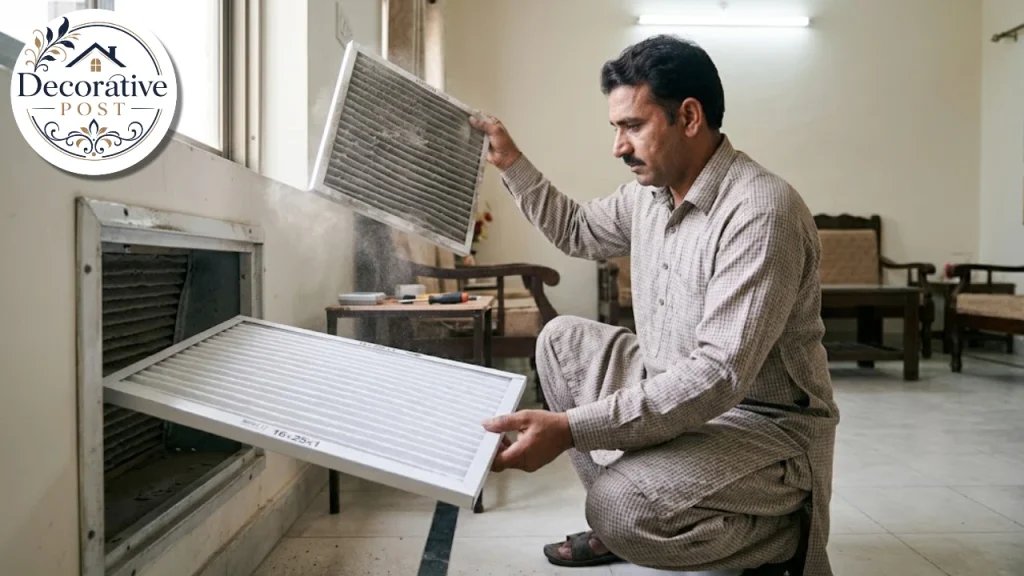
Start with the filter. A clogged one restricts airflow and can make a system struggle or freeze. The guide suggests replacing it about quarterly, or monthly with pets, allergies, or frequently open windows.
Look at the breaker panel. If a breaker has tripped, reset it once. If it trips again straight away, stop and call a professional.
Do not keep resetting it. A home-services guide warns that repeated resets risk an arc flash and further damage, and a breaker that keeps tripping often points to dirty condenser coils, a failing compressor, wiring trouble,e or a refrigerant issue.
Check the thermostat setting, and replace its batteries if it has any. A dead battery or a mode set to the wrong position is a surprisingly common cause of a “broken” system.
Finally, feel the air at the vents. In cooling mode, it should be noticeably cooler than the room. If it is the same temperature or warmer, something is wrong with the cooling cycle.
The guide notes that a service call can average about $100, so ruling out a simple fix is worth a few minutes.
Warning signs that need a call soon
Some symptoms are worth a quick booking, because they tend to get worse and more costly.
Warm air from the vents while the system runs points to refrigerant, compressor,r or airflow trouble. Ice on the indoor coil or refrigerant lines is a classic sign of restricted airflow or low refrigerant.
Water around the indoor unit often means a blocked condensate drain. Switch the system off if water is spreading, to limit damage to floors and ceilings.
Burning smells, loud grinding,ng or a unit that clicks but will not start deserve prompt attention. Turn the system off and call, since running a failing motor can cause further damage.
A sudden rise in your power bill without a change in habits is another cue. It usually means the system is working harder than it should.
If your home also has electric baseboard heat, keep it clean and clear for the same reason. The baseboard heater cleaning guide shows how dust and blocked airflow affect output.
Who to call: air tech or electrician
The two trades overlap at the breaker panel, and homeowners often call the wrong one first.
If the air conditioner itself is the problem, start with a licensed HVAC technician. They can diagnose both the mechanical and electrical parts of the system.
If the fault is in the main panel or the breaker itself, an electrician is the right call. Electricians generally do not repair HVAC components.
When in doubt, describe the symptoms on the phone. A reputable company will tell you honestly which trade you need.
The most common problems an air tech fixes
A short list of faults accounts for most calls, according to the service company descriptions I reviewed.
Dirty filters and dirty coils reduce airflow and heat exchange. They are the cheapest problems and the easiest to prevent.
Faulty thermostats cause systems to run incorrectly or not at all. Replacement is usually quick.
Failed capacitors are described by one company as the most common problem its techs see. The capacitor helps start the motors, and a weak one can stop the outdoor unit from running.
Refrigerant leaks are more serious. Refrigerant does not get used up, so low levels mean a leak, and topping up without finding it only delays the problem.
Electrical issues, from loose wiring to failed contactors, round out the list. These often show up as tripping breakers or a unit that clicks but does not start.
Compressor failure is the expensive end. When a compressor dies on an older system, the repair cost often prompts a conversation about replacement.
What an air tech charges
Prices vary by city, company, and season, so treat these as ranges to sanity-check a quote, not as a menu.
| Service or part | Typical cost (one service company’s range) |
|---|---|
| Service call and diagnosis | $150 to $250 |
| Emergency or after-hours call | $200 to $400 |
| Seasonal tune-up | $150 to $250 per visit |
| Capacitor | $150 to $250 (other sources up to $300) |
| Contactor | $100 to $200 |
| Thermostat | $100 to $300 |
| Blower motor | $400 to $600 |
| Refrigerant recharge | $400 to $800 |
| Compressor | $1,200 to $2,500 |
These figures come from a single contractor’s guide and are unverified, so they will not match every market. A separate home-services guide puts the average cost of a new central air conditioner at about $5,900.
Two points follow. First, the diagnosis fee is real, and many companies credit it toward the repair if you proceed. Ask before booking.
Second, a compressor quote near the cost of a new unit is a prompt to compare repair against replacement, not an automatic reason to replace.
Repair or replace?
The decision depends on age, repair cost, efficiency, and how often the system fails.
A common rule of thumb is that a repair is worth it when the bill is small compared with the cost of a new system and the unit is not near the end of its life. The older the system and the bigger the repair, the weaker the case for fixing it.
Ask the tech for both numbers in writing: the repair price, and the price of a replacement of the right size. Then compare.
Sizing matters. A unit that is too large cools quickly, shuts off,f and leaves the air damp, while one that is too small never catches up. The BTU guide explains how capacity is measured and why bigger is not better.
Ask whether any ducts need repair or sealing too. A new unit connected to leaky ducts will not perform as promised.
Questions to ask before you agree to a repair
A handful of direct questions protect you from most bad deals. A professional will answer them without fuss.
What exactly is wrong, and how did you confirm it? A good answer names a test or measurement, not a hunch.
What are my options, and what does each cost? Ask for the cheapest safe fix as well as the best long-term one.
Is the part new, and what does the warranty cover? Parts and labour warranties often differ.
What happens if I wait? Some faults can wait a week, and others cause damage by the hour.
Will you put this in writing before you start? Anyone reluctant to do so is a reason to pause.
An experienced air tech welcomes these questions, because they show a customer who cares about the work being done properly.
Credentials worth asking about
Not every person who shows up in a van is equally qualified. Three types of credentials matter.
The first is EPA Section 608 certification. It is a federal requirement for handling refrigerants, created under the 1990 amendments to the Clean Air Act. One technical college article states that without it, you cannot legally buy refrigerants or service systems that use them.
It comes in four types. Type I covers small appliances, Type II covers high-pressure systems such as split air conditioners and heat pumps, Type III covers low-pressure systems such as chillers, and Universal covers all three.
For a home split system, Type II or Universal is the relevant level. Do not be shy about asking.
The second is a state or local licence. Rules vary widely. Some places require a licence to work as an HVAC technician or contractor, often after several years of experience and an exam, while others regulate only the contracting company.
The third is NATE certification, the North American Technician Excellence credential. It is voluntary, not a legal requirement, but it signals that a tech has passed a national competency test. Specialty areas include air conditioning, heat pumps, gas heating, hydronics, and air distribution.
Beyond these, ask about insurance. A company that cannot show proof of liability coverage is a risk if something goes wrong inside your home.

How to hire a good air tech
A short checklist avoids most bad experiences.
Get at least two quotes for any significant job. Prices for the same repair can differ a lot, and the explanations tell you who knows the system.
Ask whether the company diagnoses before quoting. Anyone who names a price on the phone without seeing the unit is guessing.
Request a written estimate that lists parts, labour, and any warranty. Vague quotes are where surprises hide.
Check reviews, but read the details. A pattern of complaints about surprise fees or repeated returns for the same fault is more telling than a single bad day.
Ask what warranty covers the repair, on both parts and labour. A short labour warranty on a major repair is a warning sign.
Be wary of high-pressure tactics. A tech who insists you must replace everything today, with no written explanation, deserves a second opinion.
Finally, note whether the tech explains things clearly. Good techs teach as they work, and that is often the best sign of competence.
Maintenance that keeps the air tech away
Prevention is cheaper than repair, and most of it is simple.
Change the filter on a schedule. Check it monthly in heavy-use seasons and replace it when it looks grey and clogged.
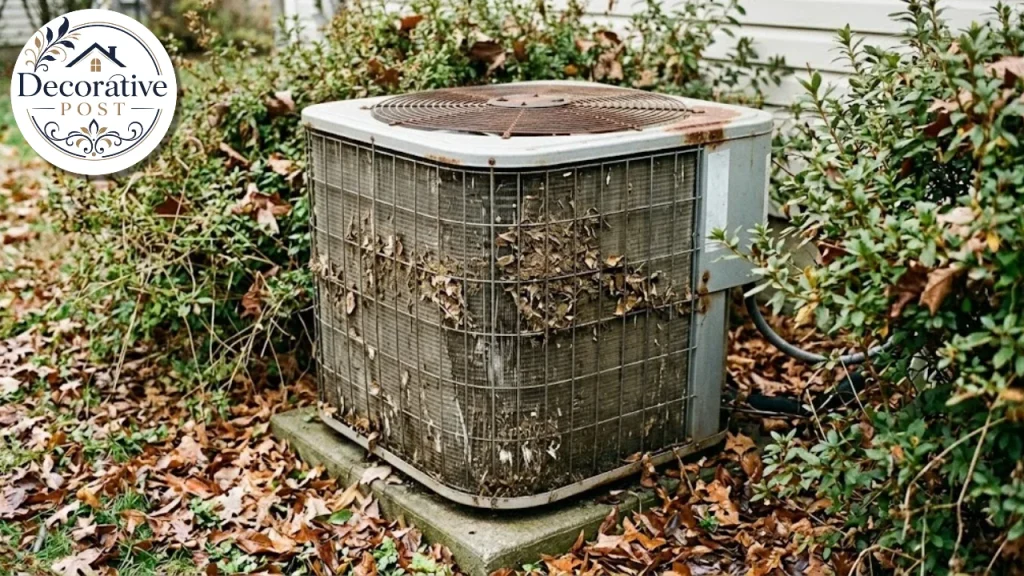
Keep the outdoor unit clear. Leaves, grass clippings,gs and cottonwood fluff block airflow, so rinse the fins gently and keep a gap around the unit.
Book a tune-up before the cooling season. One contractor recommends twice a year in a hot climate, and says a well-maintained system uses roughly 15 to 25 percent less energy than a neglected one, though that figure is the company’s own claim.
Watch for early warning signs. Rising bills, longer run times, strange noises,and ice on the lines all show up before a failure.
Keep humidity in check indoors. Excess moisture strains the system and feeds mould. The shower mould guide covers ventilation and cleaning that help here.
Heat and moisture sources matter too. Drying laundry indoors adds humidity, which the ventless washer-dryer guide discusses.
Where the system runs: crawl spaces, basements and sunrooms
Not every home gives the tech easy access, and where the equipment sits changes the job.
A home on piers often has ducts and sometimes a furnace under the floor. Damp crawl spaces damage ductwork and insulation, and the guide to the pier and beam foundation covers the moisture and access rules for that space.
Basements and attics hold equipment too, and both have heat and moisture extremes. Easy access and clear working room save you money, since a tech who cannot reach the unit bills for the delay.
Added rooms are a different problem. A sunroom or glassed-in porch often has a much bigger cooling load than the rest of the house. The Florida room guide explains why those rooms struggle and what to ask for.
If a room never cools, the answer is not always a bigger unit. Sometimes it is better ducting, shading, or insulation, and a good tech will say so.
A career as an air tech
Some readers searching this phrase are thinking about the work itself, so here is a short overview.
HVAC technicians install, maintain,ntain and repair heating, cooling, and ventilation equipment in homes and commercial buildings. Duties include service calls, troubleshooting, load calculations, routine maintenance,e and meeting building codes.
The usual training path starts with a high school diploma or equivalent. From there, many people complete a trade school or associate degree programme lasting roughly six months to two years, or enter an apprenticeship that pays while you learn.
Licensing is required in some states, normally through an exam, and certifications such as EPA 608 and NATE improve job prospects. Other credentials include HVAC Excellence and RSES.
One career site reports average yearly pay of about $34,300 for apprentices, $48,600 for journeymen technicians,hs and $102,200 for master techs. Pay varies by region and employer, so treat these as rough guides.
The work is physical. It involves lifting, tight spaces, rooftops, and hot attics in summer, and some people find that a dealbreaker.
A national training source cited growth of about nine percent in HVAC technician jobs through 2032, faster than average. Check current figures from the U.S. Bureau of Labor Statistics before you plan around it.
Keeping a simple service log
A notebook or phone note turns each visit into useful history. It takes two minutes and pays back at the next breakdown.
Record the date, the symptoms, what the tech found, the parts replaced,aced and the cost. Add the model and serial number of the indoor and outdoor units.
Note the filter size too, so you always buy the right one. Many people lose time guessing at the store.
Take a photo of the data plate on each unit. It speeds up parts orders and warranty checks.
Over a few years, the log shows patterns, such as a capacitor that fails every summer. A repeating fault is a sign to ask a deeper question, and it gives any air tech a head start.
If you sell the house, a clean service history is a selling point. Buyers and their inspectors like seeing that the system has been looked after.
Common mistakes homeowners make
Waiting too long is the biggest. A small fault that runs for months can damage the compressor.
Resetting a tripping breaker over and over is the most dangerous. It can cause further damage and, in the worst case, an arc flash.
Choosing the cheapest bid without comparing scope is the most expensive. Two quotes are only comparable if they cover the same work and parts.
Buying a bigger unit because it sounds better leaves the home damp and the bills high.
Skipping the filter is the most avoidable. It is the one task nearly everyone can do.
Ignoring other weak points in the home comes next. Poor windows leak cooling away, and the Pella warranty guide explains what window coverage actually includes.
Letting an unlicensed person handle refrigerant is the legal trap. It is both unlawful in many places and bad for the equipment.
What to take from it
An air tech is the specialist who keeps your cooling working, and the best results come from treating them as a partner rather than a last resort. Prepare, ask the right questions, and keep notes.
Check the simple things first. Then call a licensed, certified technician, ask for a written explanation,n and compare the cost of repair against replacement.
If you are researching the profession, becoming an air tech is a solid trade with several entry paths and room to grow.
Whichever side of the job you are on, the same principle applies: find the cause, fix the cause, and keep the system maintained.
FAQs:
What does an air tech do?
An air tech, or HVAC technician, installs,m aintains, and repairs air conditioning and heating systems. On a service call,ll they diagnose the fault, explain the options,ons and carry out the repair.
How much does an air tech charge for a service call?
One contractor’s guide puts a diagnosis visit at about $150 to $250 and emergency calls at $200 to $400. Another source says a call can average about $100, so prices vary by area.
What should I check before calling an air tech?
Check the air filter, the breaker panel, the thermostat setting and batteries, and the air temperature at the vents. If a breaker trips again immediately, stop and call a professional.
Is an air tech the same as an HVAC technician?
In everyday use, yes. “Air tech” and “A/C tech” are common job titles for technicians who work on air conditioning, and many also service heating.
What certifications should an air tech have?
EPA Section 608 is a federal requirement for handling refrigerants. State or local licences vary, and NATE is a voluntary but respected credential.
What is the most common air conditioner repair?
One company says failed capacitors are the most common fault its techs see. Dirty filters, dirty coils, and thermostat faults are also frequent.
Should I repair or replace an old air conditioner?
It depends on the age, the repair cost, and efficiency. Ask for both quotes in writing, and be cautious about a major repair on a system near the end of its life.
Who do I call when the AC breaker keeps tripping?
Start with a licensed HVAC technician, since the cause is often in the unit. Call an electrician if the fault is in the panel or the breaker itself.
How often should an air conditioner be serviced?
One contractor recommends a tune-up twice a year in a hot climate. Many homeowners schedule one before the cooling season.