

General information, not engineering advice. Ceiling heights, structural changes, and energy effects depend on your house, your climate,e and your local building rules, so check with a builder or engineer before changing a structure.
The short answer
A high ceiling makes a room feel larger, brighter and more formal. It also adds air to heat and cool, which can raise energy use, and it changes how you light, paint and furnish the space.
One decorating source defines a high ceiling as anything over 9 feet and a “tall room” as 12 feet or more. Most homes are built with ceilings around 8 feet, so anything noticeably above that reads as high.
The good news is that nearly every downside has a practical fix. Ceiling fans, zoned heating and cooling, well-sized lights, and a few decorating rules solve most of the problems.
What counts as a high ceiling
There is no official line, but heights fall into rough bands.
The usual new-build ceiling is about 8 feet. Nine feet is a common upgrade, and 10 feet starts to feel grand. Beyond 12 feet, you are in vaulted, cathedral,l or double-height territory.
For perspective, building codes set a minimum rather than a maximum.
One city handout gives a minimum finished ceiling height of 7 feet for habitable rooms, and a flooring guide notes the model code allows 6 feet 8 inches in newer editions. Those figures matter in basements and attics, not in tall rooms.
Terms vary. A high ceiling may be flat and simply tall. A vaulted ceiling slopes up to a peak, a cathedral ceiling has two sloping sides meeting in a ridge, and a coffered ceiling is flat with recessed panels.
The distinction matters because the fix for each problem differs. A tall flat ceiling and a sloped one need different fans, different lights,ts and different paint approaches.
Why people want one
The appeal is mostly about how a room feels. Extra height reads as space, even when the floor area is modest.
Light is a large part of it. Bob Vila’s guide notes that the extra overhead space makes rooms feel larger, grander,der and airier, and that more sunlight can come in through taller windows.
Tall rooms also allow bigger gestures. You can hang a statement chandelier, run floor-to-ceiling curtains or install a tall bookcase. A decorating blog notes that hanging fixtures suit a high ceiling because guests will not bump their heads.
There is a market argument too.
Bob Vila’s guide says high ceilings may raise a home’s value by 5 to 25 percent, though that is a wide range from one source, and it depends on the home type and neighbourhood. They are more common in high-end homes, so a tall room may suit some houses better than others.
For many people, the real reason is simpler. A tall ceiling makes a small house feel less closed in.
The honest downsides
Every design choice has a price, and this one has several.
Heating and cooling. A HomeServe article says it generally costs more to heat and cool rooms with tall ceilings, because there is more air to condition. Warm air rises, so in winter much of the heat can collect at the top of the room.
In summer, cool air settles low, leaving the upper area warm. The air conditioner may run longer to reduce the overall temperature.
Vaulted ceilings are especially tricky, since the extra volume must be conditioned and the system must circulate more air to keep the temperature even.
Windows and open plans. Rooms with a high ceiling often have larger windows or open layouts. The same article notes that these let heat escape in winter and enter in summer.
Cost to build. The extra height needs more framing, drywall, insulation, and paint. A Green Building Advisor thread lists the added cost of a 10-foot ceiling as more lumber, labour to cut non-standard studs, drywall, insulation, and siding, though it does not put a figure on it.
Noise. Tall, hard-surfaced rooms can echo. Rugs, curtains,s and upholstered furniture help.
Maintenance. Changing a bulb, dusting a fan, or painting the ceiling takes a tall ladder or scaffold.

How much more does it cost to heat and cool?
This is the question people ask most, and the honest answer is that nobody can give a single number.
The Green Building Advisor thread asks whether a 10-foot ceiling costs considerably more or just marginally more to condition. The participants do not give a figure or percentage.
Editor Martin Holladay argues in that thread that a taller ceiling enlarges the building envelope, which raises heating and cooling loads. But he adds that air leakage, window area, and insulation matter more than ceiling height for a low-energy house.
Another commenter notes that extra height increases the volume of air to be conditioned, which raises cooling loads in a standard load calculation.
A third suggests that a 10-foot ceiling with ceiling fans can feel comfortable even when the air at body height is warm, because extra heat collects above head level. He describes older homes that relied on high ceilings, trees, cross ventilation, and whole-house fans before air conditioning.
So the effect is real, but its size depends on the house. A tight, well-insulated home with good windows will cope far better than a leaky one.
If you want a number for your own home, a heating and cooling professional can run a load calculation. The BTU guide explains how capacity is measured and why the volume of a room matters, and the air tech guide covers what a technician will check.
Fixes that actually work
The HomeServe article and Bob Vila’s guide agree on a short list of remedies.
Ceiling fans are the cheapest and most effective. Run them clockwise in winter on low speed to push warm air back down, and counterclockwise in summer to make the room feel cooler without lowering the thermostat. Reverse direction is controlled by a switch on most fans.
Zoned heating and cooling controls the temperature of different areas independently. It lets you target a tall room without overworking the whole house.
A larger or higher-capacity unit may be needed if the existing system cannot keep up. Do this only after a professional calculation, because an oversized unit shortens its cycles and leaves air clammy.
Sealing air leaks limits heat loss and gain around windows and doors. Bob Vila’s guide also mentions placing ductwork according to whether heating or cooling dominates, and choosing energy-efficient windows.
Regular maintenance, including tune-ups and filter changes, keeps the system efficient.
Good windows help most of all. Look at the U-factor and solar heat gain on the label, and see the double-hung picture window combination guide for how a window group is built and rated.
Sizing a ceiling fan for a tall room
A fan in a high ceiling room needs the right blade size and the right downrod, which is the pipe that lowers the fan from the ceiling.
This Old House’s guide gives blade span by room size.
Rooms up to 75 square feet take 29 to 36 inch blades, rooms of 76 to 144 square feet take 36 to 42 inches, rooms of 144 to 225 square feet take 44 to 50 inches, and rooms of 225 to 400 square feet take 50 to 54 inches. Rooms over 400 square feet take 60 inches or larger.
The guide also lists a slightly different set of spans in another place, so treat the numbers as a range and check the fan maker’s chart.
For height, it advises hanging the fan about 8 feet above the floor. To find the downrod length, subtract 8 feet from the ceiling height and add about 1 foot for the motor and casing.
By that method, a 12-foot ceiling needs a downrod of about 5 feet. A flush mount suits ceilings of 8 to 9 feet, and anything above 9 feet needs a longer downrod.
Minimum clearances matter for safety. The guide gives at least 8 inches from the ceiling to the blades, 7 to 10 feet from the floor, and at least 18 inches from walls or sloped ceilings.
For a sloped or vaulted ceiling, you need a mounting adapter. The guide says some adapters allow angles up to 48 degrees.
Never exceed the downrod length the manufacturer allows, because a long rod on a heavy fan can wobble.
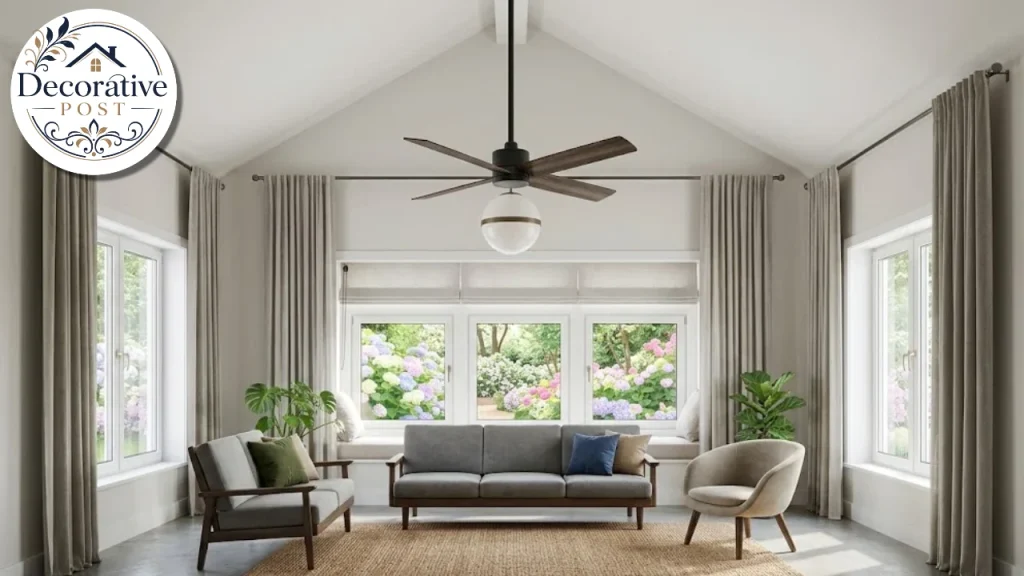
Paint: should you go dark?
The old rule that a high ceiling should be painted dark has some truth in it, but it is not a law.
One decorating source suggests painting the ceiling a deeper shade than the walls, such as a warm cocoa in eggshell or pearl sheen, so the space feels less vast. Another suggests a rich deep blue or deep brown over neutral walls for a cosier feel.
A darker ceiling visually lowers the top of the room. A white ceiling lets it float up and feel taller.
Pick based on the feeling you want. If the room already feels cold or cavernous, darker works. If you want it airy, keep it light.
For a beamed ceiling, paint the rest a solid colour such as white to contrast with dark wooden beams. For a coffered ceiling, either paint it the same colour as the room for a seamless look or highlight the moulding with stained wood.
For specific colours and finishes, the ceiling colour guide goes through the options by room.
Remember the practicalities. Painting a tall ceiling means scaffolding or a tall ladder, so many people hire it out.
Lighting a tall room
Lighting is where tall rooms are won or lost. A single fixture in a big space looks lost, and a dim upper half looks gloomy.
Use hanging fixtures to draw the eye upward. A decorating source says they link the top third of the room to the rest, with a chandelier suiting a dining area and a modern pendant suiting a living room.
Size matters. Another source says the larger the room, the larger the chandelier should be, and warns against hanging one too high or choosing one so small that it gets lost.
Layer the light. Use ambient light from pendants or recessed fixtures, task light for reading and work, and accent light for art. Wall sconces and floor lamps at eye level bring the light down to where people sit.
Add dimmers. They let you change the mood and avoid glare in a big room.
Think about maintenance. A chandelier you cannot reach is a chandelier whose bulbs you will not change, so choose long-life LED bulbs or fixtures with a lowering mechanism.
Natural light helps. Floor-to-ceiling windows bring in the most light, and transom windows above doors or windows are another option, according to one decorating guide.
Curtains, windows and wall decor
Tall walls need tall treatments. Short curtains on a tall wall look like an afterthought.
Hang the curtain rod close to the ceiling to make the room feel taller. One source says to leave at least a few inches from the ceiling, depending on wall height, and to use long curtains that fall from the high rod.
Curtains that run from ceiling to floor connect the upper and lower parts of the room. White gives a light feel, and darker fabric adds drama.
Fabric adds sound absorption too, which helps with echo.
For wall art, scale up. A decorating site says tall walls suit large, bold pieces, such as a dramatic mirror, a gallery of artwork,k or floor-to-ceiling shelving.
Hang art at eye level, not higher, even though tall walls tempt you to go up. For a large wall, use a gallery wall with space between pieces so it does not look cluttered. Leaving some of a tall wall bare is fine, so a fireplace or chandelier can be the focus.
A mirror hung high can reflect light and make the room feel bigger, according to one idea list.
Tall windows need cleaning access. The window cleaning services guide covers when to call a professional for hard-to-reach glass.

Furniture and scale
A tall room needs furniture that suits it.
Choose wider pieces. A decorating blog suggests long sofas, oversized armchairs, longer daybeds and large coffee or dining tables to anchor the room. Tiny or low-profile pieces get visually lost.
Fill the vertical space too. Tall bookshelves, floor lamps, and oversized art balance the height.
Think in zones. A large open room feels better with defined areas, each with its own rug and lighting. A conversation area, a reading nook, and a dining area give structure.
Rugs help ground the room. Choose one large enough that the front legs of the seating sit on it.
For layout and warmth in a big living space, the cozy living room guide covers how to keep a large room from feeling cold.
Built-ins make use of height. The DIY built-ins guide shows how to build tall shelving and storage that fits the wall.
Stairs and open spaces
A high ceiling often goes with an open stair, a loft, or a double-height entry. Those features bring their own rules.
Open stairs in tall spaces become a visual feature. The floating staircase guide covers how these stairs are built, what the code requires, and what they cost.
Lofts and mezzanines use the height to add floor space. They need guards at open edges and enough headroom both above and below.
Tall spaces also affect sound and privacy. A bedroom loft open to the living room will hear everything below, so plan accordingly.
Heating and cooling matter in these layouts too. A return air vent placed high and a supply vent placed low can help move air through a tall space.
Adding height to an existing house
Many people ask whether they can raise a ceiling they already have. Sometimes yes, but it is a big job.
Bob Vila’s guide says new construction can accommodate high ceilings easily, while retrofitting works with standard stick-built roofs but usually needs a structural engineer. Truss-framed roofs are generally a poor fit, since trusses are not designed to be modified after installation.
Costs are high. The guide says raising a 20-by-20-foot room to 11 or 12 feet can cost $18,000 to $25,000. Exposing existing beams is much cheaper, at roughly $2,000 to $3,200 for the same room.
That makes the cheaper options attractive. Removing a dropped ceiling, exposing joists,s or a vault where the attic allows can add height without a full rebuild.
Always involve a structural engineer and your building department. Cutting a truss or removing a load-bearing element without calculation is dangerous.
Check what lies above first. Ductwork, wiring,ng and plumbing in the ceiling space may need rerouting, which adds cost.
Basements are a different story. Their problem is too little height, and the finishing basement guide covers how to make the most of a low ceiling.
Rooms where it works best
A high ceiling suits some rooms more than others.
Living rooms and great rooms are the classic choice. The space gains drama, and a fireplace wall or large window becomes a focal point.
Entryways benefit from a double-height space, which makes a strong first impression. A hanging fixture over the entry is a classic touch.
Kitchens with a high ceiling feel airy, but cooking heat and smell rise and spread. A strong range hood matters.
Primary bedrooms can feel serene with height, though a very tall bedroom can feel cold. Use curtains and layered lighting to warm it.
Sunrooms and added rooms often have vaulted or high ceilings. The Florida room guide explains how those rooms manage light and heat.
Bathrooms and small rooms rarely need height. A small room with a very tall ceiling can feel like a shaft.
Safety, access and upkeep at height
Height adds jobs that need care. Plan for them before you build or buy.
Use the right equipment. A tall step ladder, an extension ladder or a rolling scaffold is far safer than a chair or a stack of boxes. Check the working height rating and set the ladder on firm, level ground.
Never work alone. Ask someone to hold the ladder and stay nearby, especially when changing a fixture or cleaning near a stair.
Switch off power at the breaker before you touch a fixture or a fan. A wall switch alone is not a safe isolation for wiring work.
Choose fixtures that are easy to service. Long-life LED bulbs reduce how often you climb, and a chandelier with a lowering winch or a pole-reachable bulb saves effort.
Dust collects at the top of tall rooms. A long-handled duster or a vacuum with an extension tube clears ceilings, fans, and beams, and a yearly clean keeps them from looking grey.
Watch for stains. A brown mark high on a wall or ceiling is often a roof or plumbing leak, and tall rooms hide them for longer. Check after heavy rain.
For anything involving the roof structure, wiring inside the ceiling,g or a fixture heavier than the box rating, hire a licensed professional. A tall ceiling makes the consequences of a fall or a failed fixture far greater.
Common mistakes
Choosing a fixture that is too small makes the room look unfinished.
Hanging art too high leaves the room feeling disconnected from the people in it.
Ignoring the fan’s downrod length leaves the fan too close to the ceiling, where it moves little air.
Using only one light source leaves dark corners and a gloomy top half.
Forgetting maintenance access means dead bulbs for months.
Oversizing the heating and cooling unit without a calculation leads to short cycling and clammy air.
Using furniture that is too small leaves a big room looking empty.

What to take from it
A high ceiling is a design asset when you plan for it. It adds light and drama, and a few simple choices keep it comfortable.
Use fans in the right direction, check your windows,ws and seal air leaks. Size fixtures and furniture to the room, hang curtains high,igh and scale up your art.
If you are considering raising a ceiling, get an engineer first and a firm quote. The cheaper options, such as exposing beams, may give most of the effect.
Treat a high ceiling as a design opportunity, and the room will reward you every day.
FAQs:
What is considered a high ceiling?
One decorating source defines a high ceiling as anything over 9 feet, and a tall room as 12 feet or more. Most new homes have ceilings around 8 feet.
Do high ceilings cost more to heat and cool?
Generally yes, because there is more air to condition and warm air rises. How much depends on insulation, windows, doors, and air leakage, and no source gave a single figure.
Which way should a ceiling fan turn in a high-ceilinged room?
Clockwise in winter on low speed, to push warm air down, and counterclockwise in summer for a cooling breeze. Most fans have a reverse switch.
How long should my fan downrod be?
This Old House’s guide says to subtract 8 feet from the ceiling height and add about 1 foo12-foot foot ceiling needs a downrod of about 5 feet.
Should I paint a high ceiling dark?
It can make a vast room feel cosier. A lighter colour keeps it airy. Choose based on the feeling you want.
How high should I hang curtains in a room with a high ceiling?
Close to the ceiling, leaving a few inches, with long curtains that fall to the floor. This makes the room feel taller.
How much does it cost to raise a ceiling?
Bob Vila’s guide says raising a 20-by-20-foot room to 11 or 12 feet can cost $18,000 to $25,000, and exposing existing beams about $2,000 to $3,200.
Do high ceilings add value?
Bob Vila’s guide says they may raise value by 5 to 25 percent, depending on the home and area. That is a wide range from one source.
How do I stop a tall room echoing?
Add rugs, curtains, upholstered furniture, and wall hangings. Soft surfaces absorb sound.