

A teacup poodle is a Toy Poodle that has been marketed as a smaller size. No major kennel club recognises the category. The American Kennel Club and the United Kennel Club both define the Toy at 10 inches or under at the shoulder, and neither lists anything smaller.
Sellers usually advertise a teacup at 9 inches or under and roughly 2.5 to 6 pounds. The ordinary AKC Toy already runs 4 to 6 pounds, so many “teacups” fall inside the normal range with a higher price tag attached.
The ones that really are smaller than that are the ones to think hard about. Extreme size is not a variety. It is usually a symptom of how the puppy was bred, fed, or born.
What “teacup” actually means
There are three recognised Poodle sizes, and they are separated by height alone. The Toy is 10 inches or under, the Miniature is over 10 and up to 15 inches, and the Standard is over 15 inches.
Weight follows height. A Toy typically weighs 4 to 6 pounds and a Miniature 10 to 15 pounds.
Teacup appears on none of those lists. It is a retail word, applied to puppies expected to finish small, and no registry checks the claim.
Papers do not settle it either. A pedigree documents parentage, not adult size, so a registered puppy sold as a teacup is simply a registered Toy with a promise attached.
Small breeds usually stop growing between six and eight months, and size is fixed by twelve. Any seller guaranteeing an adult weight to a ten-week-old puppy is guessing.
One breeder listed an adult at 2 pounds 7 ounces and 6.5 inches tall. At that scale,e you are no longer buying a pet that happens to be small; you are buying a margin of safety that has been engineered away.
How a puppy ends up tiny
There are really only three routes, and the first is harmless.
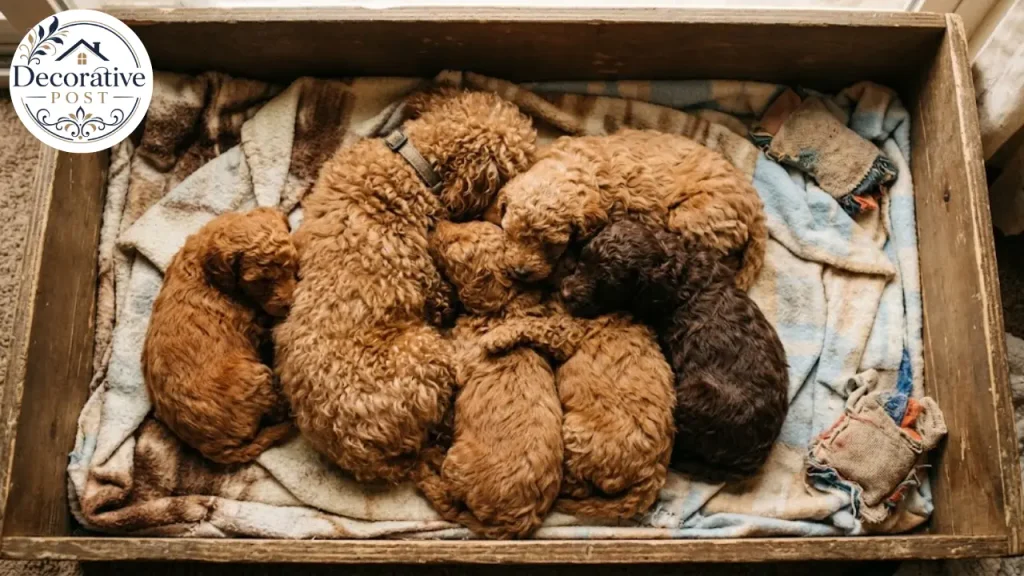
The first is an ordinary Toy from small parents who throws a small littermate. Nothing is wrong with her; she is just at the lower end of a normal range.
The second is a runt, the smallest puppy in a litter, sometimes small because of a health problem and sometimes simply because of how the womb was shared. Reputable breeders do sometimes place smaller-than-average puppies, on the condition that those dogs are never bred.
The third is deliberate. Breeders aiming at the teacup market pair the smallest female with the smallest male, generation after generation. Health becomes a secondary concern, and whatever is wrong in either parent passes straight through.
Some sellers go further and underfeed puppies to keep them small. A puppy held back this way can look the part and be permanently stunted.
Two numbers show why the pressure towards tiny is not free.
In a study of 10,810 litters across 224 breeds, the smallest breeds averaged about 3.5 puppies against 5.4 for all breeds. In a UK study of nearly 19,000 females, dogs under 10 kg had 1.6 times the odds of a difficult birth.
Smaller mothers, smaller litters, harder deliveries. Scale that to the smallest dogs of an already small breed and the welfare cost of the label becomes easier to see.
The health picture
None of these conditions is unique to a teacup poodle. Most occur across small breeds. What changes is how little room for error a2-2 to 3-pound dog has when one of them arrives.
Veterinary sources are candid that research is still open on whether these problems get more common as dogs are bred smaller. They are equally clear that poor breeding makes every one of them more likely.
Low blood sugar
Hypoglycemia is the most urgent risk in young tiny dogs, and it is most common under twelve weeks. Toy puppies carry little fat and muscle, and an immature liver cannot store enough glycogen to carry them between meals.
A cold, stressed, or very active puppy burns through what she has. Travel, intestinal parasites,s and infection make it worse.
The signs are drowsiness, trembling, weakness, loss of balance, vomiting and drooling, and in severe cases collapse or seizures. Signs usually appear when blood glucose falls to about 40 to 50 mg/dL, and the diagnosis is made below 60.
If the puppy is conscious and able to swallow, light corn syrup or honey given orally can stabilise her temporarily, and even rubbing it on the gums helps. Then go to a vet immediately, even if she seems better, because home treatment does not fix whatever caused the drop.
Prevention is small, frequent meals and avoiding long gaps, cold,ld and over-exercise.
How frequent is where sources differ. One veterinary resource suggests tiny puppies may need feeding every two hours, including overnight, until about a year old. The AKC says only to feed small, frequent meals as your vet directs. Ask your own vet for a schedule specific to your puppy.
Fragile bones
Tiny dogs have relatively delicate bones, and ordinary behaviour carries real risk. Jumping off a bed or sofa can break a forearm, and falls from a person’s arms are a classic cause.
The radius and ulna are the usual casualties. A break in a bone that thin is hard to repair, and anaesthesia for a 2- to 3-pound patient is its own hazard.
Windpipe and kneecaps
Tracheal collapse is the weakening and sagging of the windpipe, and it produces a honking cough. Treatment is medication and sometimes surgery.
Patellar luxation, where the kneecap slips out of its groove, is common in small breeds. Surgery is considered when other treatments fail.
The skull and the liver
An open fontanel is the soft spot at the top of a puppy’s skull. It normally closes, and one that persists past three to four months can be linked to hydrocephalus, fluid on the brain, which raises pressure and can cause blindness and behavioural change.
A dome-shaped head is sometimes a sign. It is not proof, but it is a reason to ask your vet to check.
Liver shunts are abnormal vessels that bypass the liver. They cause stunted growth, vomiting, and seizures that can worsen after eating, and in most cases, in tiny dogs, cannot be closed surgically. Because a shunt can make a puppy smaller, it can hide inside the very trait buyers are paying for.
Teeth and heart
Tiny mouths mean crowding and retained baby teeth, which collect plaque and lead to periodontal disease. In a study of 22,333 UK dogs, Toy Poodles had almost four times the odds of periodontal disease compared with crossbred dogs.
Degenerative mitral valve disease is very common in small breeds and usually appears in middle to older age, as a murmur that may progress to coughing and heart failure. Legg-Calvé-Perthes disease, a hip problem, and progressive retinal atrophy (PRA-prcd) also appear in the breed.
Medication and anaesthesia
This one is easy to overlook. Many common preventives are labelled for dogs of 5 pounds or more, so a very small dog may need compounded or off-label doses, which cost more.
Placing an IV, keeping a patient warm under anaesthetic, and dosing accurately are all harder at 2 to 3 pounds. Tiny dogs also seem to deteriorate faster, and stress alone can tip them into a crisis.
How long they live, and what they cost
The AKC gives Toy Poodles a life expectancy of 10 to 18 years. No study tracks the teacup poodle separately, so any specific lifespan quoted for the category is an estimate.
Price is where the market shows its hand. Teacup asking prices in a September 2026 search ran from $3,200 to $7,800, with one seller listing “celebrity bloodlines” puppies at $8,975 and up. Marketplace listings for teacup Toys ranged from $950 to $8,000.
The purchase is only the start. Rover’s 2026 estimates put first-year care at $1,460 to $6,745. Pet insurance in the puppy year runs about $175 to $880, professional grooming $300 to $975 a year, and a single emergency visit anywhere from $300 to $4,000.
Compare that with adoption fees of $50 to $500 for a Toy Poodle from a rescue. The price of the label is not the price of the dog.
Reading a breeder honestly
The Poodle Club of America publishes a code of ethics that is a useful yardstick, because it describes what a responsible breeder does regardless of size.
It does not define size limits, and it does not mention teacups at all. What it does require is health testing for all breeding stock: eye exams for PRA and cataracts, PRCD, hip X-rays, stifle and elbow X-rays, von Willebrand’s disease, sebaceous adenitis,s and thyroid.
Look at what the code requires of the sale. No puppy is released before eight weeks of age. Each puppy goes with a bill of sale, a pedigree of at least three generations, written care and feeding instructions, and current worming and vaccination records.
Proof of genetic testing goes to the buyer. A written contract covers the sale, and there is a window for a veterinary check, with return for a replacement or refund if a vet confirms a pre-existing condition. The breeder takes back any dog the owner cannot keep, for life.
A seller who markets a teacup poodle will rarely meet that standard, because the business model depends on size rather than testing. Treat the following as red flags:

A promised adult weight under four pounds. Parents who are never shown. Puppies sold before eight weeks. A price that rises as the puppy gets smaller. “Pocket,” “micro,” or “mini-teacup” as selling points. No health records, or records you cannot verify.
The safest approach is the unglamorous one. Choose a breeder of regular-size Toys who performs the recommended health tests, and accept the puppy that fits.
Setting up the house
A dog this size changes how a home has to work, in ways a normal puppy does not. This is where decor and safety overlap more than most people expect.
Recliners and moving furniture
This is the hazard most owners never hear about. A reclining mechanism is a steel linkage with scissor points, springs, and narrow gaps, and a very small dog can crawl inside or underneath it.
In Maryland, a terrier named Highway crawled deep into a recliner and became so entangled that firefighters needed hydraulic rescue tools to free him. In another case, a 14-year-old dog was underneath a lift chair when its owner lowered it, and the owner believes the pressure broke the dog’s bones.
The advice from the rescue is simple. Check underneath and around the chair before operating it, particularly if a pet has suddenly gone missing. Do not keep forcing a recliner that is not moving normally, because an animal may be hidden inside. Small dogs and cats are most at risk.
If you already own a recliner, the companion piece on reclining sofas covers the mechanism and clearances. If you are shopping for one, a stationary or wall-hugger design leaves fewer cavities, and the classic recliner is worth looking at with exactly this question in mind.

Floors
Hard floors are harder on small dogs than people assume. Hardwood is generally slippery, and glossy finishes offer less traction than satin or matte. Laminate can be slippery without an underlay.
Slipping matters more with kneecaps that already want to luxate. Non-slip runners in halls and near feeding and sleeping spots, clean, dry paws,s and regular nail trims all help.
If you are choosing new flooring, luxury vinyl plank is often recommended for pet households because it is waterproof and scratch-resistant.
I could not find reliable traction data for it, though, so test a sample with a socked foot before assuming it grips. The guide to LVP flooring in a basement covers the product side.
Heights
Every sofa, bed and chair is a fall risk. A 3-pound dog dropping from a seat to a hard floor can break a leg.
Pet steps or a ramp at each favourite perch solve most of it. Built-in storage with a low step integrated is neater than a plastic ramp, and the approach to custom built-ins carries over.
Never let a small child carry the dog. Falls from arms are one of the most common routes to a fracture.
Warmth
Small dogs lose heat quickly and may need a sweater or coat even in mild weather. Hypothermia and frostbite are real risks for dogs at this scale.
Draught-free sleeping spots matter more than decor. If you heat with electric baseboards, keep bedding clear of them and follow the maintenance and safety notes for baseboard heaters so dust is not baking against a surface a small animal lies against.
A raised bed with sides, set away from exterior walls and doorways, is a better answer than a floor cushion.
The garden
Tulips are a popular spring planting, and the bulbs are the most toxic part. Tulipalin A and B are present throughout the plant but are most concentrated in the bulb, and vomiting, diarrhoea, drooling and lethargy can follow within minutes to hours.
A dog this small can be seriously affected by a quantity a larger dog would shrug off. If it happens, remove the dog from the plant, collect what remains, and call your vet or the ASPCA Animal Poison Control Center. Do not induce vomiting unless a vet tells you to.
If you grow bulbs, the tulip care guide covers planting, and the planting depth is a good reason to keep the beds fenced.
Training a very small dog
House-training a teacup poodle is harder than a larger dog, because small bladders fill quickly and accidents are easy to miss. The standard “one hour per month of age” rule only applies to a resting puppy, and after eating or playing the interval can drop to a few minutes.
Our full housetraining guide covers the schedule, and for a dog this size the key additions are indoor options in cold or wet weather and a firm rule that nobody scolds an accident.
Socialisation matters just as much. A tiny dog that is carried everywhere learns that the world is frightening, and fearful small dogs bite. Let her walk on a harness rather than a collar, because collars put pressure on a fragile windpipe.
Keep play low to the ground, and avoid anything that involves jumping down.
The first week at home
The first seven days set the pattern, and with a teacup poodle, they carry more risk than with a larger puppy. Plan them before she arrives.
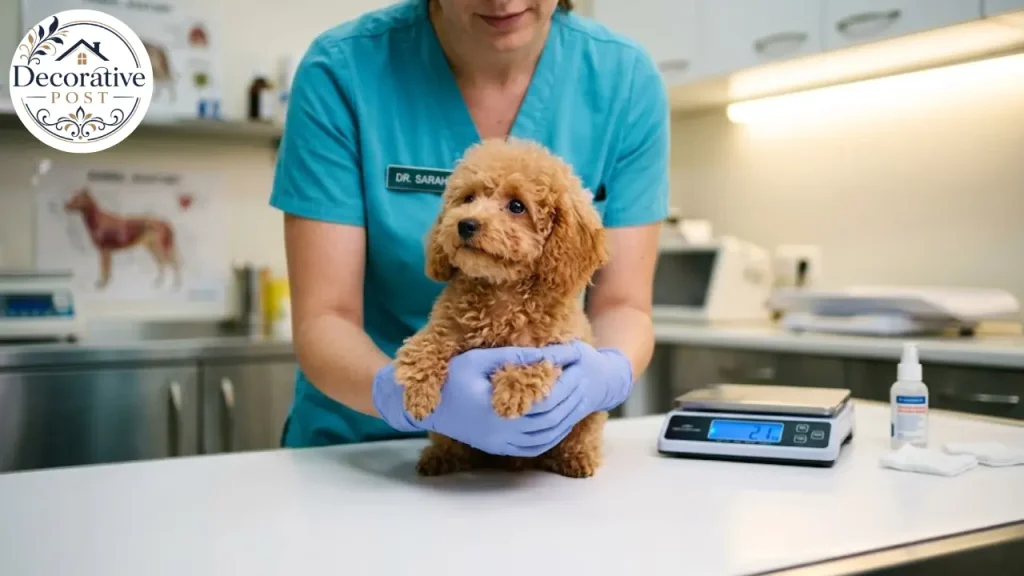
Book the first vet visit inside the breeder’s return window, ideally within two or three days. A vet who sees her early can check the fontanel, the heart, the teeth,h and the kneecaps, and can weigh her so you have a baseline.
Weigh her on a kitchen scale every few days. A tiny puppy that stops gaining, or loses weight, needs a call to the vet, not a wait-and-see.
Keep one corner of a room as her base, with a pen, a bed with sides, and water. A whole house is too much for a dog this size, and she cannot be watched in all of it.
Feed at fixed times and write them down. Keep a small bottle of corn syrup or honey in the cupboard, and know where the nearest emergency vet is before you need it.
Hold off on visitors for a few days. Every new person is stress, and stress is one of the things that drops blood sugar in a young puppy.
Travel, visitors, and children
A very small dog is easy to lose, step on, and drop. Those are the three accidents to design around.
Step on is the most common. A 3-pound dog under a moving foot at the kitchen island or the top of the stairs cannot get out of the way, so teach everyone in the house to shuffle rather than stride.
Children need clear rules. She is carried only by an adult, only when sitting, and never lifted by the chest or held above hip height.
For travel, use a carrier that fits under a seat and a harness clipped inside. Do not leave her in a parked car, even briefly, because a small body overheats and chills faster than yours does.
When guests come, the dog goes in the pen first and meets people second. A tiny dog that is passed from lap to lap learns to dread hands.

Grooming
Poodle coats do not shed in the usual way, which is why the breed has a reputation for suiting allergy-prone households. That reputation comes with a bill: a continuous coat that mats without regular brushing and needs professional grooming every few weeks.
Budget the $300 to $975 a year mentioned earlier, and teach her to accept brushing and handling from the first week. Check the ears, because the breed’s dense ear hair can trap debris.
Tooth care starts on day one. Given the periodontal numbers, daily brushing is not an extra.
The mistakes that cost the most
Buying on size. The smaller the promise, the more likely it was achieved by breeding or feeding methods that cost the dog.
Taking a seller’s guaranteed adult weight as fact. Nobody can know it at ten weeks.
Skipping the vet check inside the return window.
Letting a puppy go long gaps between meals, especially when cold or excited.
Leaving her alone with a recliner, lift chair, rocking chair, or folding furniture.
Letting her jump off beds and sofas.
Using a neck collar rather than a harness.
Assuming the dog will get big enough to be sturdy. She won’t.
If you love the look but want the odds
You do not have to choose between a small dog and a healthy one. A well-bred Toy Poodle at 4 to 6 pounds is already tiny, and it comes with a breeder who tests the parents.
Adult dogs from rescues are another option, and often a better one. An adult has a finished size, a known temperament, and a clear health history, and adoption fees of $50 to $500 are a fraction of a breeder’s price.
Some people who want a small apartment dog are better served by a slightly larger Miniature Poodle at 10 to 15 pounds. Same intelligence, same coat, far more margin for error.
What to take from it
Teacup poodle is a marketing term wrapped around a normal breed. The word itself is not the problem. The problem is what the market asks of the dog to earn it.
If you buy one anyway, buy it with open eyes: a breeder who tests, a vet who sees the puppy within days, a feeding schedule you can keep, and a house that has been walked through at floor level.
The best outcome from this whole subject is small. A dog who is allowed to be the size she naturally is, in a home that takes her size seriously.
FAQs:
How big is a teacup poodle?
There is no official size. Sellers advertise 9 inches or under and about 2.5 to 6 pounds. The AKC Toy is 10 inches or under and typically 4 to 6 pounds, so many teacups sit within the ordinary Toy range.
Is a teacup poodle a real breed?
No. It is a Toy Poodle marketed as a smaller size. The AKC and UKC recognise Toy, Miniature and Standard only, and papers document parentage rather than adult size.
How long do teacup poodles live?
The AKC gives Toy Poodles 10 to 18 years. No study tracks teacups separately, so quoted lifespans for the category are estimates.
How much does a teacup poodle cost?
Asking prices in a September 2026 search ran from $3,200 to $7,800, with some listings above $8,900. First-year care is estimated at $1,460 to $6,745, so the purchase price is only part of the cost.
What are the most common health problems?
Low blood sugar in young puppies, fractures, tracheal collapse, patellar luxation, dental disease, mitral valve disease, and, in some dogs,s an open fontanel, liver shunt, or hydrocephalus. Most are common in small breeds generally, and poor breeding raises the risk.
How often should a teacup poodle puppy eat?
Small frequent meals, and your vet should set the schedule. One veterinary resource says some very tiny puppies may need feeding every two hours until about a year old, while the AKC gives no fixed interval.
What do I do if my puppy seems weak or shaky?
If she is conscious and can swallow, give a little light corn syrup or honey, even rubbed on the gums, then go to a vet immediately. A puppy who is unresponsive or seizing needs emergency care straight away.
Is a teacup poodle safe around recliners?
Not unsupervised. A very small dog can crawl inside or underneath a reclining mechanism and be trapped or crushed. Check beneath the chair before operating it and never force one that is not moving normally.
What should I ask a breeder?
Which health tests the parents have had and for the certificates, the parents’ adult weights, whether you can meet them, when puppies go home (not before eight weeks), what the return window is, and whether they will take the dog back for life.